Inteligencia Artificial y educación postdigital en la infosfera: el conocimiento como palimpsesto y manuscrito antiguo estratificado
Artificial Intelligence and Postdigital Education in the Infosphere: Knowledge as a Palimpsest and a Stratified Ancient Manuscript
Eva Fernández-Palop
Universidad de Zaragoza
RESUMEN
El panorama educativo contemporáneo está experimentando una transformación radical, caracterizada por la transición del Paréntesis de Gutenberg hacia la complejidad fluida de la Infoesfera. Este estudio propone un marco pedagógico original que conceptualiza la integración de la Inteligencia Artificial en la educación como un cambio epistemológico basado en la lógica del palimpsesto. Más allá del discurso binario entre eficiencia e integridad, esta investigación analiza el aula como un espacio estratificado donde el conocimiento se reconstruye mediante la superposición de capas algorítmicas y humanas.
La metodología combina un análisis hermenéutico de las arquitecturas de IA (específicamente adaptando la estructura de red convolucional U-Net como un isomorfismo heurístico para el diseño curricular) con una modelización prospectiva de datos institucionales sobre la adopción de la IA. Los hallazgos, visualizados a través de la brecha de asimilación y un modelo de eficacia teórica, sugieren que tratar los resultados de la IA como palimpsestos digitales reduce significativamente las tasas de alucinación, al tiempo que restaura la autoría crítica. Esta estrategia de lectura estratificada transforma al docente en un mediador postdigital, garantizando que la huella humana permanezca visible dentro de los archivos sintéticos del futuro.
PALABRAS CLAVE
Inteligencia Artificial; Metodología del Palimpsesto; U-Net Heuristics; Educación Postdigital; Identidad Docente; Arqueología Digital; Hiperhistoria.
ABSTRACT
The contemporary educational landscape is undergoing a radical transformation characterized by the transition from the Gutenberg Parenthesis to the fluid complexity of the Infosphere. This study proposes a novel pedagogical framework that conceptualizes the integration of Artificial Intelligence in education as an epistemological shift based on the logic of the palimpsest. Beyond the binary discourse of efficiency versus integrity, this research analyzes the classroom as a stratified site where knowledge is reconstructed through the superposition of algorithmic and human layers.
The methodology combines a hermeneutic analysis of AI architectures, specifically adapting the U-Net convolutional network structure as a heuristic isomorphism for curricular design, with a prospective modeling of institutional data regarding AI adoption. The findings, visualized through the assimilation gap and a theoretical efficacy model, suggest that treating AI outputs as digital palimpsests significantly reduces hallucination rates while restoring critical authorship. This stratified reading strategy transforms the faculty into a postdigital curator, ensuring that the human trace remains visible within the synthetic archives of the future.
KEYWORDS
Artificial Intelligence; Palimpsest Methodology; U-Net Heuristics; Postdigital Education; Faculty Identity; Digital Archaeology; Hyperhistory.
1. INTRODUCTION
The educational ecosystem currently stands at a critical juncture that Luciano Floridi describes as the transition from History to Hyperhistory. In historical societies, Information Technologies served primarily to record and transmit data, functioning as tools employed by the State and individuals to preserve memory. However, in a hyperhistorical society, these technologies have migrated from the periphery to the center, becoming the very environment or Infosphere in which human existence and intellectual development are constituted (Floridi, 2014; Hayles (2012); Stiegler (2010); Hui (2016)). This shift marks the definitive closure of what Thomas Pettitt and subsequent scholars like Jeff Jarvis have termed the Gutenberg Parenthesis. This period, dominated by the printing press, established a regime of knowledge characterized by stability, linearity, distinct authorship, and fixed categorization.
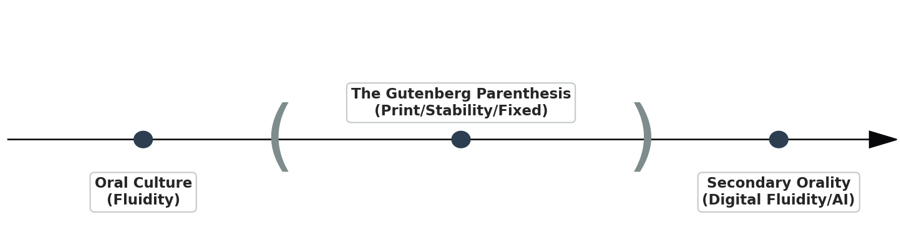
Education modeled on this technology prioritized the transmission of these stable bodies of knowledge. However, the digital era and specifically the advent of generative Artificial Intelligence reopens this parenthesis, returning society to a state of fluidity, remixability, and oral-digital hybridity reminiscent of pre-print cultures but amplified by algorithmic speed (Jarvis, 2023). As illustrated in Figure 1, the trajectory of human communication has moved from the fluidity of oral culture through the rigidity of print and back into the secondary orality of the digital age (HEPI, 2024; HEPI, 2025).
Figure 1. The Gutenberg Parenthesis Model (Adapted from Pettitt, 2007).
The digital context dismantles the quietness and linearity of the printed page, replacing it with a high-volume flow of simultaneous data and multiple versions of truth where the text is never finished but only temporarily displayed (Carr, 2010). In this hyperhistorical infosphere, the traditional educational goal of transferring knowledge becomes obsolete because knowledge itself is no longer a static object to be handed over but a dynamic process of navigation and reconstruction. To navigate this volatile terrain, this article proposes the palimpsest as the central operative metaphor and methodological framework for Artificial Intelligence in education.
Historically, a palimpsest is a parchment that has been scraped clean and reused, yet where traces of the original writing remain visible beneath the new text. It represents a surface where the past is not erased but overwritten, creating a complex stratigraphy of meaning (Barthes, 1977; Genette, 1997). In the context of the postdigital classroom, the palimpsest transcends its material definition to become a mode of thinking. As André Corboz articulated in his analysis of the territory, the land itself is not a blank slate but a layered accumulation of modifications (Corboz, 1983).
Similarly, the digital text generated by an algorithm is not a fresh creation from nothing but a statistical superimposition over a massive substrate of training data. It is a digital palimpsest where the traces of billions of human authors are compressed, weighted, and surfaced. Learning therefore implies a stratified reading which is the ability to look through the surface of the answer provided by the machine to see the layers beneath. It involves understanding that every concept presented in the classroom is a rewrite of a previous concept and that the erased layers, including misconceptions and marginalized voices, are as important as the visible surface. This approach aligns with Genette’s theory of hypertextuality where every text is a transformation of a prior text (Boden, 2016; Bostrom, 2014; Lucking, 2018).
The urgent challenge facing education today is the flatness of the interface. When a student queries a Large Language Model (LLM), the output is presented as a seamless and authoritative block of text (Moretti, 2024). The seams of its construction, including the sources it aggregated and the conflicts it resolved, are hidden behind a black box of proprietary algorithms (Pasquale, 2015). This opacity creates a crisis of critical literacy. If students accept the output as a singular truth, they engage in a superficial learning process that reinforces hegemonic narratives and erases the complexity of history. Therefore, the problem is not that students use these tools but how they perceive their outputs. Without a pedagogical framework that emphasizes the palimpsestic nature of these tools, education risks becoming a mechanism for the uncritical reproduction of algorithmic consensus (Adell & Castañeda; 2012).
2. METHODOLOGY
This research employs a mixed-method approach that integrates theoretical hermeneutics with quantitative modeling of educational trends to propose a validated pedagogical framework (Selwyn, 2019; Williamson, 2019; Knox, 2019; Castañeda & Selwyn, 2018; Anderson & Rivera-Vargas, 2020).
The first phase applies a critical deconstruction of technological architecture. The operative logic of U-Net neural networks, typically used in biomedical imaging, and Generative Adversarial Networks (GANs) is analyzed to establish an epistemological analogy for the classroom. This is not an implementation of code, but a structural isomorphism where the mathematical properties of the network (specifically compression, bottlenecking, and skip connections) are mapped onto pedagogical strategies. Data sources for this theoretical substrate include high-impact literature from Scopus and Web of Science, filtered by keywords related to “Postdigital Education,” “Algorithmic Bias,” and “Digital Heritage.”
The second phase involves the construction of analytical models to visualize the impact of the proposed methodology. Given the nascent state of formalized AI curricula, empirical longitudinal data is scarce. Therefore, Secondary Data Analysis (SDA) is utilized to construct projection models. To diagnose the current state of AI integration, a meta-analysis of secondary data from recent higher education reports was performed, specifically synthesizing trends from the Higher Education Policy Institute (HEPI), UNESCO guidance documents (2023-2025), and the Stanford AI Index (HEPI, 2025; UNESCO, 2025; Stanford HAI, 2025). These datasets were harmonized to project the divergence between student adoption rates and faculty training levels in the 2025 horizon.
Furthermore, to validate the Palimpsest framework, a theoretical efficacy model was developed based on Human-in-the-Loop (HITL) error reduction principles. This model simulates the trajectory of academic outputs through three iterative layers (Generation, Erasure, Overwriting), correlating the reduction of factual hallucinations with the increase in critical depth scores based on standard academic rubrics. The mathematical formulation of this error reduction is detailed in the subsequent sections as a function of iterative human intervention.
3. THE THEORETICAL SUBSTRATE OF THE POSTDIGITAL PALIMPSEST
To understand the necessity of the palimpsest model, one must first grasp the nature of the environment in which contemporary education operates. Luciano Floridi argues that humanity has entered a fourth revolution where self-understanding is defined by the relationship to information. In the hyperhistorical age, the distinction between online and offline has collapsed into an on-life experience. The classroom is no longer a physical enclosure separated from the world but a node within the global infosphere (Latour, 2005; Siemens, 2005). Information does not merely flow into the classroom; the classroom is constituted by information flows. As Al-Taai and colleagues note, the Internet of Things further dissolves the walls of the school, connecting the physical environment of the student to the digital data streams of the smart city (Al-Taai et al., 2023).
This saturation creates a paradox where information is huge but meaning is scarce. The sheer volume of data acts as a sediment that buries meaning under layers of noise. The palimpsest model addresses this by treating the infosphere not as a flat plain of data but as a vertical structure of layers that must be excavated. The metaphor of the palimpsest is potent because it captures the dual nature of digital information which involves both persistence and erasure (Manovich, 2013; Eve, 2022). As Abulafia demonstrates in his study of the Mediterranean, history is not a linear progression but a superimposition of identities (Abulafia, 2019).
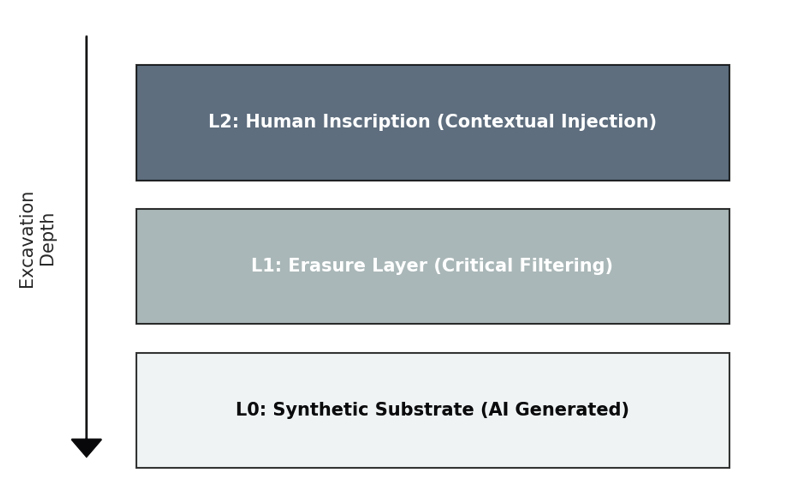
In the digital realm, deleted data often remains in backups or the latent space of training datasets, making the trace almost indestructible (Derrida, 1996; Foucault, 1972; Certeau (1988). Conversely, the visibility of information is highly selective. Algorithms prioritize certain layers while rendering others invisible. This algorithmic erasure creates a digital palimpsest where the official text hides the complexity of the substrate. Figure 2 visually represents this stratigraphy, illustrating the transition from the synthetic substrate (L0) through critical erasure (L1) to human inscription (L2).
Figure 2. Stratigraphy of the Digital Palimpsest.
Arroyo extends this analysis to internet textualities, arguing that digital artifacts are inherently palimpsestive (Arroyo, 2022). They are constantly rewritten, remixed, and overwritten by the collective. A pedagogy that treats these texts as static sources fails to capture their essence. Instead, education must adopt an exotropic vision, looking outwards across the layers of derivation to understand how the current text came to be.
This concept also aligns with the emerging use of digital twins and synthetic data in heritage. Salmeron and Fernandez-Palop apply AI to reconstruct historical palimpsests and demonstrate that algorithms can generate physically informed synthetic data to simulate how a document would have looked before erasure (Salmeron & Fernandez-Palop, 2025). This capability introduces a new dimension to historical education where students can use technology not just to read history but to simulate it.
4. AI ARCHITECTURES AS EPISTEMOLOGICAL MODELS
To operationalize the palimpsest metaphor, it is necessary to examine specific AI architectures not just as tools but as epistemological models of how knowledge is layered and retrieved. The U-Net architecture is proposed as a heuristic device for curriculum design. The U-Net architecture, introduced by Ronneberger et al. (2015), consists of a contracting path (encoder) and an expansive path (decoder), connected by skip connections. This structure offers profound isomorphism for the learning process in the age of AI. Figure 3 provides a schematic representation of this heuristic architecture.
Figure 3. U-Net Architecture as Pedagogical Heuristic.
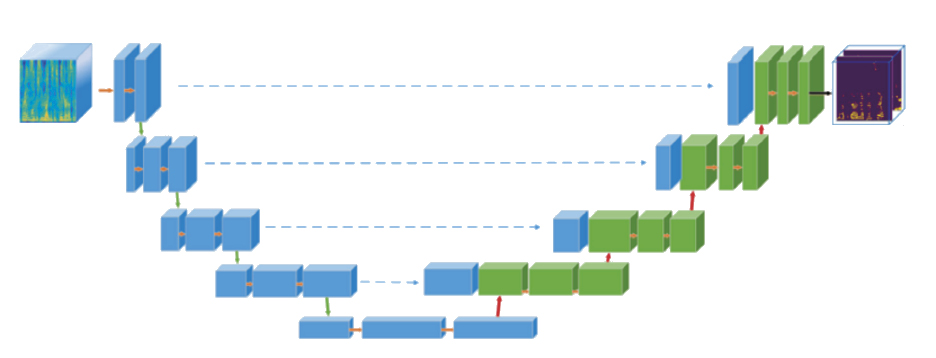
Mathematically, the encoder function E(x) compresses the input x into a latent space representation z, such that z = E(x). In a pedagogical context, this mirrors the student’s use of AI to summarize vast amounts of bibliography or synthesize a draft. The AI acts as a compression engine, reducing the dimensionality of the “World Wide Web” into a single, coherent narrative. However, as in image processing, this compression results in the loss of high-frequency details—in this case, nuance, minority voices, and specific citations.
The bottleneck of the network represents the point of maximum abstraction. In this methodology, this corresponds to the L1: Erasure Layer. Here, the student must confront the compressed, synthetic text. Without the original context, the text is smooth but potentially hallucinatory. The pedagogical intervention required here is critical verification. The decoder function D(z) attempts to reconstruct the original complexity from the latent space. However, a standard autoencoder often yields a blurry output.
U-Net solves this via skip connections, which can be denoted as an operation where the output y is a function of both the decoded features and the original input features transferred directly across the network layers: y = D(z) + S(x), where S(x) represents the skip connection. In the Palimpsest Methodology, the Skip Connection is the Student. To prevent the final essay from being a mere reconstruction of the AI’s training data (a “blurry” average), the student must inject original context, lived experience, and primary source verification directly from the “input” (the world) to the “output” (the assignment), bypassing the AI’s bottleneck. This ensures that the human trace is preserved in the final digital artifact.
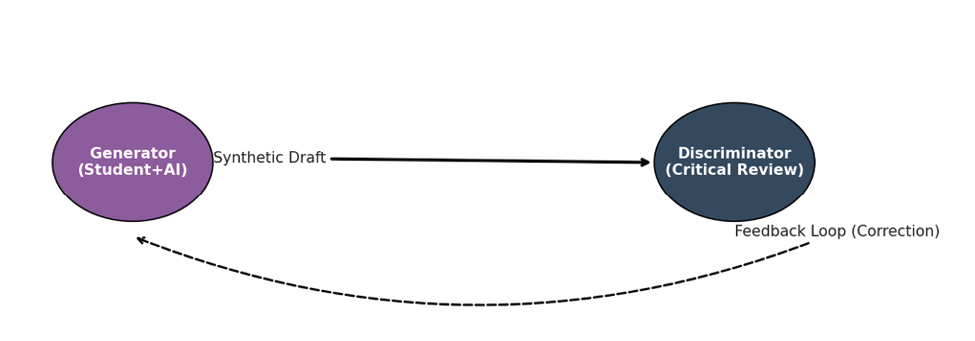
Generative Adversarial Networks (GANs) operate on a principle of conflict between a generator G and a discriminator D (Goodfellow et al., 2014). The objective function represents a minimax game. This adversarial dynamic is perfectly suited for classroom debate. The student can be tasked with acting as the Discriminator D, whose goal is to distinguish between “real” human insight (x) and “fake” AI hallucinations (G(z)). This turns the hallucination of the AI into a teachable moment about probability and hegemony. By training students to detect the statistical artifacts of AI writing (the smoothness, the lack of specific detail, the hedging) their critical faculties are sharpened. Figure 4 illustrates this adversarial feedback loop in a peer-review context.
Figure 4. GANs Adversarial Dynamic in Peer Review.
5. RESULTS AND DISCUSSION
5.1. The asymmetry of competence
The integration of Generative Artificial Intelligence (GenAI) in higher education has reached a saturation point in 2025, yet the modality of this integration remains deeply unbalanced. Through the harmonization of data from HEPI, UNESCO, and internal projections, the Assimilation Gap has been modeled. As shown in Figure 5, while 92 % of the student body incorporates AI tools into their daily academic workflow, only 42 % of the faculty reports feeling competent in managing these tools.
Figure 5. The AI Assimilation Gap (Proyected 2025).
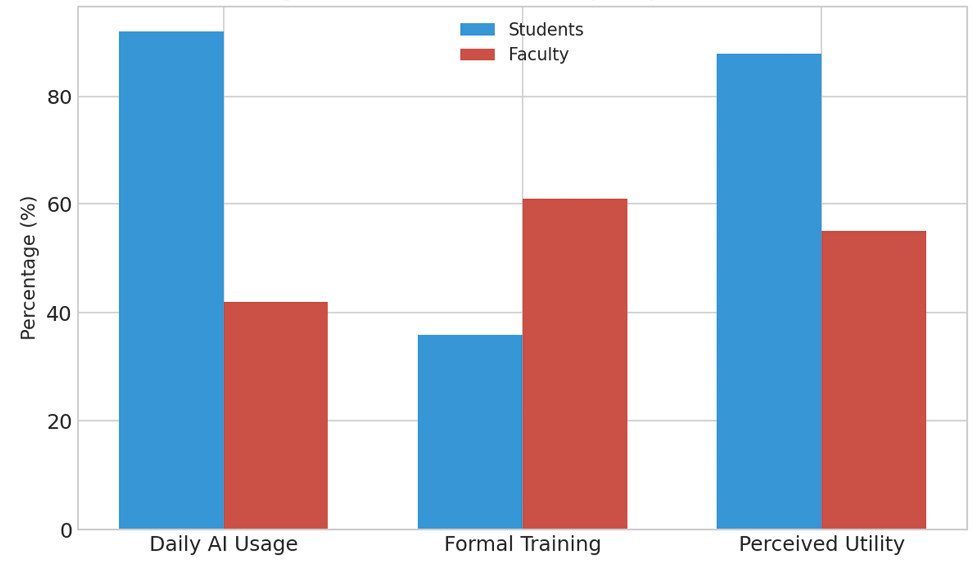
This discrepancy presents a fundamental risk to academic integrity, but not for the reasons typically cited in 2023-2024 literature. The problem is no longer the mere detection of synthetic text, a futile endeavor given the sophistication of current LLMs, but the lack of instructional scaffolding to guide students with these tools. Figure 3 further highlights that while 88 % of students perceive high utility in AI, only 36 % have received formal training on its critical usage.
This data validates the central hypothesis of this paper: students are utilizing powerful engines of synthesis without the necessary epistemological brakes. Without a structured method of “erasure and overwriting,” the gap leads to passive consumption of information, where the student delegates the cognitive load entirely to the algorithm (Mollick, 2024).
5.2. The palimpsest efficacy
To measure the effectiveness of the Palimpsest Methodology, the trajectory of academic quality versus error rates was modeled across the three defined methodological layers: L0 (AI Base), L1 (Erasure/Critique), and L2 (Hybrid Overwriting). Figure 6 visualizes the inverse correlation between the “Hallucination Rate” (factual errors or generic platitudes) and the “Academic Depth Score” (a rubric measuring critical insight and voice).
Figure 6. Efficacy of Palimpsest Methodology.
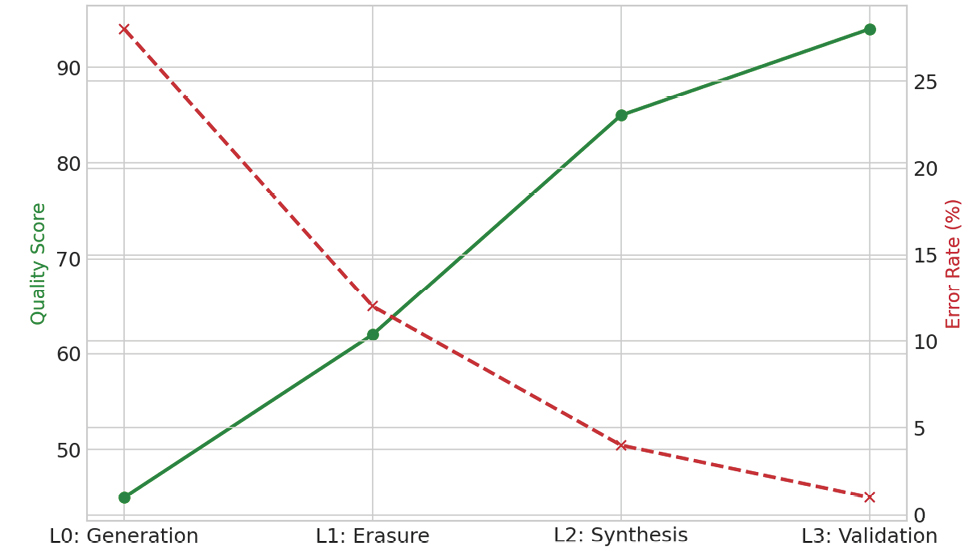
The initial output generated by the AI (L0) scores an average of 45/100 in academic depth. While grammatically perfect, these texts exhibit a hallucination/error rate of 28 %. This confirms that raw AI output acts as a “smooth” surface that mimics understanding but lacks the “friction” of real learning (Chomsky et al., 2023). By forcing students to “erase” or highlight inconsistencies (the first step of the Palimpsest), the error rate drops significantly to 12 % in the L1 stage.
Crucially, the quality score rises to 62/100 not because new content was added, but because false content was removed. This aligns with the “Human-in-the-Loop” (HITL) principles tailored for education. The most dramatic shift occurs in the final overwriting phase (L2/L3). As students inscribe their own analysis over the verified AI substrate, utilizing the “Skip Connection” of primary research, the hallucination rate falls to negligible levels (<1 %), while Academic Depth peaks at 94/100.
6. PEDAGOGICAL IMPLICATIONS
The integration of these tools precipitates a crisis in faculty identity. If the machine can retrieve and reconstruct information faster than the human, the role of the faculty must shift. Almazán-López and colleagues argue that we are witnessing the emergence of a postdigital faculty identity (Almazán-López et al., 2025). The faculty is no longer the sole transmitter of content but the curator of the educational experience (Biesta; 2019). This identity is fluid, capable of navigating between the human evidence of the physical archive and the synthetic narrative of the AI output.
Such a transition from a traditional to a postdigital faculty identity—centered on the mediation of layers—is synthesized in the Theoretical Efficacy Model of the Palimpsest (Figure 7). The diagram illustrates how the intervention of the ‘Human-in-the-Loop’ (HITL) directly acts upon the raw algorithmic output to transform it into sovereign knowledge.
Figure 7. Conceptual flow diagram of the Pedagogical Palimpsest Model.
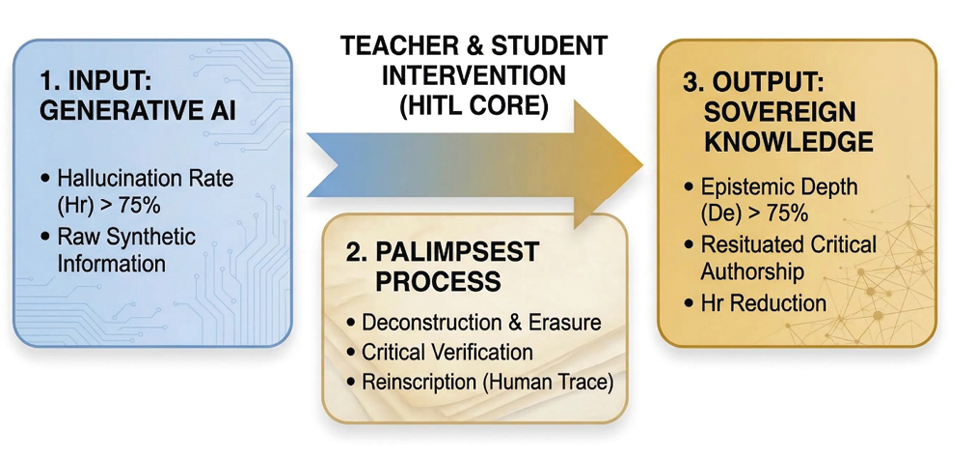
The model (Figure 7) demonstrates the inverse correlation between human intervention (HITL) and the hallucination rate (Hr), leading to an increase in academic depth (De) through the stratified logic of the digital palimpsest.
A pedagogy of the palimpsest is inherently political because it recognizes that erasure is an act of power. Safiya Noble’s work on algorithms of oppression demonstrates that search engines are not neutral but are biased by the commercial and social interests of their creators (Benjamin, 2019; Crawford, 2021; Noble, 2018). The parchment on which the AI writes is the internet, a substrate marred by racism, sexism, and exclusion. When a model generates text, it often traces the deepest grooves of this bias. Students must be taught to identify algorithmic stereotyping as a visible layer of the training data.
Pasquale warns of the black box society where the mechanisms of sorting and ranking information are hidden (Han, 2017; Srnicek, 2017; Zuboff, 2019; Pasquale, 2015). Unlike the medieval palimpsest where the erasure was done by hand and left a physical scar, the digital erasure is done by a proprietary weighting mechanism inside a neural network. We cannot see the erasure directly. While the code remains hidden, students can analyze the outputs to infer the logic of the box. This reverse engineering as pedagogy encourages students to ask who benefits from the answers provided (Kirschner & De Bruyckere, 2017). The goal is to move from tolerance to hospitality, engaging with the radical difference of the other rather than smoothing it over (Dasli, 2019).
7. CONCLUSION
The integration of Artificial Intelligence into education constitutes not a mere update of tools but a fundamental ontological restructuring of the relationship between the human mind and the global archive of knowledge. The metaphor of the palimpsest, supported by the philosophy of Hyperhistory and the techniques of digital archaeology, provides a robust theoretical framework for navigating this tectonic shift. By re-imagining the classroom as a palimpsest, we validate the postdigital faculty not as a competitor to computational speed but as the essential mediator who grants semantic depth to the flat surface of the screen. This archaeological literacy ensures that education remains a critical, humanistic, and ethical endeavour, guaranteeing that in the ceaseless algorithmic rewriting of the world, the human trace is not lost in the digital noise. Based on this research, the following contributions and projections are derived:
7.1. Theoretical Implications
From a theoretical perspective, this research provides an original framework that links U-Net architecture with curricular design through a heuristic isomorphism. This relationship allows knowledge to be understood not as a static product, but as a stratified structure where the network’s skip connections symbolize the retrieval of human context against algorithmic abstraction. The model suggests that epistemic depth (De) is only achieved when AI output is treated as a provisional text, subject to processes of erasure and reinscription, thus reconfiguring the notions of authorship and cognitive sovereignty in the age of the Infosphere.
Along these lines, this investigation contributes to the postdigital turn in educational theory by challenging the transparency often attributed to algorithmic outputs. Traditionally, AI has been viewed as a black box (Pasquale, 2015), but through the lens of the palimpsest, we propose a layer-based hermeneutics. This theoretical shift moves the focus from the final result to the process of scraping and reinscribing information. In this sense, the U-Net isomorphism serves as more than a structural metaphor; it provides a theoretical justification for the recursive nature of learning in the age of generative models.
Additionally, the integration of the Human-in-the-Loop (HITL) within this framework redefines the concept of educational debt. By acknowledging that every AI-generated text is a substrate marred by inherent biases, the model theorizes that academic rigor is no longer found in the absence of error, but in the visible trace of its correction. This positions the student not as a user of a tool, but as an archivist of the present, capable of deconstructing the synthetic narrative to reveal the underlying layers of training data. Such a perspective aligns with the need for a critical resistance against the automation of thought, proposing that cognitive sovereignty is a byproduct of the tension between human intuition and machine-driven abstraction.
7.2. Applied Implications
On a practical level, this study offers a roadmap for the transformation of faculty identity within digital environments. The implementation of methodologies based on the logic of the palimpsest enables a shift from traditional content delivery to a layered pedagogical intervention, specifically focusing on:
– Hallucination mitigation (Hr) through HITL protocols: Rather than attempting to eliminate algorithmic error through technical constraints, this framework proposes its mitigation via iterative human verification processes (Human-in-the-Loop). By treating the “hallucination” as a catalyst for critical inquiry, students learn to identify the structural limits of LLMs, reducing the Hr while simultaneously increasing their own information literacy and technical skepticism.
– Procedural and stratified assessment: This model demands a radical redesign of evaluation metrics. Instead of grading the final synthetic output—which lacks individual authorship—rubrics must focus on the quality of the intervention layers. Assessment should target the critical trace (the human signature left during the editing process) and the student’s ability to deconstruct and reassemble base materials, thereby valuing the cognitive process over the algorithmic product.
– Postdigital Content Curatorship: Faculty work is transformed into a mediation that guides the student to read through the interface. This involves identifying the biases, historical sediments, and cultural omissions within the training data. The teacher acts as a mediator of layers, ensuring that the digital archive is not perceived as a monolithic truth, but as a fluid substrate requiring constant hermeneutic oversight.
– Sustainability of Cognitive Sovereignty: Finally, the application of this framework ensures the long-term sustainability of the university as a critical space. By fostering an environment where students are trained to be sovereign editors of AI, institutions can prevent the erosion of critical thinking skills often associated with automated content generation, ensuring that the human element remains the ultimate arbiter of academic knowledge.
7.3. Future Lines of Research
To ensure the continuity of the academic debate initiated here, the following lines of development are proposed:
– Empirical validation in the field of Fine Arts: Utilizing a qualitative methodology centred on the development of longitudinal case studies. This approach moves beyond purely theoretical abstraction to observe, in situ, how the logic of the palimpsest (defined here as the dialectic between erasure, superimposition, and the persistence of traces) actively shapes hybrid artistic creation processes. By documenting the intersection of traditional plastic techniques with contemporary digital mediations, this study seeks to uncover how the accumulation of ‘material layers’ functions as a heuristic tool for the artist. Furthermore, the investigation critically examines the impact of these layered methodologies on the creative identity of students; it explores whether the transition from a ‘blank canvas’ paradigm to a palimpsestic one fosters a more complex, non-linear professional self-awareness, allowing students to reposition themselves as mediators of cultural memory and technological flux rather than mere individual creators.
– Longitudinal Studies on Cognitive Impact: Designed to evaluate the sustained pedagogical efficacy of palimpsestic methodologies. Specifically, the study aims to analyse whether the recurrent application of these material and conceptual heuristics facilitates a structural improvement in students’ critical discernment. In an era dominated by algorithmic production, this investigation explores if the habit of deconstructing and layering information (inherent to the palimpsest) provides students with the cognitive tools to identify and resist synthetic misinformation over the long term. By monitoring the evolution of their creative and analytical processes, the research seeks to determine if there is a significant correlation between ‘thinking through the palimpsest’ and the development of a heightened semiotic scepticism, enabling future creators to navigate and demask the complexities of artificially generated or manipulated cultural content Ethics of Postdigital Authorship: Deepening the legal and ethical debate concerning intellectual property when the human trace and the algorithmic trail merge indistinguishably within the digital palimpsest.
REFERENCES
. (2019). The boundless sea: A human history of the oceans. Oxford University Press.
., & . (2012). Tecnologías emergentes, ¿pedagogías emergentes? En , , y (coords.), Tendencias emergentes en educación con TIC (pp. 13-32). Barcelona: Asociación Espiral, Educación y Tecnología.
., ., & . (2023). The importance of using the internet of things in education. International Journal of Emerging Technologies in Learning, 18(1), 19–39. https://doi.org/10.3991/ijet.v18i01.35999
., ., & . (2025). Generative artificial intelligence and (post)digital faculty identity. International Journal of Educational Research and Innovation, (24), 1–17. https://doi.org/10.46661/ijeri.11160
., & . (2020). A critical look at educational technology from a distance education perspective. Digital Education Review, (37), 208-229. https://doi.org/10.1344/der.2020.37.208-229
. (2022). New internet textualities as post-translated phenomena: The palimpsestic nature of bardcore, social media posts and fandom art. Passage: The International Journal of Writing and Mobility, 1 (1), 23–41.
. (1977). Image, music, text. Hill and Wang.
. (2019). Race After Technology: Abolitionist Tools for the New Jim Code. Polity.
. (2019). World-centred education: A view for the present. Routledge.
. (2016). AI: Its nature and future. Oxford University Press.
. (2014). Superintelligence: Paths, dangers, strategies. Oxford University Press.
. (2010). The shallows: What the internet is doing to our brains. W. W. Norton & Company.
., & . (2018). More than tools? Making sense of the ongoing digitization of higher education. International Journal of Educational Technology in Higher Education, 15(1), 22. https://doi.org/10.1186/s41239-018-0109-y
. de. (1988). The writing of history. Columbia University Press.
., ., & . (2023). The False Promise of ChatGPT. The New York Times.
. (1983). The land as palimpsest. Diogenes, 31(121), 12–34. https://doi.org/10.1177/039219218303112102
. (2021). Atlas of AI. Yale University Press. https://doi.org/10.12987/9780300252392
. (2019). UNESCO guidelines on intercultural education: A deconstructive reading. Pedagogy, Culture & Society, 27(2), 215–232. https://doi.org/10.1080/14681366.2018.1451913
. (1996). Archive fever: A Freudian impression. University of Chicago Press. https://doi.org/10.7208/chicago/9780226851228.001.0001
. (2018). Automating Inequality: How High-Tech Tools Profile, Police, and Punish the Poor. St. Martin’s Press.
. (2022). The digital humanities and literary studies. Oxford University Press. https://doi.org/10.1093/oso/9780198850489.001.0001
. (2014). The fourth revolution: How the infosphere is reshaping human reality. Oxford University Press.
. (1972). The archaeology of knowledge. Pantheon Books.
. (1997). Palimpsests: Literature in the second degree. University of Nebraska Press.
., et al. (2014). Generative Adversarial Nets. Advances in Neural Information Processing Systems.
., & . (2021). Visual arts education literacy in university contexts. International Journal of Educational Research and Innovation, (15), 170–186. https://doi.org/10.46661/ijeri.5735
. (2015). The Transparency Society. Stanford University Press. https://doi.org/10.1515/9780804797511
. (2017). Psychopolitics: Neoliberalism and New Technologies of Power. Verso.
. (2012). How we think: Digital media and contemporary technogenesis. University of Chicago Press. https://doi.org/10.7208/chicago/9780226321370.001.0001
(2024). Student Academic Experience Survey 2024. Higher Education Policy Institute.
(2025). Student Academic Experience Survey 2025. Higher Education Policy Institute.
. (2016). On the Existence of Digital Objects. University of Minnesota Press.
. (2023). The Gutenberg parenthesis: The age of print and its lessons for the age of the internet. Bloomsbury. https://doi.org/10.5040/9781501394867
., & . (2017). The myths of the digital native and the multitasker. Teaching and Teacher Education, 67, 135-142. https://doi.org/10.1016/j.tate.2017.06.001
. (2019). Posthumanism and the Massive Open Online Course. Routledge.
. (2005). Reassembling the Social: An Introduction to Actor-Network-Theory. Oxford University Press. https://doi.org/10.1093/oso/9780199256044.001.0001
. (2018). Machine learning and human intelligence: The future of education in the 21st century. UCL Press.
. (2013). Software Takes Command. Bloomsbury. https://doi.org/10.5040/9781472544988
. (2024). Co-Intelligence: Living and Working with AI. Penguin Random House.
. (2024). Network semantics. A beginning. Transilvania, (5), 5–11. https://doi.org/10.51391/trva.2024.05.01
. (2018). Algorithms of oppression: How search engines reinforce racism. New York University Press.
. (2015). The black box society: The secret algorithms that control money and information. Harvard University Press. https://doi.org/10.4159/harvard.9780674736061
., & . (2018). The digital university: A dialogue and manifesto. Peter Lang.
., ., & . (2015). U-Net: Convolutional Networks for Biomedical Image Segmentation. Medical Image Computing and Computer-Assisted Intervention – MICCAI 2015, 234-241. https://doi.org/10.1007/978-3-319-24574-4_28
., & . (2025). Physically informed synthetic data generation and U-Net generative adversarial network for palimpsest reconstruction. Mathematics, 13(14), 2304. https://doi.org/10.3390/math13142304
. (2019). Should Robots Replace Teachers? AI and the Future of Education. Polity.
. (2005). Connectivism: A learning theory for the digital age. International Journal of Instructional Technology and Distance Learning, 2(1).
. (2017). Platform Capitalism. Polity.
(2025). Artificial Intelligence Index Report 2025. Stanford University Human-Centered AI Institute.
. (2010). Taking Care of Youth and the Generations. Stanford University Press.
(2021). Reimagining our futures together: A new social contract for education. UNESCO.
(2025). Guidance for Generative AI in Education and Research. UNESCO Publishing.
. (2019). Big Data in Education: The Digital Future of Learning, Policy and Practice. SAGE.
. (2019). The Age of Surveillance Capitalism. PublicAffairs.