Educación, redes sociales y prevención de la violencia de género en estudiantes de Formación Profesional
Education, Social Media, and Gender-Based Violence Prevention Among Vocational Training Students
María de la Luz Parro Carrero
Universidad de Extremadura
María Rosa Fernández-Sánchez
Universidad de Extremadura
María del Carmen Garrido-Arroyo
Universidad de Extremadura
RESUMEN
Las redes sociales se han convertido en el principal medio de socialización para adolescentes y jóvenes, alterando de manera significativa las relaciones interpersonales. Por ello, resulta esencial estudiar y contextualizar este fenómeno para analizar, desde una perspectiva de género, las interacciones interpersonales que tienen lugar en entornos virtuales entre estudiantes de la familia profesional de Servicios Socioculturales y a la Comunidad (SSC). Se llevó a cabo un estudio descriptivo mediante un cuestionario sobre violencia de género. Los resultados confirman que las redes sociales son percibidas por la juventud como un espacio violento, donde al menos 3 de cada 10 personas declaran haber sufrido acoso en línea. Sus experiencias indican que en estos espacios se perpetúan los estereotipos de género. Además, el género acentúa la reproducción del sexismo y la desigualdad, siendo las chicas las que con mayor frecuencia observan este tipo de violencia. El sistema educativo debe formar a la ciudadanía para afrontar de forma constructiva el impacto y los riesgos de los entornos virtuales en situaciones de desigualdad, posicionándose como un espacio clave para erradicar la violencia de género. La situación exige acciones educativas en competencias digitales y mediáticas para el alumnado de SSC, incorporando a sus habilidades personales, profesionales y sociales la plena integración de la cultura digital. Esto les permitirá desarrollar una comprensión crítica de las problemáticas sociales que puedan encontrar en los entornos virtuales, donde llevarán a cabo numerosas actividades profesionales y personales.
PALABRAS CLAVE
Educación; redes sociales; violencia de género; servicios socioculturales y a la comunidad (SSC); competencia digital; desigualdad.
ABSTRACT
Social media has become the primary medium of socialisation for adolescents and young people, significantly altering interpersonal relationships. It is therefore essential to study and contextualise this phenomenon to analyse the interpersonal interactions occurring in virtual environments among students in the sociocultural and community services (SSC) vocational family, from a gender-based perspective. A descriptive study was performed using a questionnaire on gender-based violence. The findings confirm that social media is perceived as a violent space by the youth, with at least 3 out of 10 reporting having been harassed online. Their experiences indicate that gender stereotypes are perpetuated in social media spaces. Furthermore, gender exacerbates the reproduction of sexism and inequality, with girls being the most frequent observers of such violence. The education system must educate citizens on how to constructively address the impact and risks of virtual environments in situations of inequality, positioning itself as a crucial space for eradicating gender-based violence. The situation necessitates educational actions in digital and media competencies for SSC vocational students, incorporating into their personal, professional, and social skills the full integration of digital culture. This will enable them to develop a critical understanding of the social issues they may encounter in virtual environments, where they will carry out numerous professional and personal activities.
KEYWORDS
Education; social media; gender; based violence; sociocultural and community services (SSC); Digital Competence; Inequality.
1. INTRODUCTION AND CONTEXT
A substantial body of research has been developed concerning the social impact of social media on younger individuals, particularly regarding its influence during adolescence. Given that this is an issue of contemporary concern, this study examines some of the most common behaviours in virtual environments and their underlying motives, drawing on the work of Donoso et al. (2018). It aims to analyse the interpersonal relationships occurring through virtual environments among young people, specifically students of the sociocultural and community services (SSC) vocational family in Extremadura, from a gender-based perspective.
Social media has become the primary means of socialisation for adolescents and young people (Alcázar, 2023; Medina & Ballano, 2015), causing a significant shift in interpersonal relationships. It was therefore deemed necessary to study and contextualise this phenomenon in order to determine the main uses that individuals in this age group make of these platforms. The possibilities that social media offers young people as communication platforms (García del Dujo et al., 2021; Lázaro, 2020; García et al., 2013) were analysed, as were the risks and threats (Megías et al., 2018; Páez et al., 2019) that may affect this demographic.
Given the current differences in socialisation and gender construction, we must question whether they also extend to virtual spaces and are reproduced through social media (Vergés et al., 2022). This article demonstrates that social media may amplify control mechanisms in interpersonal relationships and thus intensify the reproduction of sexist attitudes. There is therefore a need for educational interventions focusing on digital and media literacy to prevent certain sexist behaviours within the education system.
1.1. Youth and Virtual Environments: Social Media
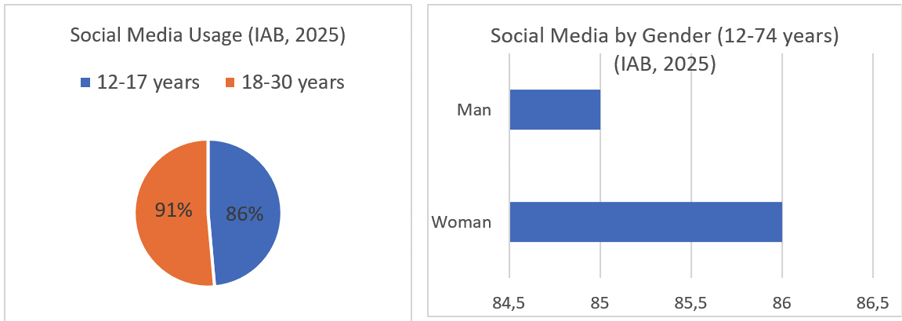
Social media is a primary environments for communication, as highlighted by the an annual study by the Association for Advertising, Marketing and Digital Communication (IAB) in 2024, conducted by Elogia (Graph 1). The report details data such as 86 % of the population aged 12 to 74 years using social networks in Spain, with the majority of users being women, 86 % compared to 85 % of men. Additionally, regarding age groups, social network usage is 86 % among those aged 12 to 17 years and 91 % among those aged 18 to 30 years. The profile of social media users varies across these age groups, with a significant difference between young people and older adults. However, these figures may change rapidly (Domoff et al., 2021; García del Castillo et al., 2020). Nonetheless, the focus of this research is not on the number of people using social media or other virtual spaces but on how they use them.
Graph 1. Social Media Usage and Social Media by Gender. IAB & Elogia, 2025.
Drawing on various sources (Ballesta, 2015; Marugán & Martín, 2023; Segarra et al., 2002; Stefani & López, 2023) makes clear that social media has become an essential part of people’s lives, as its platforms are used with great frequency. This reality leads us to assert that young people are the primary participants in the communication and interactivity that social media offers, particularly in terms of developing their technological skills and significantly altering their social and cultural structures (Sánchez et al., 2022). This phenomenon presents both opportunities for the development of new skills and certain challenges, such as a reduced attention span, less time spent on traditional socialisation, and potential negative effects on creativity and mental health. Therefore, it is essential that education encompasses the development of digital competencies and training in digital citizenship (Gutiérrez Molero et al.,2025).
This technological advancement has undeniably improved communication development. However, adolescents, attracted by the immediacy of it all, are giving more importance than ever to cyberculture, automated recreation, and social media (Feixa, 2011; González et al., 2017; Soler et al., 2019). The group of interest in this study uses technological applications excessively and disproportionately, breaking away from traditional communication barriers as the context in which interpersonal relationships develop is vastly different from that of previous years. The internet allows for the creation of new virtual relationships, but these can involve both known and unknown individuals; anonymity (Dans, 2015) enables the concealment of identity, which in turn leads to issues in interpersonal relationships (Fernández-Montalvo et al., 2015).
1.2. A New Form of Communication: The Digitalisation of Society
For young people, friendship becomes vital to their emotional development not only because they maintain a larger number of friendships but also because they interact more frequently with this core group of relationships (Muñoz et al., 2020; Colás, 2013). The way youth experience their interpersonal relationships on social media, along with the patriarchal structures and their intrinsic forms of aggression, are reflected in the technologies themselves (Rothermel, 2020), as seen in the dimensions explored in this study.
Young people are growing up and developing as individuals within the omnipresence of digital devices (Stoilova et al., 2021). Several authors have determined that yYoung people utilise various digital tools to learn, communicate, and share content online (González & López, 2018). Previous generations socialised in different, solely physical spaces. In contrast, today’s youth engage in a dual form of socialisation: on the one hand, digital technology as an everyday environment, and on the other, the interactive potential that these technologies offer. A continuous flow of relationships and exchanges is created that shapes the socialisation of young people (Maquilón et al., 2017; Merino, 2011).
Many scholars have discussed the concept of “digital natives” (a term coined by Prensky in 2001) as a myth that has led to a misguided perception of how technology is used. This myth assumes that age is the key determinant of digital proficiency (Zallo, 2016), creating a distorted and unrealistic view of generations born into a digital world and presupposing that they possess a special talent and natural ability to learn (Ballano et al., 2014).
1.3. Deconstructing Gender-Based Violence Through Education in Digital Competencies
The root of gender-based violence lies in asymmetrical power relations (De Miguel, 2005) and the legitimisation of these dynamics through the patriarchal system, which reinforces women’s internalisation of subordination and femininity (Alario, 2021; Amorós, 2020). Hence, we can infer that patriarchal traits (Lagarde, 2011) may permeate new virtual communication environments. Gender-based violence can manifest in subtle or normalised acts, as certain behaviours are repeated over time and target women, reproducing gender roles and stereotypes in virtual spaces. These acts can become normalised and mirror societal patterns outside the digital realm (Díaz et al., 2021; Donoso & Velasco, 2013; Tarriño & García-Carpintero, 2014).
In this sense, virtual violence occupies a significant space on social media with a broad range of control and abuse mechanisms to exert gender-based violence in various forms (Donoso & Velasco, 2013). This phenomenon is influenced by both patriarchy as a system and neoliberal capitalism (Cobo, 2015). We live in a society where knowledge is mediated, with almost everything we know coming through media and digital technology. This makes digital education essential for understanding and analysing how the media represents reality and how young people incorporate and reinterpret these messages (Morduchowicz, 2022).
We know that the existence of educational regulations concerning equality does not guarantee their effective implementation. Coeducation in the education system remains an unfulfilled task (Sánchez & Iglesias, 2017; Subirats, 2017). If there is one key to eradicating gender-based violence, it is providing strategies and tools through the education system. This can be achieved by reinforcing media education from a gender perspective and placing greater emphasis on the training of women, particularly young women (Martín et al., 2016). Social media has become an indispensable space for the visibility, debate, and advocacy of feminism (Tortajada & Vera, 2021).
To advance equality, the education system must adopt a feminist approach to the development of digital and media competencies and offer a critical perspective that promotes equality and democratic values (Martín et al., 2016; Moriana, 2017; Pedraza, 2021; Sánchez & Fernández, 2017). Media education should enable the acquisition of knowledge and skills by adolescents to become reflective communicators and receivers. This is crucial, as the media is undoubtedly part of the culture of young people, and building on their knowledge and experience canempower them to critically navigate these platforms (Fueyo & Andrés, 2017).
Catalina-García et al. (2014) argue for the need to strengthen educational policies that provide young people with information about the dangers associated with digital communication. It is essential to educate the younger generations with a positive and intelligent approach that raises awareness of both the risks and the potential of these media, without rejecting their use (Aguaded-Gómez et al., 2001). However, while it is necessary to develop cross-cutting practices within the education system, adaptable plans are also required to address gender equity explicitly in academic contexts (Bejarano et al., 2019; Menéndez, 2017). It is of particular importance that teachers be aware of their own attitudes and behaviours in the classroom regarding gender equality, as this is part of the informal education that students may come to legitimise and perpetuate outside the classroom (Fernández-Sánchez & Silva Quiroz, 2022). Media education with a gender perspective is essential for dismantling the symbolic mechanisms that legitimise gender-based violence in virtual environments, fostering a critical digital citizenship capable of identifying and challenging such patterns (Martínez et al., 2021).
To teach and learn how to live safely in the digital society, digital competencies must be develop that allow us to understand how information is produced and disseminated in this new context (Caccuri, 2016; Pinedo et al., 2018). If media literacy is considered a communicative competency present throughout the social and technological process, it is necessary to integrate and give it meaning in vocational training studies (García-Ruíz et al., 2013; Méndez et al., 2022).
2. METHODS
The general objective of this research was to analyse the influence and risks of violence through social media on the interpersonal relationships of SSC students. The aim was to promote the development of digital competencies, encourage respectful interaction, and enhance students’ ability to identify and prevent violent behaviours in the digital environment. This general objective is articulated through the following specific objectives: (a) To identify and describe SSC students’ perceptions of manifestations of gender-based violence in virtual environments, taking into account sex differences and the sociocultural factors that influence the reproduction of stereotypes and inequalities; (b)To analyse students’ experiences as victims, perpetrators, or bystanders of digital violence, through the application of validated instruments, in order to determine the prevalence and typology of the most frequent risk behaviours on social media; and (c) To examine the relationship between the development of digital competences and students’ ability to recognise, address, and prevent situations of gender-based violence on social media, providing evidence to support the need for educational interventions aimed at fostering critical and egalitarian digital citizenship.
2.1. Study Type
To achieve this, a descriptive study was employed with the goal of providing a clear and detailed view of how students experience violence on social media and how it impacts their interpersonal relationships. This type of study was suitable because it allows for the observation and description of phenomena in specific contexts without altering or intervening in the conditions of the investigated environment. The methodology used was non-experimental, as no variables were manipulated. Instead, the phenomenon was observed and analysed as it naturally occurs in the students’ environment (Hernández et al., 2003). The researchers collected data without intentionally modifying the environment or the participants’ experiences for a more realistic analysis of the students’ behaviours and attitudes towards violence on social media.
2.2. Instrument
The methodology employed a quantitative approach, with a descriptive study designed to transform the data collected via a questionnaire into indices or frequencies allowing for categorisation and analysis. A validated closed-ended questionnaire called the Gender-Based Violence 2.0 Questionnaire (Donoso et al., 2014) was used.
This instrument was selected due to the dimensions it examines, as it explores young people’s perceptions of gender-based violence perpetrated through social media, as well as their experiences, not only as potential aggressors but also as victims or bystanders of such situations. The Cyberbullying Offending Scale (Hinduja & Patchin, 2010), consisting of nine items and a preliminary question to assess the extent of violent behaviours in the sample population, was also included.
Table 1. Dimensions and Categories of Analysis.
|
Dimensions |
Categories of Analysis (No. of Items) |
|---|---|
|
Characterisation/ Contextualisation (Nominal and Ordinal Scales) |
Sociodemographic Data (7 items) Technological Proficiency and Usage Profile (15 items) Perception of the Internet as a Violent Environment (16 items) Perception of Impunity in Online Spaces (6 items) Perception of Having Personal Vulnerability Characteristics (2 items) Degree of Perception of Gender-Based Violence 2.0 (Likert Scale-5, 12 items) Perception of the Risk of Violence in Virtual Spaces (Likert Scale-5, 6 items) |
|
Responses to Gender-Based Violence 2.0 (Likert Scale–5) |
Cyberbullying Offending Scale (9) |
|
Experiences with Gender-Based Violence 2.0 (Likert Scale–5): • Cyber-aggressor (21 items) • Cyber-victim (21 items) • Cyber-observer (21 items) |
Deviating from Female Sexual Norms (4 items) Transgressing Mandatory Sexual Heteronormativity (3 items) Impositions of Heteronormative Beauty Standards (3 items) Violence Based on Stereotypes (1 item) Sexual Violence (4 items) Violence for Expressing Anti-patriarchal Views (1 item) Violence Associated with Myths of Romantic Love (5 items) |
|
Observer |
Responses if Victim (a, b, c, d, e, f) (21 items) Responses as an Observer (a, b, c, d) (21 items) |
2.3. Sample
The quantitative study was conducted on 314 SSC students in Extremadura. The sample was selected using cluster random sampling, with clusters consisting of various secondary education centres in Extremadura representing the variability of the target population: Al-Qázeres, Bárbara de Braganza, Fuente Roniel, Santa Lucía del Trampal, María Josefa Baraínco, Los Moriscos, Quintana de la Serena, and Suárez de Figueroa. The sample universe comprised 1503 students. At a confidence level of 95 %, with a 5 % margin of error, the sample size was representative if it exceeded 307 participants.
2.4. Data Analysis
For data analysis, the statistical analysis program SPSS version 26 was used. A descriptive analysis of all study variables was conducted, yielding frequencies for categorical variables as well as measures of central tendency and standard deviation for Likert scale items. Subsequently, Pearson’s chi-squared test was applied to measure the association between nominal-scale variables. Additionally, a comparison of means was performed using Student’s t-test (following the Kolmogorov-Smirnov test) to assess the Likert scale items in relation to the independent variable of gender.
3. RESULTS
Below are the results obtained from the data analysis conducted on a sample of n=314 students.
3.1. Degree of Perception and Risk of Gender-Based Violence in Virtual Spaces
The degree and perception of gender-based violence are summarised in Table 2, with the general conclusion that the youth studied perceived virtual environments as being close to “highly violent” spaces. Specifically, the group perceived the following actions as the most violent in virtual spaces: “posting photos related to a person’s appearance” (average of 4.92), “depicting a woman purely as a sexual object” (4.84), and “mocking a homosexual or transgender person” (4.78).
However, when this violence occurred in virtual environments, the action perceived as posing the greatest risk was “chatting multiple times with unknown people” (average of 4.49), followed by “posting personal information online” (4.45). Surprisingly, the least risky behaviour was perceived to be that related to sexting, such as “posting personal photos or videos without the other person’s consent,” with an average score of 2.93.
In general, the proposed behaviours suggest that these young people considered these actions in online spaces to be violent or highly violent. However, when considering the gender variable, a significant difference emerged in how social media use was perceived. Boys tended to perceive a higher degree of risk than girls in the following situations:
•Forcing a partner to delete someone from their social network.
•Requesting access to a partner’s account passwords.
•Sharing photos without the other person’s consent.
In contrast, girls perceived a greater level of risk in the following behaviours:
•Repeatedly chatting with someone when they have no clue about the person’s identity.
•Meeting someone they have only been chatting with for a short period of time.
Table 2. Degree of Perception and Risk of Gender-Based Violence in Virtual Spaces.
|
Perception and Risk of Violence in Virtual Environments (Likert Scale 1–5) |
Gender |
Mean |
DS |
t (p) |
|---|---|---|---|---|
|
Forcing a partner to delete some friends on Facebook or another social network |
W |
4.67 |
0.716 |
–3.062 (0.003) |
|
M |
4.89 |
0.315 |
||
|
Asking a partner for the passwords to their email or other online accounts |
W |
4.67 |
0.744 |
–2.973 (0.004) |
|
M |
4.89 |
0.315 |
||
|
Sharing sexy photos of a partner without their consent |
W |
4.87 |
0.568 |
–3.758 (0.000) |
|
M |
5.00 |
0.000 |
||
|
Repeatedly chatting with someone whose identity I have no clues about |
W |
4.55 |
0.719 |
3.212 (0.001) |
|
M |
4.07 |
0.979 |
||
|
Meeting up with someone I have only been chatting with for a short time |
W |
4.39 |
0.828 |
2.538 (0.012) |
|
M |
3.96 |
1.105 |
3.2. Responses to Gender-Based Violence Online: Cyberbullying Offending Scale
In the Cyberbullying Offending Scale (Hinduja & Patchin, 2010) (Table 3), the overall results show a positive trend towards non-participation in cyberbullying activities (Table 3). However, 34.4 % of the respondents reported having been harassed at least once, meaning that approximately 3 out of 10 young people have experienced harassment in virtual environments. On the other hand, 3.2 % admitted to having engaged in online harassment at some point.
Most of the results in this scale do not exceed a mean score of 1.25 (on a scale of 1 to 5), both for boys and for girls. However, there are gender differences in responses. For example, boys scored significantly higher than girls on threatening to harm someone over the internet (with a mean score of 1.25 and p=0.002), and on posting a cruel and offensive image of someone (with a mean score of 1.07 for boys and p=0.007).
Table 3. Cyberbullying Offending Scale.
|
Cyberbullying Offending Scale |
Gender |
Mean |
DS |
t |
p |
|---|---|---|---|---|---|
|
I have harassed someone online or via mobile |
W |
1.07 |
0.350 |
–1.471 |
0.142 |
|
M |
1.18 |
0.548 |
|||
|
I have posted cruel or offensive comments about someone on the internet |
W |
1.13 |
0.435 |
–1.384 |
0.167 |
|
M |
1.25 |
0.585 |
|||
|
I spread rumours about someone online |
W |
1.25 |
0.628 |
0.315 |
0.753 |
|
M |
1.21 |
0.630 |
|||
|
I have threatened to harm someone online |
W |
1.05 |
0.274 |
–3.126 |
0.002 |
|
M |
1.25 |
0.645 |
|||
|
I have threatened to harm someone in a mobile message |
W |
1.14 |
0.443 |
0.759 |
0.448 |
|
M |
1.07 |
0.378 |
|||
|
I have impersonated someone and acted cruelly or offensively |
W |
1.06 |
0.266 |
–2.066 |
0.40 |
|
M |
1.18 |
0.476 |
|||
|
I have posted a cruel or offensive image of someone |
W |
1 |
0.59 |
–2.740 |
0.007 |
|
M |
1.07 |
0.378 |
|||
|
I have created a cruel or offensive website about someone |
W |
1.01 |
0.102 |
–1.127 |
0.260 |
|
M |
1.04 |
0.189 |
|||
|
I have posted a cruel or offensive video of someone |
W |
1.01 |
0.132 |
–0.918 |
0.359 |
|
M |
1.04 |
0.189 |
3.3. Experiences of Gender-Based Violence in Virtual Spaces: Cyber-aggressor/Cyber-victim/Observer
As cyber-aggressors, the behaviours most frequently reported were those related to the reproduction of stereotypes; 28 % of respondents admitted to having used stereotypical comments such as “go back to the kitchen” at least once online, with 8.3 % reporting that they had done so frequently. Similarly, behaviours related to romantic love were among the most commonly reproduced, with 24.2 % admitting to controlling their partner via social media sometimes (and 1.3 % stating they did so frequently). Additionally, 27.4 % occasionally checked their partner’s phone (1.2 % did so frequently).
In contrast, as cyber-victims, certain behaviours were reported more frequently, with some occurring almost twice as often compared to being a cyber-aggressor. The most frequent behaviour was related to stereotypes, with 43.9 % of respondents stating that they had occasionally received sexist comments in virtual spaces. Another significant area was related to beauty standards, where 25.2 % reported being insulted about their physical appearance, and 10.2 % said they had been shown photos depicting women as sexual objects. Regarding violence associated with romantic love, the percentages also increased: 30.9 % stated they had been controlled by a partner on social media, 34.1 % reported having their phone checked, and 22.9 % had been forced to delete photos or stop messaging certain people.
Regarding observed behaviours, other patterns emerged. The most frequently observed behaviours related to defying female sexual norms: 31.2 % reported frequently witnessing a girl being harassed for being provocative, 28.3 % had seen someone insulted for being homosexual, and 43.3 % reported having frequently observed a girl being harassed about her appearance. Additionally, 31.5 % stated that they had frequently observed someone being criticised for their feminist ideology, even though this behaviour showed low incidences in terms of victimisation and aggression.
It can be concluded that gender was a significant factor in increasing the reproduction of sexism and inequality in virtual environments, as reflected in the following findings (Table 4):
•In the variable related to deviating from female sexual norms, there was a significant difference (p=0.003), with girls being more frequently harassed for appearing provocative on social media.
•Regarding violence against those who transgress sexual heteronormativity, there was a gender-based difference in the behaviour of impersonating someone by pretending to be homosexual (p=0.003), though the difference in average scores was minor.
•In violence related to beauty standards, the behaviour of insulting a girl about her appearance (p=0.001) primarily affected girls, who were also the most frequent observers of such incidents.
•In contrast to the previous data, when it came to violence driven by stereotypes, girls were the primary perpetrators of sexist comments like “go back to the kitchen” (p=0.001), but they were also the most frequent victims of this behaviour.
•For behaviours related to sexual violence, there was also a differentiation between boys and girls, particularly in the item “threatening someone to start a relationship” (p<0.001), which had happened more frequently to the girls.
•In behaviours related to romantic love, differences are found for nearly all scales, and they were contrary to the previous findings. While girls were more frequently the victims than the aggressors in most behaviours, when it came to controlling a partner on social media, knowing their passwords, and checking their phone, girls were the primary perpetrators. However, they were also the most frequent victims and observers of these behaviours.
•The girls were the primary observers of gender-based violence in virtual spaces, while the boys were only more likely to witness the behaviour of someone impersonating another person and pretending to be homosexual.
Table 4. Cyber-Aggression, Cyber-Victimisation, and Cyber-Observation Scales.
|
Cyber-Aggression Scale |
Cyber-Victimisation Scale |
Cyber-Observation Scale |
||||||||||||||||||
|---|---|---|---|---|---|---|---|---|---|---|---|---|---|---|---|---|---|---|---|---|
|
S |
M |
DS |
t (p) |
M |
DS |
t (p) |
M |
DS |
t (p) |
|||||||||||
|
Violence for deviating from female sexual norms |
||||||||||||||||||||
|
Harassing a girl because she is provocative, using a mobile phone or social media |
W |
1.07 |
0.250 |
–0.091 (0.928) 1.07 |
1.33 |
0.745 |
3.09 (0.003) |
2.00 |
0.791 |
0.022 (0.982) |
||||||||||
|
M |
1.07 |
0.262 |
0.378 |
2.00 |
0.816 |
|||||||||||||||
|
Violence due to the imposition of heteronormative beauty standards |
||||||||||||||||||||
|
Impersonating someone, making them appear homosexual, and ridiculing them |
W |
1.00 |
0.00 |
–0.795 (0.433) 1.00 |
1.06 |
0.351 |
3.043 (0.003) |
1.35 |
0.583 |
–717 (0.474) |
||||||||||
|
M |
1.00 |
0.00 |
0.00 |
1.43 |
0.634 |
|||||||||||||||
|
Violence resulting from the impositions of heteronormative beauty standards |
||||||||||||||||||||
|
Insulting a girl for having an unattractive appearance |
W |
1.12 |
0.321 |
0.143 (0.887) 1.21 |
1.54 |
0.887 |
2.466 (0.018) |
2.18 |
0.815 |
0.664 (0.507) |
||||||||||
|
M |
1.11 |
0.315 |
0.630 |
2.07 |
0.900 |
|||||||||||||||
|
Creating, participating in, or visiting a website that rates girls based on their appearance |
W |
1.06 |
0.238 |
–2.250 (0.032) 1.36 |
1.20 |
0.607 |
–1.008 (0.322) |
1.53 |
0.739 |
–0.273 (0.785) |
||||||||||
|
M |
1.25 |
0.441 |
0.780 |
1.57 |
0.690 |
|||||||||||||||
|
Violence based on stereotypes |
||||||||||||||||||||
|
For expressing your opinions, you’ve been told to “go clean” or “go cook” |
W |
1.48 |
0.54 |
3.606 (0.001) |
1.96 |
1.001 |
7.052 (0.000) 1.71 |
2.01 |
0.784 |
1.870 (0.062) |
||||||||||
|
M |
1.14 |
0.448 |
1.14 |
0.525 |
0.854 |
|||||||||||||||
|
Sexual violence |
||||||||||||||||||||
|
Threatening a girl to maintain a romantic relationship |
W |
1.01 |
0.084 |
0.444 (0.657) |
1.19 |
0.588 |
5.453 (0.000) 1.29 |
1.44 |
0.618 |
1.265 (0.207) |
||||||||||
|
M |
1.00 |
0.00 |
1.00 |
0.00 |
0.600 |
|||||||||||||||
|
Obtaining someone’s photos to blackmail and exploit them sexually |
W |
1.00 |
0.059 |
0.314 (0.754) |
1.08 |
0.387 |
3.377 (0.001) 1.25 |
1.39 |
0.617 |
1.15 (0.248) |
||||||||||
|
M |
1.00 |
0.00 |
1.00 |
0.00 |
0.585 |
|||||||||||||||
|
Violence associated with myths of romantic love |
||||||||||||||||||||
|
Controlling a partner on Facebook or Twitter |
W |
1.28 |
0.479 |
2.595 (0.013) |
1.65 |
0.940 |
4.502 (0.000) 1.71 |
1.92 |
0.757 |
1.387 (0.166) |
||||||||||
|
M |
1.11 |
0.315 |
1.14 |
0.525 |
0.763 |
|||||||||||||||
|
Knowing your partner’s social media password to block their friends |
W |
1.06 |
0.246 |
3.863 (0.00) |
1.31 |
0.725 |
7.203 (0.000) 1.68 |
1.85 |
0.775 |
1.125 (0.261) |
||||||||||
|
M |
1.00 |
0.00 |
1.00 |
0.00 |
0.819 |
|||||||||||||||
|
Taking your partner’s phone to check calls and inspect it |
W |
1.31 |
0.493 |
2.275 (0.029) |
1.71 |
0.959 |
2.91 (0.006) 1.79 |
1.98 |
0.761 |
1.278 (0.202) |
||||||||||
|
M |
1.14 |
0.356 |
1.29 |
0.713 |
0.787 |
|||||||||||||||
4. DISCUSSION OF THE DATA
The results analysed partially align with those from other studies conducted using the same questionnaire (Donoso et al., 2018). The data suggest that the roles adopted by young people and reinforced through social media conform to heteronormative frameworks, where anyone deviating from the “established” norm may become a target for harassment online. Boys tend to use social media to reinforce their accepted or hegemonic masculinity, viewing these spaces primarily as platforms for enjoyment and entertainment; in contrast, girls are more vulnerable to criticism related to their image and physical appearance (Ringrose, 2010).
In terms of the perception of gender-based violence, particularly regarding myths of romantic love (Esteban, 2011; Herrera, 2014), the most significant behavioural differences are associated with this dimension. Girls experience a greater prevalence of such behaviours compared to boys. Herrera (2010) defines this issue as a “collective emotional utopia” ingrained in our society, one fostering mechanisms of possession and jealousy that are distinctly manifested through social media, illustrating the differentiated notion of romantic love (Linares, 2019).
When it comes to cyber-aggression, there was little difference in the average scores of the genders. In fact, in certain cases, the girls themselves engaged in behaviours that perpetuate stereotypes based on beauty standards (Martín et al., 2016). Nevertheless, the girls scored higher as victims of these behaviours, suggesting they were more likely to be targeted online and to observe such behaviours.
The acceptance of behaviours rooted in the discourse of romantic love leads to the normalisation of certain actions which directly contribute to the early stages of gender-based violence (Esteban, 2011; Herrera, 2010; Illouiz, 2009; Ruiz, 2016). While the tendency to engage in aggression is predominantly male, certain behaviours show a surprising prevalence among females. This indicates that girls may be adopting these behaviours without recognising the harm they cause to themselves (Sousa, 2021). By embracing patriarchal behaviours to fit into the “norm,” girls inadvertently perpetuate the very structures that marginalise them—a phenomenon also observed in other studies (Cuenca et al., 2021; Donoso et al., 2017).
As De Miguel (2008) and Hernández and Doménech (2017) point out, symbolic violence is most deeply entrenched among younger generations, who have grown up with formal equality. This has led many young people to backslide on issues of gender equality when it comes to interpersonal relationships or evaluating the behaviour of others.
5. CONCLUSIONS
Overall, this study highlights the need for the Spanish education system to lead the charge in promoting an integrated model of digital culture within schools. Students must acquire digital and media literacy skills that will enable them to combat situations like those explored in this research. This can only be achieved through the full integration of educational technology into curricula, at the highest level of curricular detail, within classrooms. From the development and implementation of the Digital Education Project (PED) to the commitment of the entire educational community, these efforts must lead to structural and organisational changes to adapt to the evolving knowledge society and to globalisation.
Eva Navarro (2016) clarifies that any form of education in media competencies must involve identifying various media and information systems that allow for participation and the exchange of learning, ideas, and content aimed at fostering individual creativity and social progress.
Students in the vocational family are trained to work towards community development, often with vulnerable populations. Despite this, they demonstrated behaviours that reproduce gender roles and stereotypes, with some even admitting to engaging in violent behaviours. In general, they had a broad understanding of violent behaviours in virtual spaces (as shown in Table 2 on the perception and risk of gender-based violence in virtual environments). Their experiences, however, are best understood through the three scales of aggression, victimisation, and observation (Table 4). Responses and potential variables related to the factors that increase violent behaviours in virtual environments are largely motivated by gender and based on dimensions such as stereotypes, beauty standards, and symbolic violence linked to the myths of romantic love.
It is crucial to design and coordinate socio-educational processes to prevent risk factors and promote equality of opportunity in digital environments (Pinedo et al., 2018). In the vocational training stage, the education system must equip professionals with the necessary skills from a digital culture perspective. Key values such as respect, sharing, understanding, and empathy are essential to ensuring safe virtual environments and fostering responsible digital citizenship (Castro, 2021; Verdú et al., 2009).
Another major conclusion is the need to identify elements related to digital competencies to prevent gender-based violence online. Schools, as educational institutions, must encourage critical reflection on the values transmitted through the media (Jiménez, 2019). As Spector (2016) argues, education cannot be envisioned without considering the technologies that support teaching and learning.
Although the young people claimed to possess adequate digital skills, they had been involved in risky situations and had not largely relied on their schools to address them. This underscores the need to reformulate Information and Comunication Technologies educational policies and regional initiatives, such as Extremadura’s DEP, to include the prevention of gender-based violence. Public authorities often push teachers to use technologies in the classroom, promoting educational innovation within the system through top-down policies (Sosa & Valverde, 2017; Valverde, 2023). It is important to recognise that schools serve as a microcosm of society, spaces where learning and socialisation occur, and they have significant influence as socialising agents (Castro, 2017).
A digital education that accounts for gender inequalities (Prendes et al., 2019) is essential, especially in guiding girls, who are more vulnerable in social networks, and encouraging young people to report such behaviours with the support of their schools. The integration of digital competencies into the school environment is essential not only for meaningful learning but also for the prevention of online risks, including digital gender-based violence (González-Zamar et al., 2020). This is particularly critical when considering that only 20.4 % of the respondents believed that schools can intervene in cases of violent behaviour in virtual environments. The fact that 3 out of 10 of the young people had experienced online harassment is a troubling statistic that educational institutions must address.
Therefore, gender can be considered a risk factor for becoming a victim in the various situations analysed. The study identified that girls are particularly vulnerable to gender-based violence online. Generally, boys and girls use social media differently, and the behaviours they exhibit through these platforms reflect differentiated socialisation patterns. Gender stereotypes continue to shape heteronormative responses, a point that is also argued in studies conducted by Ferreiro et al. (2016) using the same instrument.
Despite the relevance of the findings, this study has a number of limitations that should be considered when interpreting the results and when assessing their potential generalisation to other educational contexts. The research focused exclusively on students from the Sociocultural and Community Services (SSC) vocational family in Extremadura. This narrow scope limits the generalisability of the findings to other educational contexts or vocational families, where social media usage patterns and experiences of gender-based violence may differ. And the study relied on self-administered questionnaires, which may introduce response bias due to underreporting or overreporting of violent behaviours and experiences. Consequently, the results reflect students’ perceptions and declarations rather than objectively verified behaviours. In this regard, future research should broaden the scope of the sample and incorporate complementary methodologies to contrast and enrich the findings, thereby strengthening the applicability of the results.
We agree with Ruíz (2024) that schools are an ideal space for raising awareness and educating students on the prevention of gender-based violence. Preventing gender-based violence on social media among younger populations is essential, and digital and media education in the school system must be seen as the primary strategy for preventing this violence and ensuring equal participation in digital environments for all members of society.
DATA ACCESSIBILITY STATEMENT
The datasets used and/or analysed during the current study are available from the corresponding author on reasonable request.
STATEMENT ON ETHICS
Informed written consent was secured from all participants, adhering to the ethical standards of the Declaration of Helsinki.
AUTHORSHIP CONTRIBUTION:
Conceptualization: ML Parro Carrero, MR Fernández-Sánchez & MC Garrido Arroyo. Data curation: ML Parro Carrero; Formal analysis: ML Parro Carrer. Research: ML Parro Carrero, MR Fernández-Sánchez & MC Garrido Arroyo. Methodology: ML Parro Carrero, MR Fernández-Sánchez & MC Garrido Arroyo. Project management: ML Parro Carrero, MR Fernández-Sánchez & MC Garrido Arroyo. Resources: ML Parro Carrero, MR Fernández-Sánchez & MC Garrido Arroyo. Software: ML Parro Carrero. Drafting - original draft: ML Parro Carrero & MR Fernández-Sánchez. Writing - proofreading and editing: ML Parro Carrero, MR Fernández-Sánchez & MC Garrido Arroyo
ACKNOWLEDMETS.
The present research is derived from the doctoral thesis entitled Social Media: Influence and Risk of Gender-Based Violence Among Students of Sociocultural and Community Services in Extremadura. This thesis is part of the Doctoral Program in Innovation in Teacher Training, Counseling, Analysis of Educational Practice, and ICT in Education (R010) at the University of Extremadura.
REFERENCES
., ., , , ., & . (2011). El grado de competencia mediática en la ciudadanía andaluza. Grupo Comunicar Ediciones.
. (2021). Politica Sexual De La Pornografia: Sexo, Desigualdad, Violencia. Ediciones Cátedra.
. (2023). El impacto de las redes sociales en la vida de los jóvenes. (Edición Kindle).
. (2020). Tiempo de feminismo. Sobre feminismo, proyecto ilustrado y postmodernidad. Ediciones Cátedra.
., ., & . (2014). Young users and the digital divide: readers, participants or creators on Internet? Comunicación y Sociedad, 27(4), 147-156. https://doi.org/10.15581/003.27.35982
. (2015). Internet, redes sociales y adolescencia: un estudio en centro de educación secundaria de la región de Murcia. Revista Fuentes, 109-130. https://doi.org/10.12795/revistafuentes.2015.i16.05
., ., & . (2019). Coeducar hoy. Reflexiones desde las pedagogías feministas para la despatriarcalización del curriculum. Tendencias Pedagógicas, 34, 37–50. https://doi.org/10.15366/tp2019.34.004
. (2016). Tecnología digital para docentes. Fox Andina.
. (2017). Violencia de género en la adolescencia: ¿cómo podemos prevenir? Unirevista.es, (2), 54-65.
. (2021). Para entender cómo ejercer una ciudadanía digital responsable. Colección Gestión de Conocimiento, 12. Serie para Entender. Editorial IFED-TSE.
., . . (2014). Los riesgos de los adolescentes en Internet: los menores como actores y víctimas de los peligros de Internet. Revista Latina de Comunicación Social, 69, 462-485. https://doi.org/10.4185/RLCS-2014-1020
. (2015). El cuerpo de las mujeres y la sobrecarga de sexualidad. Investigaciones feministas, 6, 7-19. https://dialnet.unirioja.es/servlet/articulo?codigo=5278191
., ., & . (2013). Juventud y redes sociales: Motivaciones y usos preferentes. Comunicar: Revista Científica de Comunicación y Educación, 20(40), 15-23. https://doi.org/10.3916/C40-2013-02-01
., ., & . (2021). ¿Empoderadas u objetivadas? Análisis de las ciberfeminidades en las influencers de moda. Revista de Investigaciones Feministas 12(1), 19-30. https://doi.org/10.5209/infe.68810
. (2015). Identidad digital de los adolescentes: la narrativa del yo. Revista de Estudios e investigación en psicología y educación, 13. https://doi.org/10.17979/reipe.2015.0.13.145
. (2008). Feminismo y juventud en las sociedades formalmente igualitarias. Revista de Estudios de Juventud, 83 (5), 29-45.
. (2005). La violencia de género: la construcción de un marco feminista de interpretación. Cuadernos de Trabajo Social, 18, 231–248.
., ., & . (2021). Sexualización de niñas en redes sociales: la necesidad de inteligencia semántica en Instagram. Investigaciones Feministas, 12(1), 31-45. https://doi.org/10.5209/infe.69559
., ., ., ., . ., & . (2021). Use of passive sensing to quantify adolescent mobile device usage: Feasibility, acceptability, and preliminary validation of the eMoodie application. Human Behavoir and Emerging Tecnologies, 3(1). 63-74. https://doi.org/10.1002/hbe2.247
., ., & . (2018). La adolescencia ante la violencia de género 2.0: Concepciones, conductas y experiencias. Educación XX1, 21(1), 109-134. https://doi.org/10.5944/educxx1.20180
., ., ., & . (2014). Cuestionario de violencias de género 2.0. Universidad de Barcelona. http://diposit.ub.edu/dspace/handle/2445/53384
. ., & . (2017). Las ciberagresiones en función del género. Revista de Investigación Educativa. 35. 197-214. https://doi.org/10.6018/rie.35.1.249771
., & . (2013) ¿Por qué una propuesta de formación en perspectiva de género en el ámbito universitario? Profesorado, 17(1), 71-88. http://hdl.handle.net/10481/24906
(2011). Crítica del pensamiento amoroso. Temas contemporáneos.
. (2011). Juventud, espacio propio y cultura digital. Revista Austral de Ciencias Sociales, 20, 105-119. https://doi.org/10.4206/rev.austral.cienc.soc.2011.n20-07
., ., & . (2015). Hábitos de uso y conductas de riesgo en Internet en la preadolescencia. Comunicar: Revista Científica de Comunicación y Educación, 22(44), 113-121. https://doi.org/10.3916/C44-2015-12
., & . (2022). Evaluación de la competencia digital de futuros docentes desde una perspectiva de género. RIED-Revista Iberoamericana de Educación a Distancia, 25(2), 327-346. https://doi.org/10.5944/ried.25.2.32128
. . y . (2016). Experiencias sexistas en las redes sociales. Perpetuando la violencia de género. En Actas de VIII Congreso Internacional de Psicología y Educación (CIPE 2016). Universidad de Alicante. https://rua.ua.es/dspace/handle/10045/63711
., & . (2017). Educación mediática: un enfoque feminista para deconstruir la violencia simbólica de los medios. Revista Fuentes, 19(2), 81–93. https://revistascientificas.us.es/index.php/fuentes/article/view/4473
. ., ., & . (2020). Social networks as tolos for the prevention and promotion of health among youth. Psicologia: Reflexao e Crítica, (33), 13. https://doi.org/10.1186/s41155-020-00150-z
., ., ., & . (2021). Pensar la (teoría de la) educación, desde la tecnología de nuestro tiempo. Teoría de la Educación. Revista Interuniversitaria, 33(2), 5-26. https://doi.org/10.14201/teri.25432
., ., & (2013). La educación mediática en la formación profesional. Propuesta de inclusión. EDMETIC, Revista de Educación Mediática y TIC, 2(1), 37-55. https://doi.org/10.21071/edmetic.v2i2.2869
, ., & . (2020). Meaningful learning in the development of digital skills. Trend analysis. IJERI: International Journal of Educational Research and Innovation, 14, 91-110. https://doi.org/10.46661/ijeri.4741
., ., & . (2017). Factores que motivan el uso de las redes sociales por los estudiantes. Psicothema, 29(2), 204–210. https://doi.org/10.7334/psicothema2016.127
., & . (2018). La identidad digital de los adolescentes: usos y riesgos de las Tecnologías de la Información y la Comunicación. RELATEC, Revista Latinoamericana De Tecnología Educativa, 17(2), 73-85. https://doi.org/10.17398/1695-288X.17.2.73
., ., & . (2025). Competencia digital en los jóvenes de la generación alfa: retos y oportunidades en la sociedad tecnológica. IJERI, International Journal of Educational Research and Innovation, 24, 1-18. https://doi.org/10.46661/ijeri.12002
. (2014). Amor romántico y desigualdad de género. Revista Feminista Casa de la Mujer, 20(2), 79-95.
. (2010). Construcción sociocultural del amor romántico. Fundamentos.
., & . (2017). Violencia de género y jóvenes. Revista Metamorfosis, 6, 48-61.
. y . (2010). Ciberbullying and Self-Esteem. Journal of School Healt, 80(12), 614-621. https://doi.org/10.1111/j.1746-1561.2010.00548.x
& . (2025). Estudio Anual de Redes Sociales 2025. Asociación de Publicidad, Marketing y Comunicación Digital. Recuperado de https://iabspain.es/estudio/estudio-de-redes-sociales-2025/
. (2009). El consumo de la utopía romántica, el amor y las contradicciones culturales del capitalismo. Katz. https://doi.org/10.2307/j.ctvm7bc9h
. (2019). Crítica del mundo imagen. Tecnos.
. (2011). Los cautiverios de las mujeres: Madres, esposas, monjas, putas, presas y locas. Horas y Horas.
. (2020). Redes sociales y menores: guía práctica. Ediciones Anaya.
. (2019). El iceber digital machista: Análisis, prevención e intervención de las realidades machistas digitales que se reproducen entre la adolescencia de la CAE: Emakunde.
., ., & . (2017). La Realidad Aumentada (RA). Recursos y propuestas para la innovación educativa. Revista Electrónica Interuniversitaria de Formación del Profesorado, 20(2), 183-183. https://doi.org/10.6018/reifop/20.2.290971
., ., ., & . (2016). A current mode of gender violence in couples of Young people. Social networks. Educación XX1, 19 (2), 405-429.
., ., & . (2016). Igualdad de género y alfabetización mediática. Revista Prisma Social, 16, 322–347. https://revistaprismasocial.es/article/view/1260
., ., y . (2021). Educación mediática con perspectiva de género para la prevención de la violencia digital. Revista Latinoamericana de Tecnología Educativa - RELATEC, 21(1), 43-55. https://doi.org/10.17398/1695-288X.21.1.43
., & . (2023). Redes Sociales y Generazión Z. Doxa Comunicación, 36, 381-399. https://doi.org/10.31921/doxacom.n36a1707
., & . (2015). Retos y problemáticas de la introducción de la educación mediática en los centros de secundaria. Revista de Educación, 369, 135-158.
., & . (2018). Jóvenes en el mundo virtual: usos, prácticas y riesgos. Centro Reina Sofía sobre Adolescencia y Juventud. Fundación de Ayuda contra la Drogadicción (FAD).
., ., ., & . (2022). Revisión sistemática sobre el uso de tecnología como recurso metodológico en el aprendizaje de matemáticas en Educación Secundaria. Revista Educativa HEKADEMOS, 33. https://www.hekademos.com/index.php/hekademos/article/view/72
. (2017). Escuelas libres de violencias machistas. Revista Complutense de Educación, 28(4), 1337-1339. https://doi.org/10.5209/RCED.55356
. (2011). Jóvenes en redes sociales: significados y prácticas de una sociabilidad digital. Revista de estudios de juventud, 95, 31-43.
. (2021). Adolescentes, participación y ciudadanía digital. Fondo de Cultura Económica. Buenos Aires.
. (2017). Educación en igualdad de género para prevenir la violencia machista. Cuestiones de Género: de la igualdad y la diferencia, 12, 267-286. https://doi.org/10.18002/cg.v0i12.4810
., , ., & . (2020). Entornos digitales, conectividad y educación. Percepción y gestión del tiempo en la construcción de la identidad digital de la juventud. Revista Española de Pedagogía, 78(277), 457-476. https://doi.org/10.22550/REP78-3-2020-07
. (2016). La educación mediática con perspectiva de género. En & (Coord.) Comunicación, periodismo y género. Una mirada desde Iberoamérica (pp. 99-128). Egregius.
., ., & . (2019). Use of social networks in adolescent population in a municipality of the Colombian east. Espacios, 40(5), 1-15.
. (2021). La brecha digital de género como vértice de las desigualdades de las mujeres en el contexto de la pandemia por Covid-19. LOGOS. Revista de Filosofía, 136(49), 9-22. https://doi.org/10.26457/lrf.v136i136.2873
., ., & . (2018). Género y educación: detección de situaciones de desigualdad de género en contextos educativos. Contextos educativos, 21, 35-51. https://doi.org/10.18172/con.3306
., ., & . (2019). La capacitación en competencia digital docente del profesorado. En , , & (Eds.), ¿Cómo abordar la educación del futuro? Conceptualización, desarrollo y evaluación desde la competencia digital docente. Octaedro.
. (2001), Nativos digitales, inmigrantes digitales. En el horizonte, 9(5), 1-6. https://doi.org/10.1108/10748120110424816
., & . (2010). Crueldades normativas y desviaciones de género: los efectos performativos del discurso del acoso para niñas y niños en la escuela. British Educational Research Journal, 36. 573-596.
. (2020). The Other Side”: Assessing the Polarization of Gender Knowledge Through a Feminist Analysis of the Affective-Discursive in Anti-Feminist Online Communities. Social Politics 27(1). https://doi.org/10.1093/sp/jxaa024
. (2016). Voces tras los datos: Una mirada cualitativa a la violencia de género en Adolescentes. Instituto Andaluz de la Mujer.
. (2017). Estrategias para educar en y para la igualdad: coeducar en los centros. Atlánticas. Revista Internacional de Estudios Feministas, 2(1), 166-191. http://dx.doi.org/10.17979/arief.2017.2.1.2063
. (2024). La cultura de la violación en las redes sociales. En ; (dir.), Igualdad de género en entornos digitales. Desafíos educativos (pp.19-30). Dykinson. https://doi.org/10.2307/jj.17381590.5
., . & (2022). La materialidad de lo digital en educación. En (Coord.). Pedagogía de las cosas. Quiebras de la educación de hoy. Octaedro.
., & . (2017). Coeducación: feminismo en acción. Revista Internacional de Estudios Feministas, 2(1), 1-6. https://doi.org/10.17979/arief.2017.2.1.2115
., & . (2017). Subactivismo feminista y repertorios de acción colectiva digitales: Prácticas ciberfeministas en Twitter. El Profesional de la Información, 26(5), 894-902. https://doi.org/10.3145/epi.2017.sep.11
., . y . (2022). Uso publicitario de Instagram por parte de modelos españoles antes del código de conducta de AEA y autocontrol. Vivat Academia. Revista de Comunicación, 155, 1-25. https://doi.org/10.15178/va.2022.155.e1410
., & . (2020). Perfiles docentes en el contexto de la transformación digital de la escuela. Bordón, 72(1), 151-173. https://doi.org/10.13042/bordon.2020.72965
. (2021). Violencia en Línea en Brasil: escenario y perspectivas. Razón y Palabra, 25(111). https://doi.org/10.26807/rp.v25i111.1781
. (2016). Foundations of educational technology: Integrative approaches and interdisciplinary perspectives. Routledge. Taylor & Francis Group.
., & . (2023). Más allá de los “me gusta”: cómo las redes sociales pueden afectar al bienestar de los jovenes. Edicion Kindle.
.; ., & . (2021). Investigating Risks and Opportunities for Children in a Digital World: A rapid review of the evidence on children’s internet use and outcomes, Innocenti Discussion Papers no. 2021-01. UNICEF Office of Research – Innocenti.
. (2017). Coeducación, apuesta por la libertada. Octaedro.
., & . (2014). Adolescentes y violencia de género en las redes sociales. En Libro de Actas del V Congreso Universitario Internacional Investigación y Género (pp. 426-439). SIEMUS (Seminario Interdisciplinar de Estudios de las Mujeres de la Universidad de Sevilla).
Tortajada I., & . (2021). Presentación del monográfico: Feminismo, misoginia y redes sociales. Investigaciones Feministas, 12(1), 1-4. https://doi.org/10.5209/infe.74446
. (1994). Sexo y filosofía. Sobre “mujer” y “poder”. Ed. Anthropos. Santa Fe de Bogotá.
. (2023). Educación digital y pensamiento de diseño. Editorial Síntesis.
., ., ., & . (2023). El concepto de competencia digital docente: revisión de la literatura. Revista electrónica de investigación educativa, 25(11). https://doi.org/10.24320/redie.2023.25.e11.4586
. ., & . (2022). Violencias machistas digitales: implicaciones de su abordaje en el marco de los circuitos de violencia machista. IDEES, 59. https://bit.ly/46CtjBS
. (2016). Tendencias en comunicación: cultura digital y poder. Gedisa Editorial.