Aprovechando la Inteligencia Artificial en las universidades: motivación, intención, eficacia y creatividad
Harnessing Artificial Intelligence in universities: motivation, intention, efficacy, and creativity
Komal Khalid
Faculty of Economics and Administration
King Abdulaziz University, Jeddah, Saudi Arabia
Juri Alsini
Faculty of Economics and Administration
King Abdulaziz University, Jeddah, Saudi Arabia
RESUMEN
Esta investigación examina las complejas relaciones entre la motivación para el aprendizaje de la inteligencia artificial (AILM), la intención (AILI), la eficacia (AILE) y la creatividad estudiantil (SC) entre estudiantes de licenciatura y posgrado en Arabia Saudita. Se empleó un enfoque cuantitativo, recopilando datos a través de cuestionarios bilingües aplicados a 466 estudiantes de cinco universidades saudíes, utilizando escalas validadas para AILM (intrínseca/extrínseca), AILI, AILE y SC. Se utilizó el modelado de ecuaciones estructurales de mínimos cuadrados parciales (PLS-SEM) para investigar tanto los efectos directos como indirectos. El análisis confirmó las nueve hipótesis, demostrando que la AILM predice significativamente la AILI y la AILE, las cuales, a su vez, potencian la SC. La AILE y la AILI son mediadores entre la AILM y la SC, siendo la ruta secuencial (AILM→AILI→AILE→SC) el mediador más fuerte. La investigación recomienda la necesidad de reformas educativas en Arabia Saudita, en consonancia con la Visión 2030, que promuevan la motivación intrínseca y extrínseca, la traducción de la intención en conductas de aprendizaje persistentes, y la construcción de la eficacia en IA para liberar la creatividad.
PALABRAS CLAVE
Motivación para el aprendizaje de la Inteligencia Artificial; Eficacia en el aprendizaje de la Inteligencia Artificial; Intención de aprendizaje de la Inteligencia Artificial; Creatividad estudiantil; Teoría de la autoeficacia.
ABSTRACT
This research examines the complex relationships between artificial intelligence learning motivation (AILM), intention (AILI), efficacy (AILE), and student creativity (SC) among Saudi Arabian undergraduate and graduate students. A quantitative approach was employed, gathering data from bilingual questionnaires administered to 466 students across five Saudi universities, utilizing validated scales for AILM (intrinsic/extrinsic), AILI, AILE, and SC. Partial least squares structural equation modeling (PLS-SEM) was utilized to access direct and indirect effects. The analysis established the nine hypotheses, signifying that AILM significantly influences AILI and AILE, thus, enhances SC. AILE and AILI could act as mediators between AILM and SC, whereas the serial mediation path (AILM→AILI→AILE→SC) represents the highest mediator. The research implies the importance for Saudi Arabia’s Vision 2030-compliant education reforms that promote both intrinsic and extrinsic motivation (ILM and ELM), intention reciprocated into learning behavior, and the development of AILE to enhance SC.
KEYWORDS
Artificial Intelligence Learning motivation; Artificial Intelligence learning efficacy; Artificial Intelligence learning intention; Student creativity; Self;efficacy theory.
INTRODUCTION
Artificial Intelligence (AI) has a prominent role in academia. It offers state-of-the-art interventions and groundbreaking learning practices. These changes impact students’ academic experiences (i.e., interactions between intention and motivation for learning AI, and efficacy). Whether it is a new perception or exploring creative work solutions, AI ranges beyond the scope of efficiency and automation, representing as a channel for student creative outcomes (Chandrasekera et al., 2025).
Artificial Intelligence (AI) is a machine learning technology that operates algorithms to employ advanced functions (i.e., understanding languages, examining data, and processing information) (Marrone et al., 2023). Recently, AI is influencing students in academia, requiring an understanding of technology usage and competencies development outside the classroom (Ivcevic et al., 2024). These learning processes are initiated with the student’s personal motivation and their intention. It results in enhancing self-efficacy levels, therefore, serving as creativity tool. Computational creativity uses a computer to replicate human creativity, placing AI at the center of that creativity (Colton et al., 2012). Additionally, this interaction between the student and generative AI has been shown to correlate with learning achievement mediated by self-efficacy. “Perceived self-efficacy is defined as people’s beliefs about their capabilities to produce designated levels of performance that exercise influence over events that affect their lives.” (Bandura, 2001).
In compliance with the Kingdom’s 2030 Vision, universities in Saudi Arabia are experiencing a significant increase in the integration of AI. The Saudi Data and Artificial Intelligence Authority (SDAIA) prioritize investment in the Kingdom’s growing AI technologies. SDAIA works to streamline Saudi Arabia’s education system by developing curricula that enhance students’ technological competencies. The actions will develop AI-based academic programs and innovation progressions in the Saudi education sector, enabling educators to foster a collaborative learning environment for students (Alotaibi et al., 2023).
Although integrating AI within universities has paved the way for creative learning and modernism, there is a lack of empirical evidence detailing how creativity is connected to intrinsic and extrinsic learning motivation and intention. Therefore, this study aims to assess the use and substantial purpose of AI during learning and its relationship with the psychological motivation for AI usage. Understanding the mediating role of AI learning efficacy may help determine the extent of learning intention (AILI) and learning motivation (AILM), as well as how they transform into student creativity (SC). Intrinsic motivation can be a feeling of genuine passion and commitment to something. Whereas motivation fundamentally evolves from external influences (Alwaely et al., 2024). Abduljaber (2024) considers differing viewpoints from Saudi students across various academic disciplines (undergraduate, graduate, and doctoral degrees) and the substantial interconnected variables that derive from artificial intelligence, informing student ingenuity.
1. LITERATURE REVIEW
1.1. Theoretical Framework
According to the Self-Efficacy Theory (Bandura, 2001), motivational and intentional factors are crucial to self-efficacy, which, in turn, influences creative outcomes. AILM is theorized to enhance AILE by promoting greater cognitive engagement, persistence, and active participation in AI-related learning (Saleem et al., 2025). Motivated learners engage in challenging tasks, seek feedback, and maintain effort despite obstacles, which contribute to mastery experiences. These experiences, identified as the most influential source of self-efficacy, support students’ beliefs in their abilities to acquire and apply AI knowledge (Usher et al., 2008). AILI positively affects AILE and emphasizes that intention is a proximal determinant of behavior (Bhatt et al., 2024).
Students with strong intentions to engage in AI learning initiate and sustain goal-directed activities that lead to competence development (Wang et al., 2024) with their strengthened perceived AILE (Acosta-Enriquez et al., 2025). AILE is proposed to be a significant predictor of student creativity (SC). SC supports that self-efficacy impacts the effort and persistence levels, and individuals’ cognitive strategies (Mathisen et al., 2009). High AILE enhances confidence in usage of AI tools and concepts, thus, motivating students to investigate new work methods, take work risks, and articulate creative ideas (Sun et al., 2020).
The relationships (i.e., AILM→AILE→SC, AILI→AILE→SC, and AILM→AILI→AILE→ SC), grounded in self-efficacy theory illustrate a mediational process. The mediating variables (i.e., AILE and AILI) through which motivational and intentional factors influence SC. Motivation and intention initiate student’s involvement in learning AI, resulting to enhanced self-efficacy from successful learning experiences. Improved AILE then enables the utility of AI learning in creative ways. These relationships highlight the theoretical framework that self-efficacy is a significant link within technology-enabled learning environments.
The theoretical framework is represented in Figure 1.
Figure 1. Theoretical Framework.

1.2. AI Learning Motivation
AI learning motivation (AILM) implies internal and external factors that affect students’ involvement in artificial intelligence learning. It contains the psychological processes that induce direct attempts to attain AI learning. AILM is acknowledged as a reason for students’ cognitive involvement, determination, and performance in technology-enabled settings (Zhang & Miao, 2025). With AI learning, awareness of the sources and nature of motivation is essential, as students’ motivational orientation extensively affects the enhancement of self-efficacy and the creative utility of AI. AILM is considered as a mix of two different but interrelated dimensions: intrinsic (ILM) and extrinsic (ELM) motivation. Intrinsic motivation impels AI learning activities by involving individuals with interest, enjoyment, or satisfaction (Ryan & Deci, 2000). Whereas, extrinsic motivation includes AI learning activities intended to achieve discrete outcomes (i.e.,academic achievements, career advancement, or societal recognition) (Zhang & Miao, 2025).
1.3. AI Learning Efficacy
AI learning efficacy (AILE) implies an individual’s confidence in learning and employing AI concepts, techniques and tools in academic settings. AILE is rooted in Bandura’s (2001) SET, which highlights the significance of confidence in one’s capabilities in completing AI learning tasks. Self-efficacy operates as a mediator between students’ learning outcomes and their interactions with generative AI tools (Ghaleb et al., 2024). Incorporating AI into classrooms enhances students’ self-efficacy and self-management skills, particularly in developing countries such as Saudi Arabia (El-Shihy & Ismail, 2025). Therefore, encouraging AILE can lead to improved academic performance and greater flexibility in technology learning contexts.
1.4. AI Learning Motivation and Efficacy
AILM is a foundational driver for AILE, as learners with high motivation exert effort in acquiring AI-related skills (Wu et al., 2024). Learners with high levels of intrinsic or extrinsic learning motivation pursue high levels of proficiency. In AI learning, motivation initiates deeper involvement and ensures confidence development while learning (Fitria et al., 2021). Motivated learners are proactive in exploring AI concepts, resulting in enhancing their capability (Mohammed et al., 2025). Consequently, motivation stimulates learning behavior and boosts their efficacy. Thus, the hypothesis is:
Hypothesis 1: AI learning motivation has a significant influence on students’ AI learning efficacy.
1.5. AI Learning Intention
AI Learning Intention (AILI) refers to the learner’s conscious decision to involve in practices or interventions to gain AI skills. AILI is a key determinant of learner’s behavioral involvement with AI tools, programs and courses in modern research. Wang et al. (2023) found that learner’s/student’s opinion and perceptions of supportive learning settings effect their intentions to engage in AI learning tools, highlighting elements that form AILI. Moreover, validated the AILI scale demonstrate that socio-technological factors (i.e., perceived usefulness, digital readiness) and internal beliefs (i.e., motivation and self-efficacy) drive AILI (Chai et al., 2024). These findings demonstrate that AILI is a multidimensional concept indicating students’ readiness to involve with AI learning and their perceived competence level. Thus, focusing on AILI is essential for building enriched engagement with AI education.
1.6. AI Learning Motivation and Intention
Intrinsic motivation highly predicts intention because intrinsic satisfaction builds long-term commitment (Hasibuan & Andina, 2023). Identified regulation (perceiving value in AI skills for future jobs/problem-solving) highly predicts intention (Chiu et al., 2024). Self-efficacy serves as a mediator; motivated students build confidence in their AI abilities, thereby strengthening their intention (Shi & Zhang, 2025). External motivators (rewards, career opportunities, grades) have a relationship with intention, causing engagement (Deci et al., 1999), but their effect is less persistent than intrinsic drivers. Extrinsic rewards can demotivate intrinsic motivation if perceived as controlling; however, they correlate positively with intention when tied to internalized goals (Lin & Chen, 2024). Hence, the study proposed:
Hypothesis 2: AI learning motivation has a significant influence on students’ AI learning intentions.
1.7. AI Learning Intention and Efficacy
AILI plays a role in predicting and shaping AILE because intention reflects a student’s planned and motivated engagement with AI-related training (El-Shihy et al., 2025). Students striving to learn AI seek learning opportunities, overcome challenges, and develop confidence in AI skills. Students’ intentions to engage with AI are positively associated with their self-perceived competence in using AI tools, indicating a direct influence on self-efficacy (Lin & Chen, 2024). Furthermore, students with higher AILI exhibit stronger task value and self-regulatory behaviors, which help foster efficacy beliefs through successful learning experiences (Lee et al., 2020). So, intention initiates learning behavior and sustains psychological and emotional investment. On this relationship, the following hypothesis is proposed:
Hypothesis 3: The learning intention of AI has a significant influence on students’ AI learning efficacy.
1.8. Student Creativity
Student creativity (SC) is the ability to generate ideas or outputs that are original and useful (Gaut, 2010). In education, prioritizing creativity requires encouraging students to think outside the box, engage in brain-building problem-solving, and apply knowledge in modern ways. Creative learning environments promote autonomy, exploration, and collaboration, significantly enhancing students’ creative abilities (Fan et al., 2022). Educators help cultivate creativity by designing educational programs that strike a balance between structure and opportunities. It prepares students to adapt and excel in a continuously evolving world (Bereczki et al., 2021).
1.9. AI Learning Motivation and Students’ Creativity
The motivation of learners to study AI is influenced by their interest, perceived usefulness, and self-efficacy regarding AI tools and principles (Hu, 2023). Intrinsic motivation, driven by curiosity and enjoyment of AI-related activities, is closely linked with autonomy and experimentation (Ryan & Deci, 2000). Students motivated to use AI’s problem-solving potential will show enhanced creative performance due to the technology and iterative feedback (Hasibuan & Andina, 2023).
Hypothesis 4: AI learning motivation significantly influences students’ creativity.
1.10. AI Learning Efficacy and Student’s Creativity
AILE influences SC by enhancing self-confidence and competence with AI-related tasks. When students perceive themselves as effective AI learners, they experiment with new ideas and approaches, thereby increasing their creative thinking (Vieriu et al., 2025). Self-efficacy empowers students to creatively utilize AI across various disciplines. In higher education institutions, AI capabilities greatly impact students’ self-efficacy and expressiveness. This suggests that institutional support in AI education can promote creative development (Wang et al., 2024). Habib et al. (2024) found that the role of generative AI tools improved students’ self-efficacy and facilitated fresh breakthroughs by allowing learners to visualize their ideas.
Hypothesis 5: AI learning efficacy significantly influences students’ creativity.
1.11. AI Learning Intention and Student’s Creativity
Highly motivated students who are eager to learn AI demonstrate greater persistence in exploring AI’s open-ended problems, which requires cognitive flexibility and the generation of new solutions (Hasibuan & Andina, 2023). The interaction promotes engagement with AI’s generative and analytical potential to drive creative thinking by facilitating rapid prototyping and iterative processes (Li et al., 2022). The intentional effort in high motivation produces long-term cognitive investment. AI-related tasks, divergent thinking, and experimentation are at the heart of creativity (Kim et al., 2022). The absence of an intention to learn AI is linked to superficial engagement, which limits exposure to initiating creative processes.
Hypothesis 6: AI learning intention significantly influences students’ creativity.
1.12. AI Learning Motivation, Efficacy, and Student’s Creativity
AILE is the mediator between AILM and SC. Students exhibiting high levels of AILM develop robust learning efficacy, enhancing creative capabilities. According to social cognitive theory (Bandura, 2001), technology self-efficacy enhances students’ proficiency with digital platforms (Abuakar et al., 2024). AI in the classroom improves students’ self-efficacy and increases exposure to experimental inventiveness. Bhatt and Muduli (2024) found that AI-savvy institutions boost students’ confidence in their abilities compared to traditional educational environments. This results in personalized feedback and adaptive learning paths, which cater to individual learning styles and proficiency in AI-based learning, engaging in creative analytics (Jeilani et al., 2025). Thus, the hypothesis is proposed:
Hypothesis 7: The efficacy of AI learning significantly mediates the relationship between AI learning motivation and student creativity.
1.13. AI Learning Motivation, Intention, and Student’s Creativity
Motivation (intrinsic interest in AI problem-solving capability) positively affects intention through the facilitation of goal-directed planning (Chiu et al., 2024). The intention serves as a proximal mechanism, facilitating persistent cognitive effort in challenging activities. Moreover, students significantly invest in AI’s generative capabilities, which directly induce creativity (Hasibuan & Andina, 2023). Chiu et al. (2024) quantitatively documented this mediation in K-12 contexts, showing the influence of motivation on creativity (assessed through divergent thinking tests). This acts as a cognitive controller process that converts motivational drivers into creative output. Kyselova (2024) explained that project-based AI learning under open-ended innovation (generative design/adaptive problem-solving) maintains effort through complex, creativity-oriented tasks.
Hypothesis 8: AI learning intention significantly mediates the relationship between AI learning motivation and student creativity.
1.14. AI Learning Motivation, Intention, Efficacy, and Student’s Creativity
Motivation constructs intention (Chiu et al., 2024), which in turn constructs efficacy through effort persistence and mastery experiences (Lin & Chen, 2024). Yue et al. (2022) developed the initial framework for K-12 AI curricula, demonstrating that the impact of motivation on creativity operates through an interdependent process, such as strengthening students’ intention to learn AI. This further strengthens their efficacy through sustained effort and mastery experiences. Kyselova (2024) demonstrated that intrinsic motivation is initially converted into specific learning intentions, predicting the development of efficacy through iterative experimentation. Efficacy is a direct cause of creativity, enabling cognitive risk-taking and persistence in complex problem-solving (Lin & Chen, 2024). Thus, the hypothesis is:
Hypothesis 9: The relationship between AI learning motivation and students’ creativity is sequentially mediated by AI learning intention and efficacy.
2. METHODOLOGY
2.1. Sample and Procedure
The study employed quantitative research techniques and collected primary data. The study population comprises undergraduate and postgraduate students from Saudi Arabia. Based on the number of students, higher education institutions (colleges and universities) from Riyadh, Jeddah, Madina, Dammam, and Jazan were selected for data collection. This sector was chosen because it reflects Saudi Arabia’s strategic shift towards a knowledge-driven, AI-based economy under Vision 2030. The study variables describe students’ readiness, willingness, and confidence to adopt AI tools for future employability in a digitally transforming labor market. Concerning the study’s exploratory nature, purposive sampling was employed to select participants with relevant exposure to AI technologies.
Google Forms were used for data collection, and participants were informed about the voluntary nature of their participation and the confidentiality of their data. The data collection took three months (1st January 2025-30th March 2025). The survey was translated into Arabic (Arabic and English professors via Back-to-Back translation. The survey form was distributed in both English and Arabic to facilitate convenient responses, with a pilot test of 20 responses. A total of 487 complete responses were received. After conducting the Cook and Leverage test for outlier detection, 466 viable responses were retained. Most participants were between 20 and 25 years old (M = 2.14, SD = 0.67). Females comprised 54.3 %, and Males comprised 45.7 %. Around 46.4 % of respondents held a bachelor’s degree, 52.8 % had a Master’s degree, 42.7 % were single, 51.9 % were married, and 5.4 % were divorced.
2.2. Measures
This study questionnaire comprised reflective constructs from existing studies. In the first section of data collection, demographic characteristics (Gender, age, qualification, specialization, and marital status) and AILM were gathered. To measure AILM (Intrinsic and Extrinsic Learning Motivation), a 14-item scale was adopted from Wang et al. (2024) (Section 2). The sample item is, “I think learning AI-related skills improves people’s opinion of me.” To measure AILE, a 5-item scale was adopted by Wang et al. (2024). The sample item is “I have enough intelligence to learn AI-related skills” (Section 3). The scale for SC (6 items) was adopted from Rasheed et al. (2020). The sample item is “I take risks in producing new ideas in my work” (Section 4). The AILI scale (3 items) was adopted by Chai et al. (2021). The sample item included “I will continue to learn AI” (Section 5). The scales were measured by a 5-point Likert scale (1 = strongly disagree, and 5= strongly agree).
2.3. Common Method Variance
It was essential to examine data for common method variance as it was collected from a single source. To reduce social desirability bias, participants were guaranteed of absolute anonymity (Tehseen et al., 2017). To minimize potential response biases, all variables were organized in separate sections of the survey. The study accesses the presence of CMV by employing Harman’s single factor test. The test utilized an unrotated principal component analysis (PCA), which represents four underlying factors (Hair et al., 2021). The first factor in PCA reported for 45.834 % of the total variance, showing a limited influence of CMV.
The structural model incorporated an unmeasured latent method factor (Hair et al., 2021). The average substantive variance was 63 %, and the variance ratio was 46:1. A cross-correlation analysis revealed the highest correlation coefficient between AILM and SC (r = 0.718, p < 0.01). These findings collectively indicate that CMV does not pose a significant concern in this study (Hair et al., 2021). For data analysis, SmartPLS version 4.1.1.3 and SPSS version 30 were utilized. This research used partial least squares structural equation modeling (PLS-SEM) to evaluate the proposed theoretical frameworks. By integrating multiple latent constructs, PLS-SEM addresses common measurement limitations within social science investigations (Hair et al., 2021) and permits the simultaneous estimation and refinement of observed indicators to clarify latent constructs while elucidating the causal relationships between latent and manifest variables.
2.4. Assessment Model
The reflective measurement model evaluates the measurement quality for six latent constructs (i.e., ILM, ELM, AILE, AILI, SC, and the second-order composite construct AILM). The evaluation is conducted within the PLS-SEM framework, in which the psychometric qualities of the constructs are assessed about their indicators (e.g., reliability, internal consistency, convergent validity, and multicollinearity). Variables are modeled reflectively except for AILM, a composite higher-order construct. AILI in this model demonstrates high indicator reliability, having loadings of 0.86 and 0.91. Likewise, ELM (Extrinsic Learning Motivation) and SC have good item loadings, ranging from 0.72 to 0.81 and from 0.70 to 0.79, respectively. While ILM (Intrinsic Learning Motivation) has several items below the optimum value (0.57), such differences can be deemed acceptable when supported by high internal consistency measures (Hair et al., 2021).
The study quantified internal consistency reliability using CA, rho-A, and CR, with a widely applied threshold of≥ 0.70 (Hair et al., 2021). All values exceed the set threshold (Table 1). The findings affirm that the items allocated to each construct reliably measure their respective latent variables. The convergent validity was assessed using the AVE. An AVE of 0.50 or higher is acceptable (Fornell & Larcker, 1981). All model constructs have this. AILI posts an AVE of 0.625, while AILE and ILM post AVEs of 0.588-0.574, respectively (Table 1). These figures indicate that the underlying latent constructs account for more than 50 % of the variance of observed indicators, thus providing sufficient convergent validity.
The multicollinearity test, conducted using VIF, revealed that multicollinearity is not a problem with the measurement model (Table 1). VIF values less than 3.3 indicate non-problematic collinearity (Hair et al., 2021). All constructs were acceptable (1.30 to 2.52 for ILM and 2.10 to 2.58). The AILM construct was theorized as a second-order composite structure of ILM and ELM. The outer weights of ILM and ELM are 0.75 and 0.82, respectively, with bias-corrected confidence intervals of (0.69, 0.83) and (0.74, 0.89). The statistically significant weight values indicate that both intrinsic and extrinsic motivational factors contribute significantly to the construction of the higher-order construct (Table 1).
Table 1. Reflective and Composite Assessment Models.
|
Constructs |
Items |
Type |
Loadings |
CA |
rho-A |
CR |
AVE |
VIF |
|---|---|---|---|---|---|---|---|---|
|
ILM |
ILM1-7 |
Reflective |
0.57 - 0.79 |
0.87 |
0.88 |
0.90 |
0.574 |
1.30 - 2.52 |
|
ELM |
ELM1-7 |
Reflective |
0.72 - 0.81 |
0.88 |
0.89 |
0.91 |
0.573 |
1.62 - 2.23 |
|
AILE |
AILE1-5 |
Reflective |
0.69 - 0.80 |
0.82 |
0.83 |
0.88 |
0.588 |
1.49. 1.88 |
|
AILI |
AILI1-3 |
Reflective |
0.86 - 0.91 |
0.88 |
0.89 |
0.92 |
0.625 |
2.10 - 2.58 |
|
SC |
SC1- 6 |
Reflective |
0.70 - 0.79 |
0.83 |
0.84 |
0.88 |
0.547 |
1.53 -1.80 |
|
AILM |
Composite |
BCCI (0.95) |
1.31-2.53 |
|||||
|
ILM |
0.75 |
[0.69, 0.83] |
||||||
|
ELM |
0.82 |
[0.74, 0.89] |
||||||
|
Note: CA = Chronbach Alpha; CR = Composite Relibility; AVE = Average Variance Extracted; VIF = Variance Inflation Factor |
||||||||
2.5. Discriminant Validity
Table 2 evaluates discriminant validity using the Heterotrait–Monotrait ratio (HTMT) and the Fornell–Larcker criterion, well-established methods in structural equation modeling. All HTMT values for all pairs of constructs are well below the conservative value of 0.85 (Hair et al., 2021), thus ensuring high discriminant validity (Table 2).
Table 2. Discriminant Validity.
|
HTMT Criterion |
Fornell-Larcker Criterion |
|||||||
|---|---|---|---|---|---|---|---|---|
|
AILE |
AILI |
AILM |
SC |
AILE |
AILI |
AILM |
SC |
|
|
AILE |
0.767 |
|||||||
|
AILI |
0.800 |
0.691 |
0.791 |
|||||
|
AILM |
0.760 |
0.680 |
0.673 |
0.617 |
0.750 |
|||
|
SC |
0.727 |
0.598 |
0.724 |
0.608 |
0.515 |
0.721 |
0.740 |
|
Additionally, the Fornell–Larcker criterion offers a further discriminant validity test, as the square root of each construct’s Average Variance Extracted (AVE) on the diagonal is larger than correlations with other constructs (Fornell & Larcker, 1981). The results collectively indicate that each construct possesses discriminant validity, thereby establishing the uniqueness of AI-related learning constructs and student creativity in the measurement model (Table 2).
3. RESULTS
3.1. Descriptive and Correlation Analysis
Table 3, which reports the descriptive and Pearson correlation analyses, captures the central tendencies and correlations among the four major constructs (i.e., AILM, AILE, AILI, and SC). The mean scores demonstrate high degree of agreement generally across these constructs, with the highest mean score of AILI (M = 4.406, SD = 0.546), of AILM (M = 4.293, SD = 0.496) and AILE (M = 4.226, SD = 0.512) and SC (M = 4.324, SD = 0.501) recording slightly lower but stable means and SD, indicate a relatively low degree of variability in the responses.
Pearson correlation analysis reveals statistically significant and positive correlations among all constructs at the 0.01 level (two-tailed). The highest correlation is between AILM and SC (r = 0.818), showing a very high correlation between motivation to learn AI and student creativity. A strong correlation was observed between AILM and AILE (r = 0.661) and between AILM and AILI (r = 0.611) (Table 3), supporting the role of motivation as a foundational construct. These results reinforce the interlinkage of motivation, efficacy, intention, and creative factors in AI-supported learning environments.
Table 3. Descriptive and Pearson Correlation Analysis.
|
Descriptive Statistics |
Pearson Correlation Analysis |
|||||||
|---|---|---|---|---|---|---|---|---|
|
Mean |
SD |
AILM |
ILM |
ELM |
AILE |
AILI |
SC |
|
|
AILM |
4.293 |
0.496 |
1 |
|||||
|
ILM |
4.295 |
0.536 |
0.974** |
1 |
||||
|
ELM |
4.290 |
0.487 |
0.968** |
0.886** |
1 |
|||
|
AILE |
4.226 |
0.512 |
0.661** |
0.618** |
0.668** |
1 |
||
|
AILI |
4.406 |
0.546 |
0.611** |
0.568** |
0.621** |
0.675** |
1 |
|
|
SC |
4.324 |
0.501 |
0.818** |
0.811** |
0.775** |
0.602** |
0.509** |
1 |
|
**. Correlation is significant at the 0.01 level (2-tailed). Note: SD = Standard Deviation; ILM = Intrinsic learning motivation; ELM = Extrinsic learning motivation |
||||||||
3.2. Structural Equation Modeling
The empirical evidence for the direct and indirect relationships between the latent constructs is evident in the results of the SEM (Table 4). All the hypothesized pathways were significant at the p < 0.01 significance level, and the BCCI values were not zero, thus providing strong evidence of the hypothesized relationships. The direct effects indicate strong relationships among the constructs. AILM is a positive predictor of AILE (β = 0.401, t = 9.253, p < 0.001) and AILI (β = 0.617, t = 17.728, p < 0.001), indicating that motivation for AI learning promotes students’ self-efficacy and their intention to learn AI. AILI strongly predicts AILE (β = 0.443, t = 9.805, p = 0.000), indicating that intention demonstrates confidence in learning. For the creativity outcome, AILM (β = 0.438, t = 11.351, p = 0.000), AILE (β = 0.482, t = 10.486, p = 0.000), and AILI (β = 0.183, t = 3.498, p = 0.000) have significant positive influences on SC (Table 4, Figure 2). These findings align with social cognitive theory, explaining that motivational and efficacy-related factors guide learning behaviors and creativity (Bandura, 2001).
Table 4. Results of Hypothesis Testing.
|
Hypothesis |
Direct / Indirect Effect |
b Values |
t Values |
p Values |
BCCI |
Hypothesis Support |
|
|---|---|---|---|---|---|---|---|
|
2.50 % |
97.50 % |
||||||
|
H1 |
AILM -> AILE |
0.401 |
9.253 |
0.000 |
0.315 |
0.485 |
Supported |
|
H2 |
AILI -> AILE |
0.443 |
9.805 |
0.000 |
0.352 |
0.527 |
Supported |
|
H3 |
AILM -> AILI |
0.617 |
17.728 |
0.000 |
0.544 |
0.680 |
Supported |
|
H4 |
AILM -> SC |
0.438 |
11.351 |
0.000 |
0.359 |
0.511 |
Supported |
|
H5 |
AILE -> SC |
0.482 |
10.486 |
0.000 |
0.386 |
0.564 |
Supported |
|
H6 |
AILI -> SC |
0.183 |
3.498 |
0.000 |
0.075 |
0.281 |
Supported |
|
H7 |
AILM -> AILE-> SC |
0.193 |
5.683 |
0.000 |
0.128 |
0.262 |
Supported |
|
H8 |
AILM -> AILI-> SC |
0.113 |
3.121 |
0.002 |
0.043 |
0.187 |
Supported |
|
H9 |
AILM -> AILI-> AILE -> SC |
0.132 |
7.801 |
0.000 |
0.101 |
0.167 |
Supported |
|
Note: AILM = AI learning motivation; AILE = AI learning efficacy; AILI = AI learning intention; SC = Student creativity |
|||||||
Figure 2. Visual Representation of Hypothesis Results.
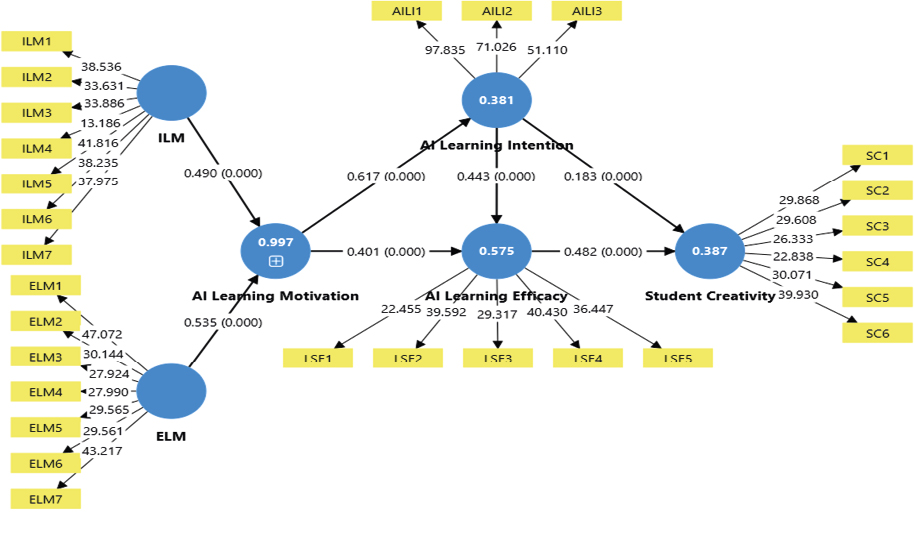
AILE is a mediator in the AILM-SC relationship (β = 0.193, t = 5.683, p = 0.000), and so is AILI for the AILM-SC relationship (β = 0.113, t = 3.121, p = 0.002). Additionally, a sequential pathway of mediation (i.e., AILM → AILI → AILE → SC) was confirmed (β = 0.132, t = 7.801, p = 0.000), indicating the complex effect of motivational constructs on student creativity via cognitive and behavioral intentions (Table 4). These findings support previous research emphasizing the importance of complex mediating pathways in learning and innovation models (Sarstedt et al., 2021).
3.3. Model Evaluation
Table 5 presents a critical examination of the structural model’s fit, explanatory power, and predictive validity using a range of assessment indicators. The model’s SRMR is 0.073, which is less than the widely referenced cutoff of 0.08, indicating a good model fit. Additionally, the Normed Fit Index (NFI) is 0.934, which exceeds the required minimum of 0.90, further supporting the model’s good goodness of fit (Hair et al., 2021).
|
Variables |
SRMR |
R2adj |
NFI |
Q²Predict |
Q² Effect |
|---|---|---|---|---|---|
|
AILM |
0.073 |
0.934 |
|||
|
AILI |
0.381 |
0.374 |
Large |
||
|
AILE |
0.575 |
0.452 |
Large |
||
|
SC |
0.387 |
0.531 |
Large |
||
|
Note: Standardized Root Mean Square Residual (SRMR); Normed Fit Index (NFI) |
|||||
The R²adj values assess the degree to which variance in the endogenous constructs is explained. AILE has an R²adj of 0.575, AILI has 0.381, and SC has 0.387, all representing a moderate to strong degree of explanatory power (Table 5). Cohen et al. (2013) argue that R²adj values of 0.26 or greater are substantial in behavioral studies. Thus, the model adequately explains student creativity and AI learning outcomes in terms of motivational, intentional, and efficacy-related predictors.
The Q²predict values, which estimate the model’s out-of-sample predictability using blindfolding methods, are also significant (Table 5). The AILI (Q²predict = 0.374), AILE (Q²predict = 0.452), and SC (Q²predict = 0.531) values, when combined, reflect a high predictive utility, far above the recommended threshold value of 0.35 as proposed by Hair et al. (2021). This shows that not only does the model adequately fit the observed data, but it also has high predictive utility, particularly for SC and AI learning constructs.
4. DISCUSSION, IMPLICATIONS, AND FUTURE DIRECTIONS
4.1. Discussions
This study examined the intricate relationship between AILM, AILI, AILE, and SC among Saudi Arabian undergraduate and graduate students. Based on Bandura’s (2001) SET, the findings demonstrate strong empirical support for the proposed theoretical model, with significant direct and mediating effects linking motivational, intentional, and efficacy measures to creative performance in AI-supported learning environments.
The findings strongly support the ground-level hypotheses formulated based on social cognitive theory. The strong positive effect of AILM on AILE (β = 0.401, p < 0.001, H1 supported) is fully consistent with theoretical models (Bandura, 2001; Wu et al., 2024; Mohammed et al., 2025) as well as previous empirical studies (Fitria et al., 2021). Students with intrinsic interests (e.g., pleasure in AI problem-solving) and extrinsic aspirations (e.g., career progression) invest cognitive resources and persistence into comprehending AI concepts and tools. Likewise, the strong pathway from AILI to AILE (β = 0.443, p < 0.001, H3 supported) indicates that intention is a strong antecedent of behavior (Bhatt et al., 2024; Wang et al., 2024). Students with strong intentions actively pursue learning experiences in AI education, thereby being confident in their capabilities (El-Shihy et al., 2025).
Moreover, the direct link from AILM to AILI (β = 0.617, p < 0.001, H2 supported) was significantly strong. This finding aligns with Chiu et al. (2024) and Wang et al. (2023), highlighting that motivation, including intrinsic interest and identified regulation, is the driving force behind the intended decision and commitment to engage in AI learning.
Furthermore, all three foundational constructs had significant direct impacts on SC. AILM (β = 0.438, p < 0.001, H4 supported) had the strongest direct impact, supporting the theoretical relationships between motivation and creativity (Hu, 2023; Hasibuan & Andina, 2023). Students with an interest in or perceived value of AI act autonomously, experiment, and probe, unleashing AI’s open-ended potential. AILE (β = 0.482, p < 0.001, H5 supported) also had a strong direct impact on SC, as reported by Mathisen et al. (2009) and Sun et al. (2020). High confidence in AI capabilities enables students to make cognitively risky decisions and persevere through iterative creative processes (Vieriu et al., 2025; Habib et al., 2024). While strong, the direct impact of AILI on SC (β = 0.183, p < 0.001, H6 supported) was comparatively weaker. This suggests that while the AILI prepares the stage for creative involvement, its direct demonstration in student’s creative outcomes may be a function of efficacy enhancement and high engagement enabled by that intention (Hasibuan & Andina, 2023; Li et al., 2022).
Findings reveal complex mediating processes that significantly support direct effects. A significant result in Table 4 demonstrates that AILE’s significant mediation between AILM-SC relationship (β = 0.193, p < 0.001), thus supporting H7. Motivation propels confidence-building (AILE) that enables students to creatively apply knowledge, experiment, and generate novel ideas (Abuakar et al., 2024; Jeilani et al., 2025). This suggests that AILE is a vital outcome and driver in translating motivational energy into creative performance.
AILI was a powerful mediator between AILM and SC (β = 0.113, p = 0.002, H8 confirmed). This finding is consistent with the studies of Chiu et al. (2024) and Kyselova (2024). These purposes are subsequently transformed into enduring, goal-oriented behavior, which necessitates and fosters cognitive flexibility and divergent thinking —the foundation of creativity (Hasibuan & Andina, 2023; Kim et al., 2022).
The most intricate and engaging result is the extensive sequential mediation path: AILM → AILI → AILE → SC (β = 0.132, p < 0.001, H9 supported). This finding outlines a dynamic psychological process: AILM initially spurs the creation of concrete AILI. These intentions give rise to long-term behavioral involvement (effort, challenge-seeking), which results in mastery experiences and enhanced robust AILE. Lastly, this accumulated confidence facilitates creative performance and problem-solving (SC). This sequential path aligns with the theoretical model proposed by Yue et al. (2022) and the empirical findings of Kyselova (2024) and Lin and Chen (2024).
4.2. Theoretical Implications
This study has robust theoretical implications for the theory of psychological determinants of SC in AI-integrated learning contexts, as outlined in self-efficacy theory (Bandura, 2001). The study provides strong empirical evidence for the fundamental assumptions of SCT in the specific and developing field of AI learning. The AILE’s robust mediating role between AILM and creativity presents it as a vital cognitive process through which student’s motivation is translated into creative outcomes. This finding confirms Bandura’s argument that self-efficacy is the significant link between individual’s personal and behavioral factors. It determines its relevance in technologically advanced learning environment that require creativity and problem-solving capability (Ghaleb et al., 2024). The serial mediation model, in which AILM gives rise to AILI, which in reciprocation stimulates the behavioral effort required to develop AILE and consequently produce SC. This finding further progresses the theory by specifying the cognitive and behavioral phases included in this transformational process in AI environment (Yue et al., 2022; Kyselova, 2024).
The study provides an important contribution to the theory by illustrating the AILI role. Although its direct creative effect, the outcome demonstrated it as a behavior facilitator (i.e., highest theoretical contribution). AILM is transformed into discreate learning intentions (AILI), which stimulates and sustain goal-directed behavior and determination for obtaining experiences. These are essential for the progression of a vigorous AILE, which directly effects to creative outcomes and risk-taking tendency (Chiu et al., 2024; Wang et al., 2024). Thus, based on SCT, AILI is not an outcome of motivation or a direct determinant but as the critical behavior connecting AILM to the AILE development required for individual’s creativity.
The study provides robust evidence regarding the theoretical significance of AILM as the key predictor in the association between AI learning and creativity. Its vast effect (i.e., directly influencing efficacy, intention, and creativity) endorses its vital role. These findings endorse behavioral theories claiming the significance of intrinsic motivation (intrinsically driven by interest and amusement) and identified regulation (recognition of the worth of AI learning) as crucial to create cognitive investment, autonomy, and the inclination to explore, that are essential in proficiently using sophisticated AI tools and to come up with creative outcomes (Ryan & Deci, 2000; Hu, 2023; Hasibuan & Andina, 2023). The findings validate that establishing healthy motivational orientations in AI is a theoretical imperative to unleash competence and creative power in technology-supported learning spaces.
4.3. Practical Implications
The findings of this study have significant and crucial implications for the Saudi educational system, its policymakers, students, and the successful implementation of the goals outlined in Vision 2030. For Saudi students to succeed in the future AI economy envisioned in Vision 2030, they need technical competence in AI, efficacy, and creativity.
The present study suggests that the evolution of intrinsic motivation to study AI’s problem-solving abilities, as well as the linking of AI skills to extrinsic motivators such as large employment opportunities, is necessary to activate this learning and unleash this innovation potential. The significant correlation between motivation, efficacy, intention, and creativity in this Saudi study extends beyond mere educational applicability and is essential to enable economic transformation.
Institutions such as SDAIA and the Ministry of Education should prioritize AI learning effectiveness as a national educational priority. Our research validates AILE as the causality between motivation and intention in students and concrete creative products. Policymakers must require and guide curriculum change towards open-ended, creative use of AI in all subjects beyond memorization. In addition, strong faculty development programs prepare teachers with the pedagogical skills to impart motivation, scaffold the development of efficacy, and enable the creation of innovative AI applications.
Saudi universities play a pivotal role in achieving Vision 2030’s objectives for human capital development. This paper compels HEIs beyond technical AI adoption to pedagogies specifically focused on maximizing AI effectiveness and creativity of learning. This includes developing experiment friendly environments, that provides individualized feedback and designing assignments that harness AI as a new tool for problem-solving and creativity. Moreover, it actively stimulates student intention (AILI) by illustrating AI’s relevance to various career paths in the Saudi context and developing a culture that encourages and supports the responsible use of AI.
4.4. Ethical Implications
The inclusion of AI in learning has vast potential to enhance student learning outcomes, complement motivation, increase efficiency, and augment creativity. Nevertheless, the exponential takeoff and general dominance of AI pose immense ethical challenges requiring serious reflections from learning institutions to guarantee sustainable uses of the technologies. Moral imperatives take center stage in reference to Saudi Vision 2030, which promotes digital transformation but emphasizes social responsibility and inclusiveness.
One major moral concern with the integration of AI in academic settings is the management of students ‘ sensitive information. AI technologies tend to require wide data samples comprising personal, behavioral, and academic data to offer an individualized learning experience. Lacking proper data protection policies, such information becomes vulnerable to leakage or abuse, thereby compromising students’ data privacy and their right to informed consent (Williamson & Eynon, 2020). In universities, the formation of digital trust requires strict data protection legislation observance, transparency in data use policies, and technical measures to prevent unlawful data access. In the case of Saudi Arabia, the data and AI regulatory framework established by the Saudi Data and Artificial Intelligence Authority (SDAIA) broadly focuses on proper use and moral management of educational technologies.
Moreover, the use of machine learning tends to inadvertently perpetuate stereotypes or perpetuate present prejudices when it is trained on biased dataset samples (Onebunne & Alade, 2024). For educational purposes, biased algorithms present unequal opportunities, disadvantaging students according to traits such as gender, socioeconomic background, or linguistic ability. Addressing such problems requires incorporating transparency in the algorithms’ design, the use of diversified sample dataset collections, and implementing regular equity audits. Moreover, there is a need for faculty staff to ensure AI literacy amongst themselves and their students in order to raise awareness and critical scrutiny of underlying AI-related prejudices inherent in educational content (Pratiwi et al., 2025).
The growing use of generative AI technologies, especially Large Language Models (LLMs), has registered great fears concerning academic integrity. Even though these technologies present promises of enriching innovative learning experience, they also present threats through ease of plagiarism and shifting critical assignments from students to AI programs (Cotton et al., 2023). This development calls into question the conventional methods of assessment, with a need for higher learning institutions to devise modern ways of fostering AI’s ethical use. Higher learning institutions should set policies to balance AI’s benefits with the need for originality, critical thinking, and ethical behavior. Teachers should encourage the proper use of AI through planning assessments with an emphasis on reflective learning, collaborative tasks, and creativity-based assignments, so reducing the incidence of academic dishonesty.
Lastly, the granting of fair access to AI-improved learning materials represents an underlying moral issue. Gaps in digital skills, linguistic competence, and socioeconomic status can play barrier roles in fomenting existing disparities (Okada et al., 2025). To promote equal access to AI resources for all students, learning organizations should implement capacity-building projects, affordable tech-based solutions, and remedial actions to support disadvantaged groups. This argumentative stance aligns with the current exhortation to overhaul education, focusing on digital equity, and closely adheres to Saudi Arabian Vision 2030, which aims to ensure fair play for everyone through equal opportunities.
4.5. Future Directions and Limitations
Based on the present study, it is recommended that future studies be repeated with K-12 and vocational students in Saudi Arabia to understand developmental differences regarding AI motivation, efficacy, and creativity channels. Additionally, cross-Gulf Cooperation Council (GCC) comparative analyses may reveal culture-specific moderators present within common regional mindsets. Employ longitudinal designs to trace the development of AILM, AILI, AILE, and SC as learners progress through AI-based learning programs. Experimental research is necessary to test causal relationships and determine the impact of specific instructional approaches (e.g., project-based vs. tool-based AI instruction) on creativity. Examine how certain institutional conditions (e.g., AI infrastructure quality, faculty knowledge), pedagogical models, and task features mediate the established paths, with a focus on creativity development. Investigate the roles of factors such as AI anxiety, initial digital literacy, cultural learning dimensions, and the ethical aspects of AI.
Moreover, the study has socio-economic and cultural limitations that requires to be acknowledged. The Saudi Arabian higher education sector is part of a distinct socio-economic environment. It is devised by Vision 2030 restructuring including rapid digital transformation, and variation in the across regions accessibility to high-end infrastructural technologies. These structural variations obstruct learner’s opportunities, motivation, and potential to creatively express themselves in AI learning contexts. Additionally, distinctive Saudi Arabia’s sociocultural characteristics (i.e., collectivist orientation, high power distance, and gender-based roles) may also obstruct the student’s way to decode and enhance motivation and efficacy into valuable results. Therefore, this motivation pattern may establish differently within less collectivist or egalitarian cultural contexts. Future studies should explore various cross-cultural contexts and integrate socio-economic diversity, consenting the exploration of the structural forces and cultural forces interactions on AILM, AILE, AILI, and SC. Thus, deeper insights will be gained concerning the applicability of these findings across various foreign higher education paradigms.
5. CONCLUSION
This research provides substantial empirical support regarding the complex interactions among AILM, AILI, AILE, and SC within the context of higher education in Saudi Arabia. The results validate the suggested hypotheses, delivering both broader theoretical and practical implications. From a theoretical perspective, the findings enhance self-efficacy theory by delineating a sequential framework (AILM → AILI → AILE → SC) through which motivational factors are converted into creativity. This contribution enriches the existing literature on technology-enhanced learning by elucidating the process through which motivational and intentional dimensions evolve into efficacy and, eventually, creativity outputs. Practically, the outcomes present explicit recommendations for Saudi universities and policymakers aiming to achieve the objectives of Vision 2030, rendering the study immediately pertinent and stimulating. Encouraging learning motivation, ensuring the transformation of intention into sustained learning behaviors, and creating opportunities to develop AILE represent essential measures. Such interventions have the potential to nurture SC and prepare students for engagement in an evolving digital workforce. Through the implementation of these strategies, universities can furnish students with the requisite adaptive skills and innovative mindset needed to succeed in AI-driven academic and professional landscapes, thereby enhancing both national and global competitiveness.
DECLARATIONS
Ethics Statement: Participants were provided written assurance of their anonymity. They were also informed of the research purpose and how the data would be utilized. All participants gave their consent (by reading the introductory paragraph of the questionnaire) for inclusion before participating in the study.
Conflict of Interest Statement/Competing Statement: The authors certify that they have no affiliations or involvement in any organization with any financial or non-financial interest in the subject matter or materials discussed in this manuscript.
Data Availability Statements: The data supporting the research findings are not publicly available but can be obtained from the corresponding author upon request.
Informed Consent Statement: Informed consent was obtained from all participants involved in the study through the survey form.
Author contributions: Conceptualization: [Dr. Komal Khalid]; Methodology: [Dr. Komal Khalid]; Data Collection: [Ms. Juri Alsini]; Formal Analysis and Investigation: [Dr. Komal Khalid]; Writing – Original Draft Preparation: [Dr. Komal Khalid, Ms. Juri Alsini]; Writing – Review and Editing: [Dr. Komal Khalid]; Supervision: [Dr. Komal Khalid]. The authors followed COPE guidelines.
REFERENCES
. (2024). Perceived Influence of Artificial Intelligence on Educational Leadership’s Decision-Making, Teaching, and Learning Outcomes: A Transcendental Phenomenological Study. PhD Dissertation, Liberty University, Lynchburg, Virginia. https://doi.org/10.1080/10494820.2025.2563089
., ., & . (2024). The influence of technology-integrated curriculum resources on student engagement and academic achievement in higher education. Advances in Mobile Learning Educational Research, 4(2), 1208-1223. https://doi.org/10.25082/AMLER.2024.02.014
., ., ., ., ., ., ., ., . (2025). The mediating roles of academic stress, critical thinking, and performance expectations in the influence of academic self-efficacy on AI dependence: a case study among college students. Computers and Education: Artificial Intelligence, 8, 100381. https://doi.org/10.1016/j.caeai.2025.100381
., & . (2023). Prospers and obstacles in using artificial intelligence in Saudi Arabia higher education institutions—The potential of AI-based learning outcomes. Sustainability, 15(13), 10723. https://doi.org/10.3390/su151310723
., ., ., ., ., & . (2024). The effect of emotional intelligence and fostering creativity on entrepreneurship, business administration: Mediating role of innovation and intrinsic motivation, Uncertain Supply Chain Management 12, 1511–1524. https://doi.org/10.5267/j.uscm.2024.4.001
. (2001). Social cognitive theory: An agentic perspective. Annual Review of Psychology, 52(1), 1–26. https://doi.org/10.1146/annurev.psych.52.1.1
., & . (2021). Technology-enhanced creativity: A multiple case study of digital technology-integration expert teachers’ beliefs and practices. Thinking Skills and Creativity, 39, 100791.
., & . (2025). Attitudes, perceptions and AI self-efficacy in K-12 education. Computers and Education: Artificial Intelligence, 8, 100358. https://doi.org/10.1016/j.caeai.2024.100358
., & . (2024). AI learning intention, learning engagement and behavioral outcomes: An empirical study. Journal of Management Development, 43(6), 920–938. https://doi.org/10.1108/JMD-05-2024-0173
., ., ., & . (2024). Development and validation of the artificial intelligence learning intention scale (AILIS) for university students. Sage Open, 14(2), 1–16. https://doi.org/10.1177/21582440241242188
., ., & . (2025). Can artificial intelligence support creativity in early design processes? International Journal of Architectural Computing, 23(1), 122–136. https://doi.org/10.1177/14780771241254637
., ., ., & . (2024). Teacher support and student motivation to learn with Artificial Intelligence (AI) based chatbot. Interactive Learning Environments, 32(7), 3240–3256. https://doi.org/10.1080/10494820.2023.2172044
., ., ., & . (2013). Applied Multiple Regression/ Correlation Analysis for the Behavioral Sciences. Routledge. https://doi.org/10.4324/9780203774441
., & . (2012). Computational creativity: The final frontier? ECAI 2012. IOS Press, 21–26.
., ., & . (2023). Chatting and cheating: Ensuring academic integrity in the era of ChatGPT. Innovations in Education and Teaching International, 60(1), 1–13. https://doi.org/10.1080/14703297.2023.2190148
., & . (2025). The role of AI personalization in shaping students’ decision-making: The mediating role of students’ intentions and the moderating effect of academic technology experience in higher education. The Arab Journal of Administration, 46(1), 1–18. https://doi.org/10.21608/aja.2025.352984.1779
., & . (2022). How does a creative learning environment foster student creativity? An examination of multiple explanatory mechanisms. Current Psychology, 41(7), 4667-4676. https://doi.org/10.1007/s12144-020-00974-z
. (2021, December). Artificial intelligence (AI) in education: Using AI tools for teaching and learning process. In Prosiding Seminar Nasional & Call for Paper STIE AAS (pp. 134–147).
., & . (1981). Evaluating structural equation models with unobservable variables and measurement error. Journal of Marketing Research, 18(1), 39–50. https://doi.org/10.1177/002224378101800104
. (2010). The philosophy of creativity. Philosophy Compass, 5(12), 1034–1046. https://doi.org/10.1111/j.1747-9991.2010.00351.x
., ., ., & . (2024). How does generative artificial intelligence impact student creativity? Journal of Creativity, 34(1), 100072. https://doi.org/10.1016/j.yjoc.2023.100072
., ., ., ., ., . (2021). The seminar package. Partial least squares structural equation modeling (PLS-SEM) using R: A workbook, 49–74. https://doi.org/10.1007/978-3-030-80519-7
., & . (2023). Analyzing the potential of artificial intelligence (AI) in personalizing learning to foster creativity in students. Enigma in Education, 1(1), 6–10. https://doi.org/10.61996/edu.v1i1.2
. (2023). An exploration of the key determinants for the application of AI-enabled higher education based on a hybrid Soft-computing technique and a DEMATEL approach. Expert Systems with Applications, 212, 118762.
., & . (2025). The influence of generative artificial intelligence on creative cognition of design students: A chain mediation model of self-efficacy and anxiety. Frontiers in Psychology, 15, 1455015.
., & . (2024). Artificial intelligence as a tool for creativity. Journal of Creativity, 34(2), 100079. https://doi.org/10.1016/j.yjoc.2024.100079
., & . (2025). Perceived institutional support and its effects on student perceptions of AI learning in higher education: The role of mediating perceived learning outcomes and moderating technology self-efficacy. Frontiers in Education (10). Frontiers Media SA. https://doi.org/10.3389/feduc.2025.1548900
., ., & . (2022). Learning design to support student-AI collaboration: Perspectives of leading teachers for AI in education. Education and Information Technologies, 27(5), 6069–6104. https://doi.org/10.1007/s10639-021-10831-6
. (2024). Implementing project-based learning using artificial intelligence. Problems of Modern Transformations,4, 1-7. https://doi.org/10.54929/2786-9199-2024-4-06-02
., ., & . (2020). The relationships between self-efficacy, task value, and self-regulated learning strategies in massive open online courses. International Review of Research in Open and Distributed Learning, 21(1), 23–39. https://doi.org/10.19173/irrodl.v20i5.4389
. (2022). The impact of AI programming motivation on computational creativity: An empirical study in high school. Computers & Education, 187, 104547.
., & . (2024). Artificial intelligence (AI)-integrated educational applications and college students’ creativity and academic emotions: Students and teachers’ perceptions and attitudes. BMC Psychology, 12(1), 487. https://doi.org/10.1186/s40359-024-01979-0
., ., & . (2022). Creativity and artificial intelligence—A student perspective. Journal of Intelligence, 10(3), 65. https://doi.org/10.3390/jintelligence10030065
., & . (2009). Creative self-efficacy: An intervention study. International Journal of Educational Research, 48(1), 21–29. https://doi.org/10.1016/j.ijer.2009.02.009
., ., ., ., & . (2025). Empowering the faculty of education students: Applying AI’s potential for motivating and enhancing learning. Innovative Higher Education, 50, 587-607. https://doi.org/10.1007/s10755-024-09747-z
., ., ., & . (2025). Fostering transversal skills through open schooling supported by the CARE-KNOW-DO pedagogical model and the UNESCO AI competencies framework. International Journal of Artificial Intelligence in Education, 1-46. https://doi.org/10.1007/s40593-025-00458-w
., & . (2024). Bias and Fairness in AI Models: Addressing Disparities in Machine Learning Applications. International Research Journal of Modernization in Engineering Technology and Science, 6(09), 1921-1934. https://www.doi.org/10.56726/IRJMETS61692
., ., ., ., & . (2025). Transforming Learning or Creating Dependency? Teachers’ Perspectives and Barriers to AI Integration in Education. Journal of Pedagogical Research, 9(2), 127-142. https://doi.org/10.33902/JPR.202531677
., ., ., ., ., & . (2020). Usage of social media, student engagement, and creativity: The role of knowledge sharing behavior and cyberbullying. Computers & Education, 159, 104002. https://doi.org/10.1016/j.compedu.2020.104002
., & . (2000). Intrinsic and extrinsic motivations: Classic definitions and new directions. Contemporary Educational Psychology, 25(1), 54–67. https://doi.org/10.1006/ceps.1999.1020
., ., ., & . (2025). AI in education: Personalized learning systems and their impact on student performance and engagement. The Critical Review of Social Sciences Studies, 3(1), 2445–2459. https://doi.org/10.59075/c35qa453
., ., & . (2021). Partial least squares structural equation modeling. In Handbook of market research (pp. 587–632). Cham: Springer International Publishing. https://doi.org/10.1007/978-3-319-57413-4_15
., & . (2025). EFL students’ motivation predicted by their self-efficacy and resilience in artificial intelligence (AI)-based context: From a self-determination theory perspective. Learning and Motivation, 91, 102151. https://doi.org/10.1016/j.lmot.2025.102151
., ., & . (2020). Effects of divergent thinking training on students’ scientific creativity: The impact of individual creative potential and domain knowledge. Thinking Skills and Creativity, 37, 100682. https://doi.org/10.1016/j.tsc.2020.100682
., ., & . (2017). Testing and controlling for common method variance: A review of available methods. Journal of Management Sciences, 4(2), 142-168.https://doi.org/10.20547/jms.2014.1704202
., & . (2008). Sources of self-efficacy in school: Critical review of the literature and future directions. Review of educational research, 78(4), 751-796. https://doi.org/10.3102/0034654308321456
., & . (2025). The impact of artificial intelligence (AI) on students’ academic development. Education Sciences, 15(3), 343. https://doi.org/10.3390/educsci15030343
., ., ., & . (2023). University students’ intentions to learn artificial intelligence: The roles of supportive environments and expectancy-value beliefs. International Journal of Educational Technology in Higher Education, 20(1), 51. https://doi.org/10.1186/s41239-023-00417-2
., ., ., ., & . (2024). What drives students’ AI learning behavior: A perspective of AI anxiety. Interactive Learning Environments, 32(6), 2584–2600.
., & . (2020). Historical threads, missing links, and future directions in AI in education. Learning, Media and Technology, 45(3), 223–235. https://doi.org/10.1080/17439884.2020.1798995
., ., ., ., & . (2024). Unlocking potential: Key factors shaping undergraduate self-directed learning in AI-enhanced educational environments. Systems, 12(9), 332. https://doi.org/10.3390/systems12090332
., ., & . (2022). Pedagogical design of K-12 artificial intelligence education: A systematic review. Sustainability, 14(23), 15620. https://doi.org/10.3390/su142315620
., & . (2025). Enhancing EFL learners’ engagement and motivation through immersive technologies: The role of artificial intelligence, augmented reality, virtual reality, and mobile applications. European Journal of Education, 60(2), e70128. https://doi.org/10.1111/ejed.70128