Prácticas remotas inteligentes: un estudio cualitativo del PREVIEW RIB y el papel estructurante de la inteligencia artificial educativa
Intelligent Remote Internships: A Qualitative Study of the PREVIEW RIB and the Structuring Role of Educational AI
Francisco José García-Peñalvo
Research GRoup in InterAction and eLearning (GRIAL)
Research Institute for Educational Sciences (IUCE)
University of Salamanca
Ana María Pinto-Llorente
Research GRoup in InterAction and eLearning (GRIAL)
Research Institute for Educational Sciences (IUCE)
University of Salamanca
Sonia Verdugo-Castro
Research GRoup in InterAction and eLearning (GRIAL)
Research Institute for Educational Sciences (IUCE)
University of Salamanca
Lucía García-Holgado
Research GRoup in InterAction and eLearning (GRIAL)
Research Institute for Educational Sciences (IUCE)
University of Salamanca
RESUMEN
La expansión de las prácticas de trabajo en remoto ha transformado el aprendizaje integrado en el trabajo en la educación superior, incluidas las prácticas universitarias. Aunque las prácticas remotas adquirieron visibilidad tras la pandemia de la COVID-19, la investigación empírica sobre su diseño pedagógico, las percepciones de los actores implicados y su implementación institucional sigue siendo limitada. Este estudio aborda esta laguna analizando las percepciones de los grupos de interés sobre las prácticas remotas y examinando el PREVIEW Remote Internship Blueprint (RIB) como una infraestructura pedagógica que puede apoyar la transición de las prácticas remotas convencionales a las prácticas remotas inteligentes. Se adoptó un diseño cualitativo fenomenológico. Los datos se recogieron mediante grupos focales con estudiantes, mentores de empresa y supervisores académicos de cinco instituciones europeas de educación superior. Se aplicaron análisis de contenido, análisis semántico y un marco DAFO mediante software CAQDAS. Los resultados indican que las prácticas remotas se perciben como viables y pedagógicamente significativas cuando están diseñadas de forma intencional y cuentan con un apoyo adecuado, especialmente en cuanto a la flexibilidad, la accesibilidad, la internacionalización y el desarrollo de competencias digitales y transversales. Al mismo tiempo, los participantes señalaron desafíos vinculados a una menor interacción social, a riesgos de aislamiento, a una capacidad desigual de mentorización y a dificultades para proporcionar retroalimentación formativa oportuna y evaluar competencias transversales a escala. A partir de estas evidencias cualitativas, se discute cómo las fases estructuradas, los roles y los puntos de seguimiento definidos en el PREVIEW RIB lo convierten en un marco preparado para la inteligencia artificial, permitiendo que la analítica de aprendizaje y la inteligencia artificial educativa refuercen el seguimiento, la personalización, la evaluación formativa y la coordinación universidad–empresa, manteniendo la agencia humana y alineándose con principios éticos y de sostenibilidad.
PALABRAS CLAVE
Prácticas remotas inteligentes; inteligencia artificial educativa; analítica del aprendizaje; aprendizaje integrado en el trabajo; educación superior; investigación cualitativa; competencias digitales.
ABSTRACT
The expansion of remote work practices has transformed work-integrated learning in higher education, including university internships. Although remote internships gained visibility after the COVID-19 pandemic, empirical research on their pedagogical design, stakeholder perceptions, and institutional implementation remains limited. This study addresses this gap by analysing stakeholders’ perceptions of remote internships and examining the PREVIEW Remote Internship Blueprint (RIB) as a pedagogical infrastructure that can support the transition from conventional remote internships to intelligent remote internships. A qualitative phenomenological design was adopted. Data were collected through focus groups with students, company mentors, and academic supervisors from five European higher education institutions. Content analysis, semantic analysis, and a SWOT framework were applied using CAQDAS software. Findings indicate that remote internships are perceived as viable and pedagogically meaningful when intentionally structured and adequately supported, particularly in relation to flexibility, accessibility, internationalisation, and the development of digital and transversal competences. At the same time, participants reported challenges related to reduced social interaction, risks of isolation, uneven mentoring capacity, and difficulties in providing timely formative feedback and assessing transversal competences at scale. Building on these qualitative insights, the study discusses how the structured phases, roles, and evidence flows defined in the PREVIEW RIB make it artificial intelligence-ready, enabling learning analytics and educational AI to enhance monitoring, personalisation, formative assessment, and university–enterprise coordination while maintaining human agency and aligning with ethical and sustainability principles.
KEYWORDS
Intelligent remote internships; educational artificial intelligence; learning analytics; work; integrated learning; higher education; qualitative research; digital competences.
1. INTRODUCTION
Digital technologies have rapidly reshaped contemporary societies, affecting work organisation, professional practices, and education systems. Advances in digital technologies, computing power, and artificial intelligence have driven the so-called Fourth Industrial Revolution, characterised by global interconnectivity, automation, and digitally mediated collaboration (García-Peñalvo et al., 2024; González-Pérez & Ramírez-Montoya, 2022). As physical and virtual environments increasingly overlap, new organisational models and flexible work arrangements have emerged (Zoppelletto et al., 2023).
These transformations have redefined the skills and competences required for labour market participation. Digitalisation has created opportunities for innovation, efficiency, and new business models, while also generating challenges such as digital skills gaps, organisational resistance, and cybersecurity risks (Bouwmans et al., 2024; Suharto, 2024). Recent literature highlights the growing relevance of transversal, digital, and socio-emotional competences, including adaptability, collaboration, and self-regulation, in digitally mediated and hybrid work environments (Bersin et al., 2021; Sawatzky & Sawatzky, 2022). Labour markets have been particularly affected: rigid hierarchical structures have progressively given way to more agile, project-based, and collaborative models in which digital tools mediate communication and task coordination (Restrepo, 2023), while automation has increased the importance of higher-order cognitive, social, and digital competences, shifting professional development towards creativity, autonomy, adaptability, and lifelong learning.
The COVID-19 pandemic accelerated these transformations by prompting the widespread adoption of remote working solutions and the rapid expansion of digital infrastructures, including in organisations previously reluctant to telework (García-Peñalvo et al., 2021; Izquierdo-Álvarez & Pinto-Llorente, 2021; Yang et al., 2022). Since then, hybrid and remote work arrangements have become stable components of contemporary labour models rather than temporary crisis responses (Simovic, 2024; Zhou, 2024). In this context, higher education institutions have had to reconsider their role in preparing students for digital and hybrid professional environments.
Work-integrated learning, particularly external placements, has therefore gained relevance as a mechanism for aligning academic training with evolving labour market demands. Although internships have traditionally been associated with physical presence in workplaces, they are increasingly being reconfigured to include remote and hybrid modalities, enabling participation beyond geographical constraints (Irwin et al., 2022). Prior research highlights several potential advantages of remote internships, including greater accessibility and inclusion for students facing economic, personal, or mobility-related barriers (Irwin et al., 2022; Pretti et al., 2020), support for the development of digital communication, collaboration, and self-regulation skills valued in contemporary labour markets (Jakopec & Aparac Jelušić, 2024; Jeske & Linehan, 2020; Kakkar et al., 2024), and opportunities for internationalisation through cross-border collaboration without physical relocation (Gamage, 2022).
At the same time, the shift from face-to-face to remote or hybrid internship modalities represents a significant change in educational practice. Several authors describe this transition as a milestone in the evolution of internships, reflecting a move towards more flexible and digitally mediated forms of professional learning (Bilderback & Kilpatrick, 2024; MacRae & Sawatzky, 2020). However, the literature also identifies persistent challenges associated with remote internship models, including reduced informal learning opportunities, limited social interaction, difficulties in supervision and mentoring, risks of student isolation, and challenges related to assessment and quality assurance (Jeske & Linehan, 2020; Srivastava et al., 2024). Concerns also remain regarding the extent to which remote internships can reproduce the experiential richness of face-to-face placements, particularly in disciplines that rely heavily on interpersonal interaction or hands-on practice (Irwin et al., 2022).
From a pedagogical perspective, remote internships can be understood within broader theories of learning that extend beyond traditional classroom and workplace boundaries. The concept of expanded learning conceptualises learning as a process occurring across interconnected physical, digital, and social spaces, supported by technological mediation and collaborative practices (Elkington & Dickinson, 2025). This view aligns with situated learning theory, which emphasises that knowledge is constructed through participation in authentic practices and communities of practice (Lave & Wenger, 1991). Internships have long been recognised as situated learning experiences in which students learn through participation in real-world work contexts and reflection on their activities (Riley et al., 2024). In remote internships, the conditions are transformed rather than eliminated, as participation is mediated through digital platforms, collaborative tools, and mentoring structures that require intentional design to sustain engagement and continuity of learning.
Research on technology-mediated education supports the effectiveness of digital learning environments when they are structured around clear objectives, active methodologies, and sustained support mechanisms (Jeske & Linehan, 2020). In internship contexts, educational quality depends not only on task content, but also on organisational coherence, supervision practices, and opportunities for feedback and reflection. The virtualisation of internships therefore requires a reconfiguration of pedagogical and organisational elements rather than implying an inherent reduction in educational quality. This distinction echoes the differentiation between emergency remote practices and intentionally designed digital learning experiences highlighted in the literature (Hodges et al., 2020).
1.1. From conventional remote internships to intelligent remote internships
Building on this distinction, it is useful to differentiate between conventional remote internships and intelligent remote internships. Conventional remote internships are characterised by the technological mediation of space and time: communication, coordination, and supervision take place through basic digital tools that enable remote participation, but without a systematic layer of data-informed educational support. By contrast, intelligent remote internships incorporate learning analytics and Educational AI as a transversal support layer explicitly aimed at strengthening learning quality, equity, and formative effectiveness. In this view, “intelligence” lies not in technology itself, but in its capacity to provide timely, actionable information that improves pedagogical and organisational decision-making while preserving the central role of human actors.
Accordingly, the transition towards intelligent remote internships is framed here not as a technocratic upgrade, but as an evolution in pedagogical infrastructure. Structured processes, coherent learning outcomes, and transparent monitoring points create the conditions for data-informed support that is proactive rather than reactive, and personalised, without undermining curricular coherence.
1.2. Converging theoretical foundations for integrating Educational AI in remote internships
The integration of educational AI into intelligent remote internships can be grounded in converging learning and assessment perspectives already used to interpret work-integrated learning in digitally mediated contexts. Situated learning suggests that sustained participation in professional communities, even when digitally mediated, requires intentional scaffolding and feedback loops that support legitimate participation over time. Self-regulated learning is especially salient in remote formats, where learners must manage goals, time, motivation, and engagement; data-informed feedback can support monitoring and metacognitive regulation. Formative assessment emphasises continuous feedback and iterative improvement, while educational AI can assist by organising and summarising evidence of learning to enable more timely and targeted human feedback. Learning analytics, in turn, provides an empirical basis for understanding and enhancing learning processes through traces generated during participation, communication, and task completion.
Taken together, these perspectives support a view of remote internships as learning environments whose quality depends on structured monitoring, feedback, coordination, and equitable conditions for participation. Within this framework, educational AI may be considered a complementary support layer rather than a replacement for human mentoring and academic judgment.
Equity and inclusion are also central to discussions of remote internships. Virtual placements have been shown to reduce barriers associated with traditional internships, including financial constraints, caregiving responsibilities, disabilities, and mobility limitations (Irwin et al., 2022; Pretti et al., 2020). However, this inclusive potential depends on institutions ensuring equitable access to digital infrastructure, appropriate devices, and continuous academic and technical support.
From an institutional and organisational perspective, implementing remote internships requires new capabilities and governance structures. Universities must establish clear protocols, define roles and responsibilities, and provide training for academic supervisors working in virtual environments. Host organisations, in turn, need to adapt onboarding, supervision, and evaluation processes to integrate interns effectively into digital workflows. The absence of clear structures and expectations has been identified as a key risk factor affecting the quality and sustainability of remote internships.
Competence development emerges as a unifying element across these discussions. The literature consistently highlights the importance of transversal competences such as digital literacy, communication, collaboration, adaptability, and autonomous organisation for effective participation in remote and hybrid work environments (Bersin et al., 2021; Sawatzky & Sawatzky, 2022). These competences are closely linked to professional resilience in increasingly dynamic labour markets.
Experiential and situated learning perspectives further support this interpretation by emphasising that professional knowledge develops through meaningful practice, reflection on action, and interaction with authentic work contexts. Accordingly, remote internships should be seen not merely as digitally delivered alternatives to in-person placements, but as valid settings for work-integrated learning when they enable purposeful engagement with professional tasks, structured guidance, and opportunities for reflection and feedback. This helps explain how competences may develop in remote environments through the interplay of activity, supervision, and contextualised participation.
The transition towards intelligent remote internships can likewise be framed through a human–AI collaboration perspective. Educational AI should not replace supervision, mentoring, or academic judgement, but serve as an additional pedagogical support layer for monitoring, feedback, and coordination. Its value lies less in automation than in enhancing the quality, timeliness, and coherence of pedagogical decision-making in digitally mediated internship environments. Intelligent remote internships may therefore be understood as structured remote learning settings in which AI supports formative processes and organisational coordination while preserving human agency, academic responsibility, and the relational dimension of learning.
This also requires careful attention to ethics and governance. AI use in these contexts should be guided by transparency, data privacy, human oversight, and proportionality, so that technological support does not undermine student agency or reduce educational processes to automated monitoring. From this perspective, the educational value of AI depends not only on its technical capabilities, but also on its integration within responsible pedagogical and institutional frameworks.
1.3. Bridge to PREVIEW RIB (AI-ready infrastructure)
Against this background, the move towards intelligent remote internships depends on pedagogically robust frameworks that clearly define phases, roles, learning outcomes, and monitoring processes, thereby enabling coherent decision points and structured educational evidence. In this sense, the PREVIEW Remote Internship Blueprint (RIB) can be understood not only as a design framework for quality remote internships, but also as an AI-ready pedagogical infrastructure: its structured phases, explicit stakeholder roles, learning outcomes, and quality assurance logic provide a basis for integrating educational AI as a supportive layer that enhances human mentoring, coordination, and formative follow-up without altering the underlying pedagogical rationale.
At the European level, initiatives such as the VALS project demonstrate the potential of structured university-industry collaboration models supported by digital technologies and open innovation principles (García-Peñalvo et al., 2016). Building on this background, the European project PREVIEW aims to address existing gaps by developing a coherent, inclusive, and scalable model for remote internships through the PREVIEW RIB. It integrates pedagogical, organisational, and technological dimensions, emphasising stakeholder coordination, mentoring structures, learning outcomes, and quality assurance as central components of remote internship design.
Within this framework, the present study analyses stakeholders’ perceptions of remote internships across five European higher education institutions. Using a qualitative, phenomenological approach, it examines experiences, expectations, and concerns related to remote internships and assesses the perceived relevance of the PREVIEW RIB. The study is guided by the following research question: What are the perceptions of students, academic supervisors, and company mentors regarding remote internship experiences and the design of the PREVIEW RIB?
2. METHOD
2.1. Objective and Research Question
This study examines the perceptions of key stakeholders involved in remote internships, including students, company mentors, and academic supervisors and coordinators, regarding remote internship experiences and the design of the PREVIEW RIB.
Conducted within the European project PREVIEW, it involved five partner institutions: Academia de Studii Economice din București (ASE), Nevşehir Hacı Bektaş Veli University (NEVU), the University of Salamanca (USAL), the Consiglio Nazionale delle Ricerche (CNR), and the Università degli Studi di Sassari (UNISS).
The research was guided by the following question: What are the perceptions of stakeholders involved in curricular and extracurricular internships regarding remote internship experiences and the design of the PREVIEW RIB?
2.2. Research Design
A qualitative phenomenological design was adopted to explore participants’ experiences and interpretations of educational and professional practices (García-Holgado et al., 2021; Verdugo-Castro et al., 2020). The study followed a descriptive qualitative orientation, prioritising contextual understanding and meaning over statistical inference (Hernández Sampieri et al., 2014).
After data collection, data reduction and transformation procedures were applied to support analytical clarity and interpretative synthesis (Miles & Huberman, 1984). The analysis combined classical content analysis, semantic analysis, and a SWOT framework to capture complementary dimensions of participants’ discourse (Andréu Abela, 2000).
The study population included students, company mentors, and academic supervisors and coordinators from the five partner institutions. Participants were recruited through expert sampling (Hernández Sampieri et al., 2014), a non-probabilistic strategy commonly used in qualitative research to access information-rich cases and informed perspectives.
Expert sampling was considered appropriate because participants’ direct involvement in internship processes and institutional roles enabled the analysis to capture stakeholder-specific experiences, expectations, and concerns related to remote internships.
This sampling strategy has limitations. As a non-probabilistic approach, it does not aim for statistical representativeness. Findings should therefore be interpreted in terms of analytical transferability rather than generalisability. Potential sources of bias include institutional context and self-selection effects. These limitations were addressed through the inclusion of multiple institutions from different European contexts and the deliberate representation of three stakeholder profiles.
The final sample consisted of 41 participants, aged 18 to 65 years, including 26 men and 15 women. Nine participants were affiliated with ASE, ten with NEVU, nine with USAL, five with CNR, and eight with UNISS. The sample included students, company mentors, academic supervisors, and academic supervisors with coordination responsibilities, ensuring the representation of both educational and organisational perspectives.
2.3. Data Collection
Data were collected through five focus groups conducted between May and June 2023. Organised by the five partner institutions, each group included five to ten participants, allowing interaction while maintaining conditions for in-depth discussion. Sessions were conducted online or face to face, depending on local preferences and logistical conditions.
A shared protocol ensured procedural consistency across institutions by defining the main discussion topics, facilitation guidelines, and steps for preparing the data for analysis.
Ethical procedures were applied throughout the data collection process. All participants received information about the study’s purpose and procedures, provided informed consent before participation, and were informed that the data would be anonymised and analysed in aggregated form. All focus group sessions were recorded and later transcribed for analysis.
Each focus group followed a three-stage structure: first, participants discussed their perceptions of remote internships, including their advantages, limitations, and the conditions necessary for effective implementation; second, facilitators presented the PREVIEW project and the PREVIEW RIB to establish a common reference framework; third, participants provided feedback on the RIB, focusing on clarity, feasibility, and suggestions for improvement and evaluation.
2.4. Data Analysis
Data analysis followed an iterative and systematic process. An initial category system was developed deductively from the PREVIEW RIB and the literature on remote internships, then refined inductively through close reading of the transcripts and the identification of emerging themes. NVivo was used to support coding, organisation, and retrieval of coded segments.
Content analysis was used to identify stakeholder perspectives, recurrent themes, and institutional specificities. Semantic analysis examined frequently used concepts and their associations within participants’ discourse. A SWOT framework was applied to synthesise perceived strengths, weaknesses, opportunities, and threats related to remote internships, integrating internal and external factors relevant to programme design and implementation.
To support analytical rigour, the research team iteratively reviewed codes and category definitions to improve consistency and transparency. Intercoder agreement statistics were not calculated because of the study’s exploratory and interpretive nature. Credibility was supported through triangulation across stakeholder groups and the use of three analytical lenses: content, semantic, and SWOT.
3. RESULTS
The qualitative analysis produced a structured category system organised around the meta-category Remote Internships, comprising ten main categories and related subcategories (Figure 1). These categories reflect key dimensions of remote internship experiences, including perceptions, expectations, organisational arrangements, support mechanisms, and evaluation criteria.

3.2. Content Analysis
3.2.1. Opinion
Participants expressed diverse views on remote and face-to-face internships. Remote internships were generally considered feasible, although their applicability varied across disciplines, especially in areas requiring intensive interpersonal interaction: “There are areas where it is not possible to work online” (ASE_7).
Hybrid models were seen as combining the strengths of both modalities, preserving the pedagogical benefits of digital technologies while mitigating limitations related to social interaction and contextual immersion. Remote internships were thus described as complementary rather than substitutive within work-integrated learning: “face-to-face experience leads to the development of certain cognitive skills, while online experience develops other cognitive skills” (ASE_9).
Flexibility and accessibility emerged as key advantages of remote internships, enabling participation regardless of location and supporting the development of digital competencies. At the same time, concerns about social interaction and engagement persisted, as technology-mediated environments were seen as limiting informal interaction and requiring higher levels of self-discipline and proactivity from students (ASE_7; ASE_8). Consequently, the success of remote internships was linked to clear structure, intentional design, and adequate institutional support.
3.2.2. Expectations of Learning Outcomes
Participants emphasised the need to define and explicitly assess learning outcomes in remote internships. Success was not limited to task completion but linked to the achievement of predefined objectives and relevant competences: “The success of a remote internship can be measured by achieving learning outcomes and demonstrating relevant skills” (ASE_4). Indicators such as quality of work, adherence to deadlines, and active participation in virtual tasks were considered valid evidence of learning (ASE_4).
Formative processes, particularly feedback and self-assessment, were described as essential for monitoring academic and professional development. Evaluation was seen as a continuous process supporting reflection and improvement, with success also associated with students’ digital competences, adaptability to remote work environments, and contribution to organisational activities (ASE_8).
Participants also highlighted that learning outcomes defined for face-to-face internships require revision in remote contexts. One academic supervisor underlined the need to “thoroughly review and clearly define the expected learning outcomes of remote internships,” involving all stakeholders to ensure coherence and shared understanding (NEVU_3).
Finally, combining remote and in-person modalities was considered relevant for achieving a broader range of learning objectives. While some outcomes were seen as achievable remotely, others were perceived as benefiting from direct human interaction (CNR_5). Internships were also described as project-based experiences focused on delivering specific outcomes regardless of time or physical location (UNISS_6).
3.2.3. Expectations of Competence Development
Participants highlighted the central role of specialised and transversal competences in internship experiences. Competence development was described as cumulative and essential to the educational value of internships, regardless of modality: “Every competency that students acquire contributes to the internship” (ASE_9).
Clear distinctions were drawn between types of competences and their contexts of development. Transversal competences related to interpersonal interaction, teamwork, and relationship-building were frequently associated with face-to-face settings, revealing perceived limitations of fully remote formats in this area: “transversal competences are important and are mainly obtained through face-to-face interaction” (ASE_9).
Despite these concerns, participants broadly supported hybrid internship models combining remote and in-person elements. These were seen as integrating the strengths of both modalities, particularly given that “most or almost all sequences of the specialised internship can be done online” (ASE_9). Specialised internships were described as including curricular components and an extracurricular dimension linked to professional relationships (ASE_9).
Participants also emphasised the need to revise competence frameworks for remote internships. Competences defined for face-to-face placements were considered insufficiently specified for remote contexts, requiring greater clarity and explicitness: “the expected competence is not well defined in face-to-face internships, but it must be deeply defined in remote internships due to their properties” (NEVU_3).
Finally, competence redefinition was not limited to students. Participants stressed that the roles and competences of academic tutors and company mentors also require revision to ensure adequate support in digital environments: “interns’, academic tutors’, and company mentors’ competences must be re-defined for high sustainability and digital competences” (NEVU_7).
3.2.4. Experiences
Participants reported diverse experiences of remote internships, highlighting both the benefits and limitations. Flexibility emerged as a key advantage, particularly the possibility of working from any location and the opportunity to develop digital competencies. One student highlighted the value of geographical independence and skills development enabled by remote formats (ASE_2).
At the same time, participants expressed reservations about the suitability of remote internships in certain professional contexts. Some questioned their effectiveness in fields requiring sustained face-to-face interaction or hands-on practical skills (ASE_3). Others acknowledged their advantages but stressed that face-to-face placements provide learning experiences that cannot be fully replicated in virtual environments (ASE_6).
By contrast, other participants reported positive experiences, indicating that remote internships can achieve learning outcomes comparable to traditional formats when well designed and adequately supported. Structured remote internships were described as capable of offering educational value comparable to face-to-face experiences under appropriate organisational and pedagogical conditions (ASE_9).
Participants also referred to the emotional and cognitive demands associated with remote internship experiences. Mental and emotional adaptation was considered necessary to address isolation, self-regulation, and engagement in virtual work environments (NEVU_5). Discipline-specific experiences further underlined the importance of technological familiarity, as students need proficiency in field-specific digital tools to participate effectively in remote internship activities (NEVU_3).
3.2.5. Organisation of Remote Internships
Participants described the organisation of remote internships as a multidimensional process requiring coordination across institutional, pedagogical, and organisational elements. Time management emerged as a central concern, with repeated emphasis on combining fixed and flexible schedules to balance structure and adaptability. This was considered necessary to accommodate students’ learning needs and the operational constraints of host organisations: “An ideal remote internship should have a combination of fixed and flexible scheduling” (ASE_1).
Clear and measurable learning objectives were identified as a core organisational requirement. Participants stressed that these should be explicitly defined and aligned with curricular frameworks and organisational expectations. A well-defined methodological structure integrating online activities and, where possible, offline components was seen as necessary to ensure coherence and continuity in the learning process. Regular meetings, whether virtual or face-to-face, were considered important to support interaction, monitor progress, and sustain engagement (CNR_1).
The importance of a structured preparatory phase before the internship was also highlighted. Clear information about procedures, expectations, and digital tools was considered essential to ensure consistency across contexts, and to adapt internship projects to students’ interests, capacities, and individual circumstances (CNR_5; NEVU_10).
Regarding duration, participants did not identify a single preferred model. Instead, they argued that the length of remote internships should remain flexible and depend on the nature of the internship, curricular requirements, and the learning objectives defined by academic supervisors and company mentors (ASE_2; NEVU_4).
Communication was consistently identified as a key organisational dimension. Regular structured communication routines supported by appropriate technological tools were considered essential for effective mentoring, task coordination, and timely feedback (ASE_7).
Finally, mentoring structures were described as critical to organisational effectiveness. Participants emphasised the importance of clearly defining the roles and responsibilities of academic supervisors and company mentors to ensure continuity of support. Remote tutoring was considered feasible and effective when responsibilities were explicit and organisational practices were aligned with objective- and project-based work models (USAL_6; CNR_5). These arrangements were closely linked to student motivation and engagement, particularly when accompanied by clear expectations and continuous formative feedback (ASE_1; NEVU_1).
3.2.6. The Internship Project
Participants identified communication and coordination as central elements in remote internship projects. Regular meetings and collaborative work were considered essential for task coordination, shared understanding, and knowledge exchange: “Regular online meetings, video conferences, and virtual teamwork are crucial for efficient communication, task coordination, and sharing knowledge” (ASE_4).
Participants emphasised the importance of clear expectations from the outset. They stressed the need to define tasks and responsibilities early and to provide students with training in digital collaboration tools and project management software to support effective participation in remote settings: “It would be great if they provide us with training on using collaboration tools, project management software, and other tech resources that will be used during the internship” (ASE_5).
Finally, participants valued a balance between individual tasks and teamwork. The combination was perceived as supporting independent learning while fostering collaborative competences: “A mix of individual and team-based tasks can be assigned to strike a balance between independent work and collaborative problem-solving” (ASE_6). Overall, internship projects were described as requiring deliberate alignment among communication, task organisation, and learning objectives in remote or hybrid contexts.
3.2.7. Tutoring
Participants highlighted the central role of academic supervisors and company mentors in supporting students during remote internships. The clear definition of roles and responsibilities was repeatedly identified as a condition for effective tutoring: “The tasks and roles of academic supervisors and company mentors need to be clearly defined. If this is properly defined, remote tutoring can be feasible and help students to work better during internships” (USAL_6).
Participants also noted that remote internships require revisions to existing organisational practices in universities and host organisations. Remote work was associated with a shift towards objective- and project-based management, a model that not all institutions are prepared to adopt: “Remote work forces you to revise your internal organisation methods because it forces you to work for objectives and projects” (CNR_5). From this perspective, tutoring was understood not only as individual student support but also as a structural element requiring institutional adaptation to ensure continuity and quality in supervision.
3.2.8. Encouraging Student Motivation
Student motivation proved to be a key factor in the success of remote internships. Participants valued combining fixed and flexible schedules to support routine, responsibility, and a balance between academic and personal demands: “ensuring that students have a sense of routine and accountability” (ASE_1).
Motivation was also linked to clear, relevant tasks that allow students to apply technical knowledge and develop transversal skills such as communication, problem-solving, critical thinking, and adaptability: “Apart from gaining technical knowledge specific to our field of study, we should also aim to enhance our communication, problem-solving, critical thinking, and adaptability skills” (ASE_3).
Participants identified continuous formative feedback as another important motivational element that also supports engagement. They also suggested virtual networking events, online conferences, and industry-specific webinars to broaden professional exposure (ASE_9). Future employment opportunities were described as a strong incentive: “The most important reward for the intern is to be employed in that company after graduation” (NEVU_1). A consistent mentor was considered important to reduce disorientation and maintain motivation.
3.2.9. Success Factors for Remote Internships
Participants identified several interrelated factors contributing to the success of remote internships. They highlighted the simplicity and usability of supporting systems as essential. User-friendly tools were seen as facilitating joint decision-making between students and internship centres while supporting autonomy and active participation: “The system must be simple. The student may be able to decide on FFI and RI” (NEVU_2).
Success was also associated with attention to students’ individual needs, group cohesion, and flexibility in adapting to different personal and contextual situations. Participants emphasised the need to consider both employability outcomes and the development of specific and transversal competences when evaluating internship effectiveness.
Several indicators of success were identified, including the achievement of learning objectives, quality and timeliness of work, active participation, effective communication, use of digital tools, and students’ professional and personal development: “The success of a remote internship can be measured by the interns’ ability to meet the established goals and objectives of their internship programme” (ASE_1).
Ultimately, participants emphasised that successful remote internships depend on effective collaboration and communication among all parties involved. Support from organisational members beyond direct supervisors, as well as from students’ families, was also considered relevant: “The success is the sum-up of all the partners” (NEVU_4).
3.2.10. The PREVIEW RIB
Participants expressed largely positive perceptions of the PREVIEW RIB, particularly regarding its structure and level of detail. The RIB was seen as clearly defining the phases of remote internships and the roles assigned to academic supervisors and company mentors: “The methodology looks perfect, it looks complete, it looks like it can optimise everything” (USAL_6), while another noted, “It seems to me that it is very complete” (USAL_7).
Students associated the RIB with expectations of professional development and higher cognitive demands: “The expectations from the graduates of the RI will not be same with former years” (NEVU_3). Another participant stressed that “Cognitive skill of the interns must be at some minimum level for RI” (NEVU_5), pointing to perceived changes in competence requirements.
Participants repeatedly highlighted the structure and support provided by the RIB, especially in relation to task definition, guidance, and feedback. The framework was valued for supporting student integration into company environments and fostering shared commitment between students and host organisations. The clear definition of roles and minimum requirements was considered essential, as reflected in the statement, “A system is established that says these are the minimums” (USAL_6).
Academic supervisors were described as providing ongoing guidance throughout the internship, while company tutors were valued for their professional expertise and sector-specific knowledge (ASE_5). Participants also emphasised the importance of access to learning resources and digital tools, including advanced technologies, for effective implementation of the RIB (NEVU_1; NEVU_7). In addition, the platform was perceived as facilitating administrative procedures and communication, making the process “more comfortable for everyone” (USAL_2).
3.3. Semantic analysis
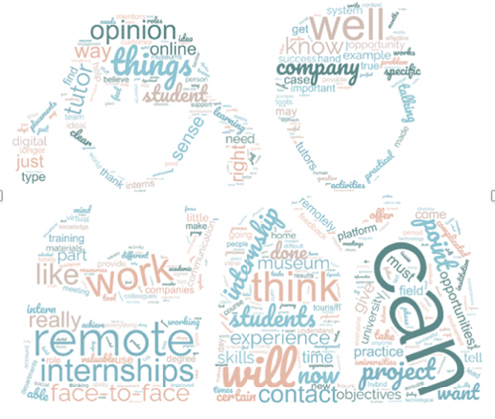
Semantic analysis identified recurring terms and clarified the dominant themes in participants’ discourse. The most frequently used words were competence, experience, opportunity, communication, and project, reflecting central dimensions of remote internship design and implementation.
The prominence of competence indicates a strong focus on learning and professional development. Participants linked remote internships to the acquisition of transversal and digital competences, stressing their cumulative nature: “Every competency that students acquire contributes to the internship” (ASE_9). The discourse also pointed to a complementary relationship between modalities: “In-person experience leads to the development of certain cognitive skills, whereas online experience develops other cognitive skills” (ASE_9). Remote internships were further associated with specific requirements, particularly self-regulation and virtual communication skills, as reflected in the statement, “Remote internships require a different set of skills, such as self-motivation and effective virtual communication” (ASE_7).
Communication emerged as another central term. Participants emphasised the importance of regular feedback, clear instructions, and access to appropriate communication tools. Reported difficulties included delayed feedback and challenges in reproducing professional communication dynamics in virtual settings (NEVU_3). These issues reinforced the need for clear communication guidelines and accessible digital channels (NEVU_4; NEVU_1). Personal contact with students was considered essential to sustain engagement and reduce isolation (USAL_5; USAL_7; USAL_4).
The term experience referred to both the benefits and limitations of remote internships. Flexibility and improved time management were frequently mentioned as key strengths, while reduced human interaction and lower immersion in organisational contexts were also highlighted: “When I go for an internship, I want to go to a place where I can also gain experience, therefore meeting people, that whole part would be missing” (UNISS_8). These views underline the importance of guidance roles and continuous support to compensate for the lack of physical presence (CNR_1; CNR_2), as well as the role of stakeholder commitment in limiting isolation (CNR_3; CNR_4).
Project was closely linked to the organisation and structure. Participants emphasised the need for clearly defined objectives, detailed planning, and ongoing guidance to ensure feasibility: “The project must be very detailed… what we are going to do is very targeted” (UNISS_1). Well-structured projects were associated with higher engagement, better coordination, and effective use of digital tools.
Finally, opportunity reflected a recognition of remote internships as a means of expanding access to professional experiences, particularly for students facing geographical, personal, or economic constraints: “Online internships… could be an advantage for them” (UNISS_6). Participants also stressed that these opportunities depend on organisational adaptability, stakeholder commitment, and effective communication strategies (CNR_3).
Overall, the semantic analysis reinforces the findings of the content analysis. Flexibility and accessibility appear as key strengths of remote internships, while structured projects, clear communication, and continuous support remain essential conditions for meaningful learning experiences. Figure 2 presents the word cloud of the most frequently identified terms in the focus group discussions.
3.4. Main highlights and insights on the PREVIEW platform
The analysis yields convergent insights on remote internships that inform the design and implementation of the PREVIEW Hub platform. Participants highlighted flexibility and accessibility as core strengths, linking them to broader student participation, particularly for those facing geographical, economic, or personal constraints. Remote internships were also associated with greater equity in access to work-integrated learning, the development of digital competences demanded in current labour markets, and improved time management and task organisation.
Persistent challenges were also identified. Reduced social interaction and difficulties in building professional relationships and networks emerged as relevant limitations. These issues were especially salient in sectors where face-to-face interaction and practical engagement are central, such as tourism and hospitality. The absence of informal learning opportunities and embodied workplace experiences was perceived as a risk to students’ professional socialisation when remote internships lacked adequate support.
Participants also emphasised the importance of structure and continuous support. Hybrid models were widely valued as a way to balance flexibility and interpersonal interaction. Initial face-to-face orientation phases followed by remote activities were perceived as supporting integration, clarifying expectations, and sustaining engagement.
These findings have direct implications for the PREVIEW Hub platform. Participants stressed the importance of features that facilitate human interaction, including spaces for communication, collaboration, and feedback. Clear organisational structures, accessible technical support, and flexible configurations adaptable to different contexts were also considered essential. Attention to students’ emotional and social well-being was also identified as a relevant design aspect.
Overall, the findings indicate that remote internships require integrated responses to technological, organisational, and supervisory challenges. Clear objectives, continuous guidance, and coordinated stakeholder involvement were identified as critical conditions. Within this context, the PREVIEW Hub platform functions as an enabling infrastructure for high-quality, inclusive, and scalable remote internship experiences across diverse settings.
3.5. SWOT analysis
Finally, a SWOT analysis was conducted as an integrative synthesis of the qualitative findings, bringing together the main internal and external factors influencing the implementation of remote internships (Figure 3). The dimensions included in the SWOT matrix were derived inductively from the categories and subcategories identified in the content and semantic analyses.
Figure 3. Results of the SWOT analysis
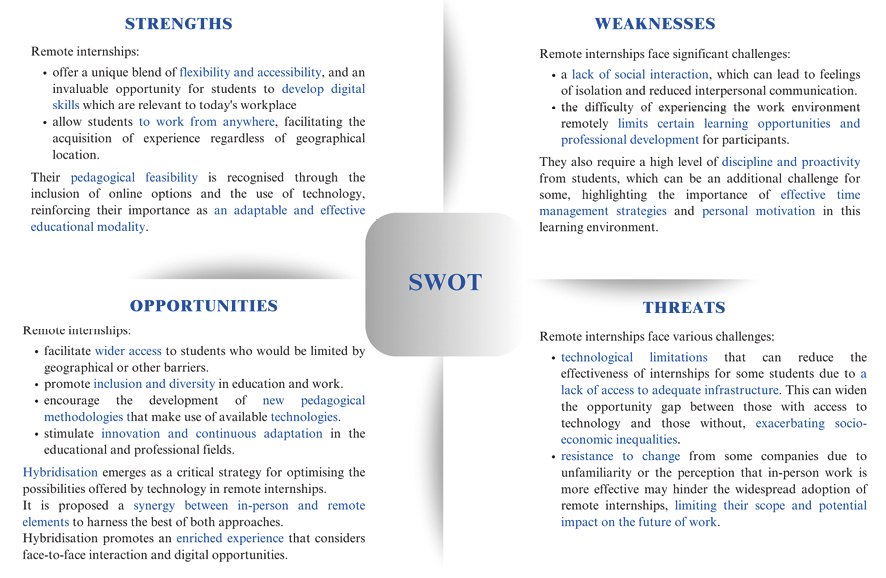
Strengths and weaknesses reflect internal characteristics identified in participants’ experiences, including flexibility, accessibility, pedagogical feasibility, social interaction, and student self-regulation. Opportunities and threats refer to external conditions shaping the sustainability and scalability of remote internships, including institutional openness to innovation, technological infrastructure, equity-related factors, and organisational resistance to change.
The SWOT analysis provides a structured overview of the key enabling factors and tensions affecting the implementation of remote internships. It does not offer prescriptive conclusions. Instead, it informs the design principles of the PREVIEW RIB and the PREVIEW Hub platform, as discussed in the following section.
4. DISCUSSION AND CONCLUSIONS
This study examined stakeholder perceptions of remote internships and the pedagogical, organisational, and technological conditions shaping their implementation, with specific attention to the PREVIEW RIB. The findings suggest that remote internships are no longer seen only as emergency or temporary arrangements, but as a legitimate modality of work-integrated learning when intentionally designed and adequately supported, particularly in digitally mediated learning contexts (Elkington & Dickinson, 2025; Irwin et al., 2022).
Consistent with research distinguishing emergency remote practices from intentionally designed digital learning experiences (Hodges et al., 2020), participants clearly differentiated between poorly structured remote internships and those embedded in coherent pedagogical frameworks. Remote internships were considered feasible and educationally meaningful when learning outcomes, mentoring roles, communication processes, and assessment mechanisms were clearly defined and understood. This finding reinforces prior evidence that educational quality in digital contexts primarily depends on design, structure, and support, rather than on the delivery mode (Jeske & Linehan, 2020).
A key contribution of this study lies in its multi-stakeholder perspective. By including students, academic supervisors, and company mentors from different European contexts, it addresses limitations in prior research, which has often focused on single institutions or stakeholder groups (Edgar et al., 2023). Participants identified flexibility, accessibility, and internationalisation as major strengths of remote internships, linked to increased participation among students facing geographical, financial, or personal constraints, while also recognising that this potential depends on adequate institutional support and access to digital infrastructure.
The findings also confirm challenges widely reported in the literature, particularly those related to social interaction, emotional well-being, and professional immersion in remote environments (Srivastava et al., 2024; Wilson et al., 2020). Participants referred to risks of isolation, reduced informal learning, and limited exposure to organisational culture in fully remote settings. Importantly, these challenges were described as design-related rather than intrinsic limitations. Hybrid models, structured socialisation practices, and sustained mentoring emerged as effective strategies for addressing them (Bilderback & Kilpatrick, 2024).
Competence development emerged as a central theme across the analysis. Stakeholders emphasised the relevance of transversal competences such as digital communication, self-regulation, adaptability, and collaboration in remote and hybrid work contexts, consistent with previous research on their importance for employability (Bersin et al., 2021; Lim et al., 2020; Sawatzky & Sawatzky, 2022). At the same time, the misalignment identified between competence frameworks designed for face-to-face internships and the requirements of remote modalities points to the need not only to recognise the relevance of these competences, but also to translate them into explicit assessment practices with observable indicators, relevant sources of evidence, and clearly defined assessment actors. This is consistent with participants’ emphasis on clearly defined learning outcomes, continuous feedback, and shared expectations across stakeholders, and reinforces the value of the PREVIEW RIB as a pedagogical infrastructure for structuring competence development and formative assessment in digitally mediated internship settings (Jakopec & Aparac Jelušić, 2024; Kakkar et al., 2024).
From an organisational perspective, the study confirms that effective coordination between universities and host organisations is critical to the success of remote internships. Clear role definitions, shared expectations, and regular communication were identified as essential conditions for effective teamwork, consistent with previous research on internship governance and supervision (Jeske & Linehan, 2020; Ruggiero & Boehm, 2016). The emphasis on formative feedback, continuous monitoring, and personalised support is consistent with experiential and situated learning approaches that underline the social nature of learning processes, including in virtual environments.
The integrative SWOT analysis provides a structured synthesis of these findings. It highlights the enabling conditions and persistent tensions shaping the implementation of remote internships, including the balance between flexibility and structure, accessibility and social presence, and innovation and institutional readiness. These tensions inform the design logic of the PREVIEW RIB, which prioritises stakeholder coordination, pedagogical coherence, and quality assurance over a purely technological focus.
Overall, this study moves beyond binary comparisons between remote and face-to-face internships by positioning remote internships within a broader continuum of work-integrated learning modalities. By grounding the PREVIEW RIB in empirical, multi-stakeholder evidence, it offers a transferable framework to support the design of inclusive, scalable, and pedagogically robust remote internship programmes aligned with current labour market demands.
4.1. From remote internships to intelligent remote internships: the role of Educational AI
Building on these results, the PREVIEW RIB can also be interpreted as a foundation for the next step: intelligent remote internships. In this paper, intelligence lies not in technology itself, but in the capacity of data-informed and AI-enabled supports to improve educational decision-making, strengthen equity, and enhance learning quality while maintaining the centrality of human actors. This positioning is consistent with scenario-based views of AI in education, which distinguish between responsible assistance, guided collaboration, and co-creation according to pedagogical purpose, agency, and risk, while keeping academic judgment central (García-Peñalvo, 2025). It also aligns with the learning analytics tradition, which understands data as a means of interpreting and improving learning processes within a specific context (Siemens & Baker, 2012).
4.2. Implications: Educational AI opportunities enabled by the PREVIEW RIB structure
The PREVIEW RIB can be understood as an AI-ready pedagogical infrastructure, not because it presupposes automated decision-making, but because it defines phases, roles, learning outcomes, and monitoring points that may support bounded, pedagogically supervised uses of Educational AI across the internship lifecycle. The implications outlined below should therefore be interpreted as potential assistive applications rather than automated replacements for supervision, mentoring, or academic judgment. In this context, the value of AI lies in its capacity to strengthen the quality, timeliness, and coherence of pedagogical and organisational decision-making while preserving the centrality of human actors.
4.2.1. Intelligent formative monitoring and process analytics
Our qualitative findings suggest that remote contexts can lead to reactive supervision, difficulties in detecting early signs of disengagement, and overload for tutors and mentors, particularly when informal workplace cues are absent. In this regard, learning analytics and Educational AI may support a more proactive, preventive monitoring model by identifying potential risk patterns (e.g., low participation, delayed submissions, reduced responsiveness), issuing early-warning alerts, and providing role-sensitive dashboards. This logic is consistent with early-warning approaches such as Course Signals, which show how predictive indicators and timely interventions can be operationalised to support student success (Arnold & Pistilli, 2012). However, such uses should be understood as mechanisms for informing timely human intervention rather than as systems that replace professional judgement or relational follow-up.
4.2.2. Personalised learning and competence pathways within a coherent blueprint
A recurring insight across institutions is the need for adaptability across heterogeneous European contexts. Within the shared RIB structure, Educational AI could support personalisation through recommendations aligned with the intern’s context and progress, dynamic mapping between project tasks and competence development, and adaptive pathways calibrated to entry level and goals. Research on tutoring systems suggests that well-designed intelligent supports can approach the effectiveness of human tutoring under specific learning conditions, reinforcing the plausibility of AI as an assistive layer rather than a replacement for mentoring (VanLehn, 2011). These possibilities should be understood as pedagogically guided mechanisms for adaptation within a common blueprint, not as substitutes for mentor guidance, student reflection, or academic judgement.
4.2.3. AI-assisted formative, reflective, and competence-oriented assessment
The study highlights the importance and the workload of sustained feedback and assessment in remote placements. Educational AI could support academic staff through preliminary analysis of reflective texts and digital artefacts, surfacing potential evidence of critical reflection, theory-practice integration, and competence development. Research on automated essay evaluation and feedback systems clarifies the affordances and limitations of such approaches in assessment contexts (Shermis & Burstein, 2013). Crucially, these supports should remain assistive and supervised: AI may reduce routine cognitive load and increase the time available for deeper, contextualised academic feedback rather than automate judgement. Any AI-enabled assessment support should be treated as a means of surfacing evidence for human interpretation, not of delegating evaluative authority.
4.2.4. Strengthening university–industry coordination and quality assurance
The SWOT-informed tensions reported in this study include mismatches between academic and organisational expectations, communication friction, and uneven follow-up quality. In response, AI-enabled analysis of communication and progress data could help identify emerging misalignments, prompt timely coordination, and generate aggregated evidence for institutional improvement and scaling, supporting the sustainability of the PREVIEW model across diverse partnerships. Here again, AI would serve to inform coordination and quality assurance by making patterns more visible and actionable, while leaving interpretation and decision-making to the relevant human stakeholders.
4.3. Connecting qualitative findings to AI opportunities
Table 1 synthesises the key qualitative insights from this study and identifies potential opportunities for Educational AI within the PREVIEW RIB. Rather than proposing technology-driven changes or automated solutions, the mapping is evidence-led: each opportunity derives from stakeholders’ reported needs, including continuous feedback, early detection of disengagement, competence assessment, coordination across university-industry settings, and contextual personalisation, and is framed as a possible assistive layer that strengthens the RIB’s pedagogical logic while preserving human agency, accountability, and academic judgement. Table 1 should be read as a bridge between the empirical findings and a set of plausible, pedagogically bounded implications, clarifying where AI-enabled supports could add value without displacing human mentoring or academic judgement.
Table 1. Mapping qualitative findings to Educational AI opportunities within the PREVIEW RIB
|
Qualitative finding (this study) |
Educational AI opportunity (within PREVIEW RIB) |
|---|---|
|
Need for continuous feedback and formative follow-up |
AI-assisted formative feedback + progress dashboards |
|
Risk of student isolation and disengagement |
Predictive analytics + early-warning alerts (e.g., Course Signals-type logic) |
|
Difficulty assessing transversal competences remotely |
NLP-supported analysis of reflective evidence + artefact-based competence detection |
|
Heterogeneity and coordination challenges university–industry |
Detection of expectation gaps + coordination support + aggregated reports |
|
Demand for personalisation across diverse European contexts |
Adaptive competence pathways + educational recommender systems |
Building on Table 1, the pedagogical value of intelligent remote internships also depends on making competence assessment more explicit and operational in digitally mediated contexts. Our findings suggest that one of the main challenges lies not only in recognising the importance of transversal competences, but also in defining how they can be observed, evidenced, and assessed in remote placements. Table 2, therefore, proposes an operational framework linking the key competences identified in this study to observable indicators, possible sources of evidence, relevant assessment actors, and possible AI and learning analytics support. It should be read as a pedagogical scaffold for implementation rather than as a fixed or exhaustive assessment instrument.
Table 2. Proposed framework for competence assessment in intelligent remote internships
|
Competence |
Operational definition (Ability to) |
Observable indicators |
Evidence |
Actors |
Possible AI / LA support |
|---|---|---|---|---|---|
|
Self-regulated learning |
plan, monitor, and autonomous adjust work in digitally mediated environments |
Timely task completion, goal setting, planning updates, responsiveness to feedback, self-monitoring evidence |
Work plans, milestone logs, reflective journals, task management records, mentor notes |
S, AS, CM |
Progress dashboards, deadline monitoring, detection of low participation or delayed submissions |
|
Digital communication |
communicate clearly, appropriately, and professionally through digital channels |
Clarity of written messages, responsiveness, appropriate platform use, communication tone, progress reporting |
Emails/messages, meeting summaries, recorded presentations, communication logs |
CM AS, P |
Communication pattern analysis, reminders, interaction-trace summarisation |
|
Virtual collaboration |
work effectively with others in distributed or hybrid teams |
Meeting participation, contribution to shared tasks, peer coordination, collaborative problem-solving, follow-through on agreed actions |
Shared documents, collaborative platforms, meeting attendance, peer feedback, team artefacts |
CM, P, AS |
Participation analytics, collaboration dashboards, disengagement or uneven contribution detection |
|
Adaptability to remote/hybrid work |
adjust to changing tasks, tools, routines, and digitally mediated professional conditions |
Flexibility in task execution, effective use of tools, adjustment to changing priorities, ability to work across remote/hybrid dynamics |
Mentor observations, project artefacts, platform usage traces, reflective entries |
CM, AS, S |
Tool-adoption pattern detection, alerts on reduced activity after workflow changes |
|
Autonomous work organisation |
structure tasks, time, and priorities with limited direct supervision |
Time management, prioritisation, consistency in work rhythm, meeting preparation, organisation of deliverables |
Calendars, task boards, project logs, submitted outputs, mentor follow-up notes |
S, CM, AS |
Timeline visualisation, milestone tracking, irregular-work-pattern alerts |
|
Reflective capacity |
critically interpret experience, connect practice with learning outcomes, and identify areas for improvement |
Depth of reflection, theory–practice integration, recognition of difficulties, evidence of learning from feedback |
Reflective diaries, learning portfolios, self-assessment reports, oral debriefings |
S, AS |
Preliminary analysis of reflective texts, thematic clustering of reflective entries, evidence surfacing for tutor review |
|
Socio-emotional competence |
manage emotions, sustain motivation, seek support when needed, and maintain constructive professional relationships in remote settings |
Persistence, help-seeking behaviour, emotional self-management, respectful interaction, ability to cope with isolation or uncertainty |
Reflective journals, mentoring records, check-in notes, self-assessment, tutor observations |
S, AS, CM |
Participation-change early-warning indicators, check-in prompts, sustained-disengagement monitoring |
|
Professional responsibility |
behave reliably, ethically, and responsibly in relation to tasks, deadlines, and workplace expectations |
Reliability, accountability, respect for confidentiality, consistency in deliverables, appropriate professional conduct |
Deliverables, attendance records, mentor reports, internship agreements, progress reviews |
CM, AS |
Deadline tracking, submission-pattern anomaly detection, documentation support |
|
Problem-solving and initiative |
address tasks proactively, propose solutions, and act independently within project constraints |
Initiative-taking, proposal of alternatives, issue-resolution capacity, constructive questions, decision-making evidence |
Project outputs, mentor feedback, meeting records, reflective accounts |
CM, AS |
Task progression pattern recognition, identification of stalled tasks needing support |
|
Digital/technical competence |
use relevant digital and professional tools required by the internship context |
Functional platform use, correct digital-tool use, technical autonomy, effective completion of tool-mediated tasks |
Platform traces, project artefacts, mentor observations, task outputs |
CM, AS |
Usage analytics, support recommendations, training needs detection |
|
Note. S = student, AS = academic supervisor, CM = company mentor, P = peers. AI = artificial intelligence, LA = learning analytics. |
|||||
4.4. Ethical, pedagogical, and sustainability considerations
The integration of Educational AI into remote internship ecosystems must also be approached as a matter of responsible governance. Its pedagogical value depends not only on technical functionality, but also on the conditions of its use, including transparency, human oversight, data privacy, fairness, and proportionality. In this sense, AI should support clearly defined educational purposes and accountable decision-making processes rather than introduce automated monitoring that may weaken student agency, professional judgement, or the relational basis of formative practice (Molina-Carmona & García-Peñalvo, 2025). Accordingly, because the ethics of generative AI in education remain actively debated, ethical guidance should be operationalised in concrete design and governance requirements rather than stated only at the level of general principles (García-Peñalvo et al., 2025).
Principles (normative layer)
•Transparency and explainability: students and staff should understand what the system recommends and why.
•Human agency and accountability: final decisions about support, evaluation, and intervention remain human.
•Privacy and data protection: data minimisation, security, and compliance with applicable regulations (e.g., GDPR) must be built in from the outset.
•Equity and fairness: avoid algorithmic bias that could reproduce socio-economic, gender, cultural, or disability-related inequalities.
•Support, not control: AI should be designed to empower learning and mentoring, rather than intensifying surveillance.
These principles align with the Ethics Guidelines for Trustworthy AI of the European Commission’s High-Level Expert Group on AI (European Commission, 2019).
Operational implications (design layer)
•Role-based access and purpose limitation (what mentors see vs. academic supervisors vs. students).
•Explicit consent and communication practices aligned with internship governance.
•Auditability and continuous evaluation of bias, false positives/negatives in alerts, and unintended effects on mentoring relationships.
•Student-facing mechanisms for contestability and dialogue (e.g., “Why am I receiving this recommendation?” and “How can I act on it?”).
Finally, framing the PREVIEW RIB as an infrastructure for intelligent remote internships strengthens its alignment with sustainability and social impact agendas, including the following SDGs (United Nations, 2015):
•SDG4 (Quality Education): improved learning quality through structured support, feedback, and coherent competence development.
•SDG9 (Industry, Innovation and Infrastructure): responsible innovation in higher education through scalable, evidence-informed internship infrastructures.
•SDG10 (Reduced Inequalities): targeted support and accessibility for students facing mobility, economic, caregiving, or disability-related barriers.
This SDG-oriented framing aligns with work that links safe, transparent, and ethical AI directly to educational quality and sustainability, particularly in relation to SDG4 (García-Peñalvo et al., 2024).
4.5. Limitations and future research
Several limitations should be acknowledged. Although the sample included multiple stakeholder groups and institutions from different European countries, it does not fully capture the diversity of disciplinary and institutional contexts across Europe. The qualitative design limits generalisability, as the analysis focuses on perceptions, expectations, and meanings rather than measured outcomes. In addition, the limited representation of highly practice-based or laboratory-intensive internships may have influenced the emphasis placed on specific challenges and opportunities.
A further limitation concerns the status of the Educational AI layer discussed in this paper. Although the study offers a pedagogically grounded interpretation of how the PREVIEW RIB could support the transition towards intelligent remote internships, the proposed AI-related functions remain conceptual and prospective. They derive from qualitative findings and the structured logic of the PREVIEW RIB but were not empirically validated within the scope of this study. Accordingly, the paper should not be read as evidence of the effectiveness of AI-enabled monitoring, feedback, personalisation, or coordination mechanisms, but rather as outlining plausible and theoretically informed directions for future development.
Future research should therefore examine the use of remote internship platforms in real educational settings. Although the PREVIEW platform has already been implemented, empirical evidence of its impact is not yet available. Further studies will be needed to analyse its contribution to coordination, supervision, competence development, and student support once sufficient data have been collected. In addition, to substantiate the shift towards intelligent remote internships, future work should evaluate (i) the validity and educational consequences of early-warning indicators, (ii) the reliability, fairness, and pedagogical usefulness of AI-assisted feedback and competence-evidence detection, and (iii) the conditions under which AI support strengthens, rather than weakens human mentoring relationships, student agency, and institutional trust.
4.6. Concluding reflection
Intelligent remote internships represent a pedagogical, not merely technological, evolution of work-integrated learning. Interpreting Educational AI as a transversal support layer within the PREVIEW RIB does not imply automating learning; rather, it offers a route to humanise remote placements through better-informed decisions, more equitable support, and stronger coordination. In this sense, the PREVIEW RIB can be positioned not only as a framework for high-quality remote internships, but also as a scalable blueprint for intelligent remote internships in European higher education.
ACKNOWLEDGEMENTS
This article was undertaken with the support of the Erasmus+ Programme of the European Union: “KA2 – Cooperation partnership in higher education.” Promoting Resilience and Employability in uniVersity (PREVIEW) (Reference number 2022-1-IT02-KA220-HED-000088742). Views and opinions expressed are those of the author(s) only and do not necessarily reflect those of the European Union or the European Education and Culture Executive Agency (EACEA). Neither the European Union nor EACEA can be held responsible for them.
REFERENCES
. (2000). Las técnicas de Análisis de Contenido: Una revisión actualizada. Fundación Centro Estudios Andaluces, Universidad de Granada, 10(2), 1-34.
., & . (2012). Course signals at Purdue: using learning analytics to increase student success. In LAK ‘12: Proceedings of the 2nd International Conference on Learning Analytics and Knowledge (Vancouver, British Columbia, Canada, 29 April 2012 - 2 May 2012) (pp. 267–270). Association for Computing Machinery. https://doi.org/10.1145/2330601.2330666
., ., & . (2021). Big reset playbook: Human-centered leadership. Josh Bersin.
., & . (2024). Global perspectives on redefining workplace presence: The impact of remote work on organizational culture. Journal of Ethics in Entrepreneurship and Technology, 4(1), 62–72. https://doi.org/10.1108/JEET-08-2024-0023
., ., ., & . (2024). Developing the digital transformation skills framework: A systematic literature review approach. PLOS ONE, 19(7), e0304127. https://doi.org/10.1371/journal.pone.0304127
., ., ., et al. (2023). Virtual simulated international placements as an innovation for internationalisation in undergraduate programs: A mixed methods study. BMC Medical Education, 23, 258. https://doi.org/10.1186/s12909-023-04260-x
., & . (2025). Reimagining Higher Education learning spaces: assembling theory, methods, and practice. Higher Education Research & Development, 44(1), 8-19. https://doi.org/10.1080/07294360.2024.2438587
. (2019). . Ethics guidelines for trustworthy AI. European Commission. https://d66z.short.gy/2p0WdC
., ., ., ., ., ., & . (2021). The experience of women students in engineering and mathematics careers: A focus group study. In , , & (Eds.), Proceedings of the 2021 IEEE Global Engineering Education Conference, EDUCON 2021 (pp. 50-56). 9454079 (IEEE Global Engineering Education Conference, EDUCON; Vol. 2021-April). IEEE Computer Society. https://doi.org/10.1109/EDUCON46332.2021.9454079
. (2025). Three Scenarios for AI in Education: From Responsible Assistance to Co-Creation. Education in the Knowledge Society, 26, e32932. https://doi.org/10.14201/eks.32932
., ., ., & . (2024). Safe, Transparent, and Ethical Artificial Intelligence: Keys to Quality Sustainable Education (SDG4). IJERI – International Journal of Educational Research and Innovation (22), 1–21. https://doi.org/10.46661/ijeri.11036
., ., ., & . (2025). The ethics of generative artificial intelligence in education under debate. A perspective from the development of a theoretical-practical case study. Revista Española de Pedagogía, 83(291), 281–293. https://doi.org/10.22550/2174-0909.4577
., ., ., & . (2021). Recommendations for Mandatory Online Assessment in Higher Education During the COVID-19 Pandemic. In , , & (Eds.), Radical Solutions for Education in a Crisis Context: COVID-19 as an Opportunity for Global Learning (pp. 85–98). Springer. https://doi.org/10.1007/978-981-15-7869-4_6
., ., ., & . (2016). Virtual Placements Management Process Supported by Technology: Proposal and First Results of the Semester of Code. IEEE Revista Iberoamericana de Tecnologias Del Aprendizaje, 11(1), 47–54. https://doi.org/10.1109/RITA.2016.2518461
., ., & . (2024). La nueva realidad de la educación ante los avances de la inteligencia artificial generativa. RIED-Revista Iberoamericana de Educación a Distancia, 27(1), Article 1. https://doi.org/10.5944/ried.27.1.37716
. (2022). An Inclusive Multifaceted Approach for the Development of Electronic Work-Integrated Learning (eWIL) Curriculum. Studies in Higher Education 47(7), 1357-1371. https://doi.org/10.1080/03075079.2021.1894116
., & . (2022). Components of Education 4.0 in 21st Century Skills Frameworks: Systematic Review. Sustainability, 14(3), Article 3. https://doi.org/10.3390/su14031493
., ., & . (2014). Metodología de la investigación (6th ed.). McGraw-Hill Education.
.,., ., ., & . (2020). The difference between emergency remote teaching and online learning. Educause Review. https://bit.ly/3b0Nzx7
., ., ., & . (2022). Is the Future of Internships Online? An Examination of Stakeholder Attitudes Towards Online Internships. Higher Education, Skills and Work-Based Learning 12(4), 629-644. https://doi.org/10.1108/HESWBL-05-2021-0102
., &. (2021). Opportunities and Challenges of E-Learning in Spanish Institutions of Higher Education. In ,, , (Eds.), Challenges and Opportunities for the Global Implementation of E-Learning Frameworks (pp. 112-127). IGI Global. https://doi.org/10.4018/978-1-7998-7607-6.ch008
., & . (2024). New challenges and opportunities for IT companies and (L)IS departments in managing student internships in the time of crisis. Education for Information, 40(1), 45-64. https://doi.org/10.3233/EFI-230023
., & . (2020). Mentoring and Skill Development in e-Internships. Journal of Work-Applied Management 12(2), 245-258. https://doi.org/10.1108/JWAM-09-2019-0028
., ., ., & . (2024). Understanding factors shaping engagement in remote internships: the role of institutional communication, faculty support and intern cynicism. International Journal of Educational Management, 38(4), 1219–1240. https://doi.org/10.1108/IJEM-08-2023-0378
., & . (1991). Situated learning: Legitimate peripheral participation. Cambridge University Press. https://doi.org/10.1017/CBO9780511815355
., ., ., ., & . (2020). Integrated work study program: Students’ growth mindset and perception of change in work-related skills. International Journal of Work-Integrated Learning, 21(2), 103-115.
., & . (2020). Trabajo remoto: Personalidad y rendimiento Resultados de la investigación. https://bit.ly/42Gkwcs
., & . (1984). Qualitative data analysis. A source book of new methods. SAGE.
., & . (2025). Safeguarding Knowledge: Ethical Artificial Intelligence Governance in the University Digital Transformation. In , , & (Eds.), Advanced Technologies and the University of the Future (pp. 201–220). Springer Nature Switzerland. https://doi.org/10.1007/978-3-031-71530-3_14
., ., & . (2020). Remote Work-Integrated Learning Experiences: Student Perceptions. International Journal of Work-Integrated Learning 21(4), 401-414.
. (2023). Automation: Theory, Evidence, and Outlook. Annual Review of Economics, 16, 1–25. https://doi.org/10.1146/annurev-economics-090523-113355
., ., ., ., ., ., & . (2024). Lessons for expanding virtual mentoring in academic medical institutions: a qualitative study among senior mentors. BMC Medical Education 24, 934. https://doi.org/10.1186/s12909-024-05852-x
., & . (2016). Design and Development of a Learning Design Virtual Internship Program. International Review of Research in Open and Distributed Learning, 17(4), 105–120. https://doi.org/10.19173/irrodl.v17i4.2385
., & . (2022). Competences for Success in remote and hybrid working context. https://doi.org/10.13140/RG.2.2.29227.52007
., & . (Eds.). (2013). Handbook of automated essay evaluation: Current applications and new directions. Routledge. https://doi.org/10.4324/9780203122761
., & . (2012). Learning analytics and educational data mining: towards communication and collaboration. In LAK ‘12: Proceedings of the 2nd International Conference on Learning Analytics and Knowledge (Vancouver, British Columbia, Canada, 29 April 2012 - 2 May 2012) (pp. 252–254). Association for Computing Machinery. https://doi.org/10.1145/2330601.2330661
. (2024). The Ultimate List of Remote Work Statistics: The 2024 Edition. https://www.smallbizgenius.net/by-the-numbers/remote-work-statistics/
., ., ., ., & . (2024). Knowledge management during emergency remote teaching: An interpretative phenomenological analysis of the transition experiences of faculty members. Journal of Knowledge Management, 28(11), 78–105. https://doi.org/10.1108/jkm-02-2023-0112
. (2024). Challenges and opportunities of digital transformation in strategy management. International Journal of Science and Society, 6(1), 620-630. https://doi.org/10.54783/ijsoc.v6i1.1050
. (2015). Transforming our world: The 2030 Agenda for Sustainable Development (A/RES/70/1). United Nations. https://docs.un.org/en/A/RES/70/1
. (2011). The Relative Effectiveness of Human Tutoring, Intelligent Tutoring Systems, and Other Tutoring Systems. Educational Psychologist, 46(4), 197–221. https://doi.org/10.1080/00461520.2011.611369
., ., & . (2020). Interviews of Spanish women in STEM: a multimedia analysis about their experiences. In (Ed.), Proceedings of the 8th International Conference on Technological Ecosystems for Enhancing Multiculturality (TEEM 2020) (Salamanca, Spain, October 21-23, 2020). ACM. https://doi.org/10.1145/3434780.3436693
., ., & . (2020). Faculty support and student engagement in undergraduate engineering. Journal of Research in Innovative Teaching and Learning, 13(1), 83-101. https://doi.org/10.1108/JRIT-02-2020-0011
., ., ., ., ., ., ., ., ., ., & . (2022). The effects of remote work on collaboration among information workers. Nature Human Behaviour, 6(1), 43–54. https://doi.org/10.1038/s41562-021-01196-4
. (2024). The interrelationship between remote work and organizational culture: Implications for engagement, productivity, and leadership. Advances in Economics, Management and Political Sciences, 131, 164-172. https://doi.org/10.54254/2754-1169/2024.18434
., ., ., ., & . (2023). Organizational roles in the context of digital transformation: A microlevel perspective. Journal of Business Research, 157, 113563. https://doi.org/10.1016/j.jbusres.2022.113563