Repensar los entornos digitales de aprendizaje: usabilidad, innovación e interacción docente–estudiante en plataformas virtuales
Rethinking digital learning environments: usability, innovation and teacher–student interaction in virtual platforms
Cristhiam José Quelix Rodríguez
Universidad de Córdoba
Verónica Marín Díaz
Universidad de Córdoba
Melchor Gómez García
Universidad Autónoma de Madrid
RESUMEN
La llegada de la COVID-19 provocó el cierre de las instituciones educativas y la interrupción de la modalidad presencial, impulsando la incorporación de plataformas virtuales de aprendizaje y el uso de recursos digitales como medios para la interacción con los estudiantes y el desarrollo del proceso académico. Este estudio tiene como objetivo determinar qué aspectos de las plataformas virtuales de aprendizaje resultan innovadores y amigables en la interacción docente-alumno en centros educativos de enseñanza secundaria dominicanos, a partir de un diseño ex post facto basado en las experiencias vividas por los participantes.
Los resultados evidencian que utilizaron una amplia diversidad de plataformas virtuales, entre las que destacan Zoom, Google Meet, WhatsApp, Classroom, Teams y Moodle. Asimismo, se identifican como aspectos innovadores y amigables las características funcionales de las plataformas, así como la integración de herramientas y recursos digitales considerados indispensables. Otro hallazgo relevante es la alta valoración otorgada a la atención de los estilos de aprendizaje, lo que refuerza la efectividad pedagógica de estos entornos. Finalmente, se concluye que la interacción docente-alumno debe promoverse de forma participativa, colaborativa y comunicativa, con el fin de reducir barreras y propiciar un ambiente de aprendizaje cercano y afectivo.
PALABRAS CLAVE
Plataformas virtuales; entornos de aprendizaje amigables; innovación; Interacción educativa; Relación profesor-alumno.
ABSTRACT
The arrival of COVID-19 led to the closure of educational institutions and the interruption of in-person learning, prompting the adoption of virtual learning platforms and the use of digital resources as means for interacting with students and developing the academic process. This study aims to determine which aspects of virtual learning platforms are innovative and user-friendly in teacher-student interaction in Dominican secondary schools, based on an ex post facto design informed by the participants’ experiences.
The results show that a wide variety of virtual platforms were used, including Zoom, Google Meet, WhatsApp, Classroom, Teams, and Moodle. The functional features of the platforms, as well as the integration of essential digital tools and resources, were identified as innovative and user-friendly aspects. Another relevant finding is the high value placed on addressing learning styles, which reinforces the pedagogical effectiveness of these environments. Finally, it is concluded that teacher-student interaction should be promoted in a participatory, collaborative, and communicative manner in order to reduce barriers and foster a close and supportive learning environment.
KEYWORDS
Virtual platforms; user-friendly learning environments; innovation; educational interaction; teacher-student relationship.
1. INTRODUCTION
The evolution of computers has driven the development of Information and Communication Technologies (henceforth ICT). With the emergence of the internet, a global connection has been forged that has generated innovative advances, such as the Internet of Things, quantum computing, robotics, or augmented reality. In the area of education, these technologies have enabled online professionalization through virtual learning environments (henceforth VLE) or virtual platforms.
Virtual platforms have become essential digital tools for synchronous or asynchronous online modalities, acting as a strategic structure for exchanges between students, teachers, and high level specialists.
The COVID-19 pandemic closed school doors just 12 weeks before the end of the 2019-2020 academic year in the Dominican Republic. This forced the Ministry of Education (Minerd) to promote distance-learning education strategies to finish the cycle, taking advantage of the previous implementation of the ICT. Many education centers continued their education duties by using the digital tools and technological equipment at their installations.
This mandatory closing of the in-person modality forced the use of virtual platforms to interact with students and make advances in the academic process. Thus, these tools became fundamental for the implementation of online learning, becoming a permanent resource in the Dominican education system. They were included in education projects, plans, and programs as an innovative strategy to further motivate adolescents and youth to finish their pre-university studies.
It must be understood that virtual learning platforms are presented as very useful tools for remote teaching-learning, as they enable planning, teaching, assessment, and feedback, essential processes for both teachers and students (Ramos and Macahuachi-Nuñez, 2021; Romero-Saritama and Simaluiza, 2025). They are born as part of modern technological advances and the rapid evolution of the computer generations, allowing for more interactive, dynamic learning environments, rich in digital tools and multimedia content. Caballero and Lara (2024, pg. 211) describe them as programs that include diverse types of tools with educational aims, whose main function is to enable the creation of virtual environments to teach distance learning courses.
Initially, virtual platforms focused on the management of contents through LMS (Learning Management Systems), offering basic functions such as assignment submission, discussion forums, and exams. However, over time, they have evolved towards more interactive and integrated environments, through the inclusion of emergent technologies such as artificial intelligence, machine learning, augmented reality, and learning analytics (Fernández-Batanero et al., 2023).
According to Moral-Sánchez et al. (2022), modern platforms not only manage learning, but also analyze it, predict it, and personalize it. These tools identify student behavior patterns, anticipate difficulties, and offer resources adapted to individual needs. Likewise, there is an emerging tendency towards open learning environments, in which the VLE are integrated with education applications, academic social networks, and external digital resources, providing more fluid and collaborative user-centered experiences.
Virtual platforms offer a great variety of resources such as educational videos, discussion forums, online collaboration tools, and interactive assessments, used both inside and outside of the classroom (Núñez-Naranjo et al., 2025).
“The integration of the virtual platform will put into practice the collaboration of teachers and students, facilitating the teaching and learning process by improving access to educational resources, supporting teaching activity, and enhancing student interaction.”
(Altamirano and Páramo, 2025, p. 57).
The use of virtual platforms promotes independent learning through the interaction with digital contents, collaborative activities, and continuous assessment, allowing students to not only acquire knowledge, but also develop critical skills that favor their comprehensive development (Fernández and Loor, 2024; Martínez-Goikoloea et al, 2025). These platforms have acquired a significant importance, becoming essential tools for education entities at all levels, making possible access to study programs no matter the distance, time, or culture. Many private and open access platforms have emerged that enable institutions to have their own virtual learning environment.
According to Alcívar et al. (2022), a positive teacher-student relationship in virtual environments energizes the process of learning to learn, eliminating barriers to ensure education success. Plans to improve virtual learning emphasize quality and human warmth in tutoring, fostering closeness and group commitment. Online learning creates online education environments that promote collaboration between students, teachers, and resources, recognizing that knowledge is constructed in virtual communities rather than individual approaches (Manzueta and Pérez, 2023; Romero-Saritama and Simaluiza, 2025).
From a technological perspective, the platforms must have designs that enable user-friendly interactions between students, resources, and teachers. Those produced between teachers-students must consider communicative, pedagogical, and socioemotional dimensions to maintain balance, comfort, and trust, guaranteeing sustainability, motivation, and emotional stability. They must be marked by a constant dialogue and teacher contact that understands the virtual reality within which it is developed, thus strengthening the interaction. It must therefore be understood that the omission of these dimensions creates learning barriers. In this sense, Muñoz-Basols and Fuertes (2024) underline that a good management of virtual interaction requires awareness of contextual factors, interactive processes, and learning results. It includes teacher presence (presentation of contents), cognitive presence (constructive reflection of the meaning), and social presence (participative skills). Thus, good management and use of these resources provides valuable perspectives for the design of materials and activities adapted to the learning styles, work rhythms, and student preferences, promoting motivation and commitment. Personalization responds to student diversity, through the adaptation of teaching methods and didactic resources to specific needs, to provide more optimal learning paths (Manzueta and Pérez, 2023).
As a consequence, an innovative and user-friendly virtual classroom must consider the characteristics of the students, their learning styles, the functionalities of the platforms, and interactive resources between teachers and peers.
During the 2020-2021 academic year, the “Education for All Plan Preserving Health” (Ministerio de Educación, 2024) was applied, with classes over the radio, television, and YouTube, which were reinforced with booklets and WhatsApp groups. However, many educational centers opted for synchronous and asynchronous virtual learning platforms. As Cabrera-Félix (2024) points out, “During the COVID-19 pandemic, the most used tools were WhatsApp, computers and digital platforms, while the least used resources were radio and tablets” (pg. 46). This crisis transformed pre-university education, redefining the role of education and teachers in the field of academic training (Caballero and Lara, 2024, p. 211).
The aim of the present study was to determine innovative and user-friendly aspects of the virtual learning environments in the teacher-student interaction, based on the COVID-19 experience. The study sought to answer the following questions:
RQ1. What are the most used virtual learning platforms by teachers?
RQ2. What features and resources of virtual platforms are innovative and intuitive in teacher-student interaction?
RQ3. What is the interaction like between teachers and students through virtual learning platforms?
The study tries to identify innovative and intuitive aspects of the virtual learning environments in the teacher-student interaction, using the experiences of the teaching staff and student body over a period lasting more than a year, during the COVID-19 pandemic. In addition, it allows generating conclusions and critical recommendations to optimize education processes in the era of knowledge, adapting these tools to user-friendly and personalized environments according to the learning styles of the students (Salas-Rueda, et al., 2024).
2. METHOD
The present study is framed within an ex-post facto descriptive design (Mateo, 2012), given that the virtual platforms were used by the students and teachers for less than an entire academic year. According to Hernández-Sampieri et al., (2022), it is a non-experimental study, as variables are not manipulated. Instead, they are analyzed in their natural context, based on phenomena that already occurred in the educational centers that used virtual learning platforms, with a quantitative approach. The data collection was performed in a single moment in time, through the application of structured surveys, which allowed obtaining objective statistical information.
The design made it possible to characterize the aspects of the virtual learning platforms used in education innovation in the Dominican Republic, through the identification of structures, patterns, and trends, as well as the virtual platforms used by the teachers and students, thus contributing with a comprehensive understanding of the phenomenon studied.
The population comprised students and teachers from educational centers in District 15-03, Santo Domingo South Central, in the Secondary Level Technical Professional Education modality. The sample was selected through non-probabilistic, convenience sampling (Hernández-Sampieri et al., (2022)), including 7 public and co-managed educational centers of said modality that implemented virtual platforms (synchronous, asynchronous, or mixed).
•Students: 6th year of secondary school (2024-2025 period), final year of high school, for having experienced a full year virtually and the transition to face-to-face learning.
•Teaching staff: All those who teach in Technical and Vocational Education at the 7 centers, for a comprehensive view of the implementation.
A structured survey was used to collect the data. Its validation was performed through expert judgement with 5 specialists (Masters and PhDs in education and ICT). Each expert assessed pertinence (1=not pertinent, 5=very pertinent) and adequacy (1=not adequate, 5=very adequate) of the variables/indicators of the questionnaire, providing pertinent observations.
The data obtained from the surveys were analyzed with the Statistical Package for the Social Sciences (SPSS) v.28 program, in order to obtain precise quantitative information. Descriptive analyses were applied, such as frequencies and percentages, analysis of multiple answers, and measurements of central tendency and dispersion (mean and standard deviation). Likewise, inferential analyses were performed, as well as a repeated measures analysis of variance (ANOVA) and Friedman’s test, in order to identify significant differences between the variables studied. The results were systematically organized and interpreted through tables and figures.
2.1 Ethics declaration
All the participants signed an informed consent before participating in the study, which clearly explained the purpose of the study, the procedures to be followed, and the use of the information provided. The study was performed by strictly following the ethical principles of research, and in compliance with Law N. 172-13 of the Dominican Republic, on the protection of personal data, thus guaranteeing confidentiality, privacy, and protection of the information from the participants. The data were collected, treated, and stored safely and anonymously, and were exclusively used with academic and scientific aims, without allowing for the direct or indirect identification of the people involved.
The possible ethical impacts of the study were addressed preventively and systematically from the design of the research until the application of the technological tools used. To minimize biases in the technological tools, general use accessible digital resources were selected, avoiding platforms that could discriminate due to socioeconomic level, gender, age, or digital competences. Likewise, efforts were made to ensure that the activities and data collection instruments were reviewed beforehand, in order to guarantee clear and inclusive language that was culturally pertinent to the Dominican education context.
As for accessibility, the real-life conditions of the participants were considered, offering participation alternatives (in-person or digital, whenever possible), and using tools that were compatible with different devices, in order not to exclude individuals with technological or connectivity limitations.
3. RESULTS
In the context of the research presented, through the understanding of the topic of user-friendly and innovative virtual learning environments in the teacher-student interaction, it is of vital importance to determine key aspects of the virtual learning platforms to be considered user-friendly or innovative in the teacher-student interaction. The study aims to contribute scientific knowledge in a deductive manner, by answering the question: What aspects of the virtual learning platforms are innovative and user-friendly (intuitive) in the teacher-student interaction?
In the following section, the quantitative results obtained from the application of the instruments and data analysis of the survey to students and teachers will be presented. The results were divided into three topics or sections for better visualization, presentation, and understanding of the questions.
RQ1. What are the most used virtual learning platforms by teachers?
RQ2. What features and resources of virtual platforms are innovative and intuitive in teacher-student interaction?
RQ3. What is the interaction like between teachers and students through virtual learning platforms?
3.1 Use of Virtual Learning Platforms
Figure 1. Virtual Learning Platforms used by teachers. Source: Created by the authors.
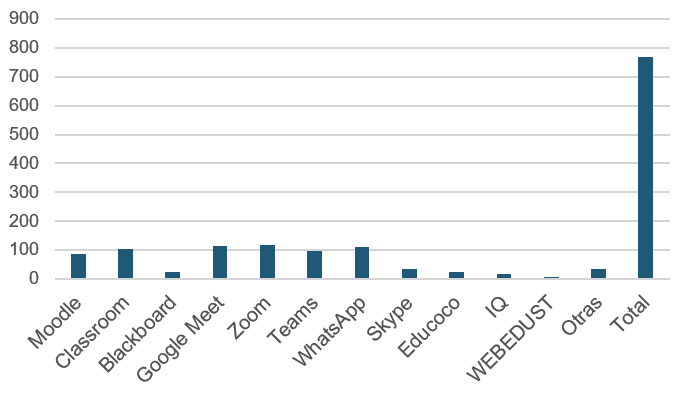
Figure 1 shows the virtual learning platforms utilized by the teachers, based on an analysis of multiple responses, considering each platform as a dichotomous variable (0 = Yes, 1 = No). The results indicate that the most utilized platforms by teachers were Zoom (96.7 %), Google Meet (95 %), WhatsApp (90.8 %), Classroom (85.8 %), Teams (81.7 %), and Moodle (71.7 %). As a whole, the data indicate a high diversity of platforms used by the teachers in their teaching practices.
In addition, it was observed that 57.54 % of the students had utilized virtual learning platforms sometimes, 30.39 % frequently, 10.90 % very frequently, and 1.16 % never.
3.2. Aspects of user-friendly and innovative Virtual Learning Platforms
With respect to the user-friendly and innovative aspects of the virtual learning platforms, it was corroborated that these were highly valued (M=7.43; SD=2.024)
In this sense, the set of features that are grouped, for a platform to be considered user-friendly, was organized around four dimensions. Dimension a) includes accessibility, intuitive, interactivity, collaborative work, and exchange, with a mean of M = 6.96. Dimension b) includes attractive design and presentation, adaptability to any device, and permanent virtual support (M = 7.06). Dimension c) encompasses visibility of the information, effective communication, prioritization of the contents, as well as navigation tutorials and instructions (M = 7.06). Finally, dimension d) refers to the integration of tools and resources –synchronous and asynchronous platforms, multimedia resources, virtual library, and artificial intelligence- along with technical support and system management, which includes the ability to correct mistakes, modify and migrate content, accessible configuration, privacy, and personalization (M = 7.14) (see Figure 2).
Figure 2. How important are the following features for the virtual learning platform to be user-friendly? Source: Created by the authors.
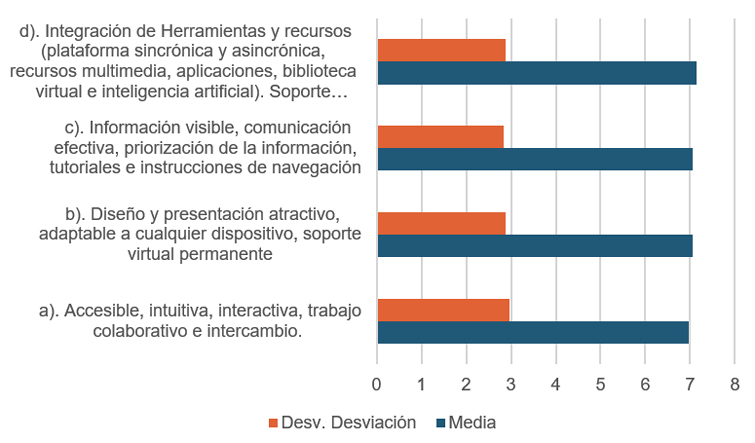
Although no strong differences were observed between the means, the results indicate that the students highly valued the aspect related with the integration of tools and resources, which demonstrates the importance of this component in the perception of the virtual platform as being user-friendly.
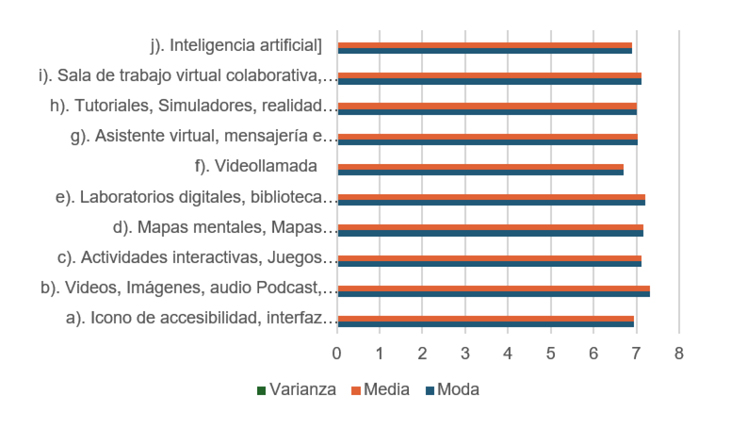
Figure 3. Rate the following resources, giving 10 if you consider them indispensable and 1 if you consider them unnecessary. Source: Created by the authors.
The Friedman test was applied to discover if there are significant differences between the items assessed. The results confirmed the presence of statistically significant differences χ2(9,N=431)=62.76, p<.001\chi^2(9, N = 431) = 62.76, p <.001 χ2(9,N=431)=62.76, p<.001. Complementarily, a repeated measures analysis of variance was performed, which showed a variance with a small effect (partial η2 =.020), indicating that the explained variability represents approximately 2 % of the total. This result confirms that all the resources evaluated are indispensable within a Virtual Learning Platform for it to be perceived as user-friendly and innovative.
Nevertheless, the means of the resources were different, with a better rating given to the following sets: b) videos, images, audio, podcast and audiobooks (M=7.32); e) digital laboratories, digital library, and classified pages (M=7.21); d) mental maps, conceptual maps, schemes, prioritized text, and trial and error testing (M=7.17); i) virtual collaborative workspaces, idea exchange spaces, forums, and shared editing documents (M=7.13); c) Interactive activities, interactive games, infographs, podcasts, jigsaw puzzles and puzzles (M=7.12); g) virtual assistant, messaging, and personal exchanges with the tutor (M=7.03); h) tutorials, simulators, virtual reality, and metaverse (M=7.02); a) accessibility icons, graphical interface, and menu access (M=6.95); j) artificial intelligence (M=6.89); and lastly, video calling (M=6.71).
These results show that although all the resources were positively scored, those related with multimedia content, advance digital resources, and collaborative spaces, were more highly regarded by the participants.
3.3 Interaction of teachers and students through the virtual learning environments
From the total, 21.81 % considered that the teacher-student interaction through virtual learning environments was recurrent (participative). On their part, 19.49 % perceived it as distant (does not generate an effect), 18.10 % as confusing (creates barriers), and 15.06 % as close (collaborative). Likewise, 12.53 % considered it attractive (communicative), and 12.99 % affable (generates trust).
Figure 4. Student survey on teacher-student interaction through the virtual learning platform.
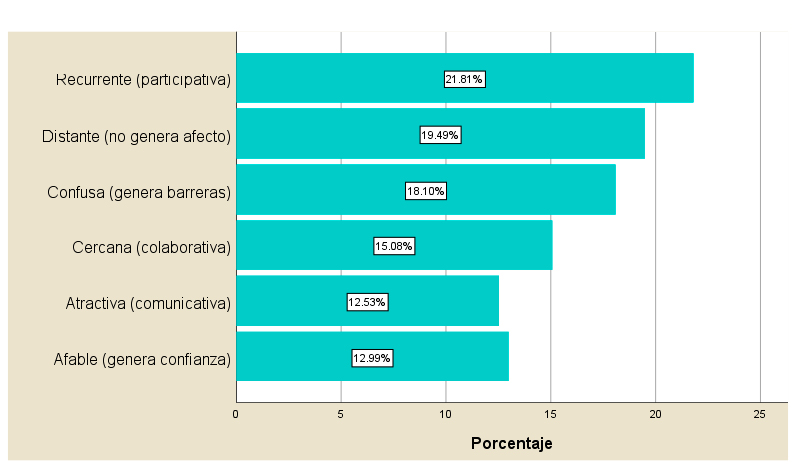
These results demonstrate diverse views about the teacher-student interaction in virtual learning environments.
In the survey given to teachers about the teacher-student interaction through virtual learning platforms, the results showed that 27.5 % considered them close (collaborative), 25.8 % attractive (communicative), and 24.2 % recurrent (participative). In lower percentages, 10.8 % perceived them as affable (generates trust), 5.8 % qualified them as confusing (creates barriers), while another 5.8 % as distant (does not generate affection).
These results show a predominantly positive assessment of the teacher-student interaction by teachers in virtual learning environments.
With respect to the assessment of a user-friendly virtual platform that address the different learning styles, a mean of 7.81 % was obtained from a scale of 10. Likewise, the results showed that 25 % of the participants was found in a percentile less than or equal to 7, 50 % in a percentile less or equal to 8, and 75 % in a percentile less or equal to 9, which demonstrates a predominantly high assessment by the participants.
4. DISCUSSION AND CONCLUSIONS
The study results allowed us to analyze, from an empirical perspective, the innovative and user-friendly aspects of the virtual learning environments in the teacher-student interaction, using the educational experience before and after the COVID-19 pandemic as the reference. In agreement with the aim of the study, the findings demonstrate that the virtual platforms transcended their initial function of content management to become comprehensive environments of interaction, communication, and pedagogic support, as pointed out in recent studies on digital education (Alcívar Fajardo et al., 2022; Fernández-Batanero et al., 2023; Sánchez-Cruzado et al., 2022).
With respect to the diversity of the platforms utilized, the results confirm a broad adoption of synchronous and asynchronous tools, with Zoom, Google Meet, WhatsApp, Google Classroom, Microsoft Teams, and Moodle being notable. This multiplicity coincides with that reported by Altamirano and Páramo (2025) and Ramos-Vite and Macahuachi-Núñez (2021), who sustained that after the pandemic, teachers opted for flexible platforms that were easy to access, compatible with different devices, prioritizing the continuity of the education process above technological standardization. The high diversity observed suggests a pragmatic adaptation of the teaching staff, oriented towards responding to real conditions of connectivity and digital competences of the students.
Similarly, the results show that most of the students used the virtual learning platforms intermittently. This suggests that although the virtual platforms were significantly incorporated into the educational process, their use is still not fully systematic for all students. This trend coincides with what was stated by Ramos-Vite and Macahuachi-Núñez (2021) who pointed out that after the COVID-19 pandemic, the integration of virtual learning environments has been progressive although unequal, conditioned by factors such as access to technology, the level of digital competence, and pedagogic strategies implemented by the teachers.
With respect to the innovative and user-friendly characteristics, the results showed high scores in all the dimensions assessed, underlining the integration of tools and resources (synchronous and asynchronous platforms, multimedia resources, digital libraries, and artificial intelligence), which was the aspect that was most valued by the students. This finding is consistent with studies that emphasized that innovation in virtual environments not only depends on the visual design, but the ability to integrate resources that enable personalization, autonomy, and active learning (Muñoz-Basols et al., 2024; Moral-Sánchez et al., 2022). The Friedman test confirmed statistically significant differences between the resources evaluated, although with a small effect size, which indicates that all the elements are relevant, although some are better evaluated depending on the experience of use.
As for the teaching staff-student body interaction, the results revealed different perceptions between students and teachers. While the former describe the interaction as mainly recurrent (participative, followed by perceptions of distance or confusing, the latter mostly evaluated it as close, attractive, and recurrent. This difference suggests a perception gap that coincides with that stated by Caballero and Lara (2024) and Feliz-Rosario et al. (2022), who pointed out that the effectiveness of the virtual interaction not only depends on the frequency of contact, but also the quality in communication, the clarity of guidance, and pedagogic support. The coexistence of positive and critical perceptions demonstrate that technology, by itself, does not guarantee an effective interaction, but requires intentional didactic strategies.
Similarly, the students revealed that the user-friendly and innovative platforms must be highly effective in addressing different learning styles, which complements what was stated by Manzueta and Pérez (2023), in that digital tools provide valuable perspectives for designing materials and activities adapted to different learning styles, work rhythms, and student preferences, promoting motivation and commitment. Personalization answers to student diversity, by adapting teaching methods and didactic resources to specific needs to offer optimum learning paths. Designing an effective platform enables interaction and increases the levels of motivation of both students and teachers.
From an ethical and pedagogical standpoint, these results have important implications. The high value placed on multimedia resources, collaborative spaces, and intelligent tools, reinforces the need for continued teacher training on the pedagogic use of technologies, as well as the design of platforms centered on the user experience, accessibility, and inclusion, aspects that are widely discussed in post-pandemic literature (Fernández-Batanero et al., 2023; Moral-Sánchez et al., 2022).
In response to the general aim, the study concludes that virtual learning environments, based on the experience during the COVID-19 pandemic, have become key spaces for the teacher-student interaction, as long as they include innovative and intuitive features oriented towards collaborative learning.
With respect to the research questions, the most utilized platforms were Zoom, Google Meet, WhatsApp, Google Classroom, Microsoft Teams and Moodle, demonstrating a preference for accessible, versatile, and widely known tools, as well as diverse usage. The use of virtual learning platforms by students is mostly moderate to frequent, which shows their consolidation as relevant resources in the modern educational context. However, the predominance of their occasional use suggests the need to strengthen institutional and pedagogic strategies that promote a more systematic and effective integration of these platforms, to favor a more consistent, equitable, and innovative learning experience.
The most highly valued features were the integration of tools and resources, the use of multimedia content, collaborative spaces, technical support, personalization, and ease of navigation, which confirms that innovation is associated to pedagogic functionality rather than an isolated technological aspect.
Interaction was mostly perceived as recurrent, close, and attractive, although perceptions of distance and confusion persisted, especially according to the students, which demonstrates the need to strengthen strategies of communication and pedagogic support in virtual environments. The platform’s effectiveness in addressing learning styles could provide an integrating aspect.
Lastly, the study contributes to the field of educational technology, as it provides empirical evidence on the perception of teachers and students with respect to virtual interaction in a post-pandemic context, highlighting that the effectiveness of virtual platforms depends on both technological resources and their intentional pedagogic use. The teacher-student interaction must be participative, collaborative, and communicative, seeking to considerably decrease barriers and generate a close and affective environment even at a distance.
5. STUDY LIMITATIONS AND FUTURE LINES OF RESEARCH
Despite the relevance of the findings, we believe it is necessary to point out some limitations that were found during the study, which could affect the reach and the interpretation of the results. These limitations, inherent to the design, sample and the instruments utilized, allow contextualizing the internal and external validity of the study, and provide the basis for strengthening posterior studies. With respect to the research design, causal relationships could not be established, only associative ones. Given the cross-cutting nature of the study, this could make it difficult to identify changes in the views, beliefs, perceptions, or attitudes towards the platforms. In addition, the lack of control of external variables impeded or limited the ability of the researchers to isolate the factors that could have an influence or delimit the results obtained.
In addition, the sample size could have been a limiting element for the generalization of the data, as it was only centered on an area in the Dominican Republic, although we find here the possibility of conducting a broader study, given that the study could be extended to the entire Dominican Republic population starting with the data obtained. Another future line of research involves using a qualitative approach of this work, through either focus groups or interviews to key informants, to grant a voice to the participants beyond the mere collection of quantitative data.
6. CONTRIBUTION OF THE AUTHORS
Conceptualization, CJQR and VM; data analysis, CJQR; formal analysis, CJQR; research, CJQR; methodology CJQR; writing3—preparation of the original draft, CJQR, VM, MG; writing—revision and editing, CJQR, VM, MG.
7. FUNDING
This study did not receive funding for its completion; it was developed entirely with the researcher’s own resources, without financial support from public or private institutions or national or international funding bodies.
8. REFERENCES
., ., & . (2022). Interacción y participación en ambientes virtuales de aprendizaje: Una mirada comprensiva desde la práctica. Universidad y Sociedad, 14(6), 526–533. http://scielo.sld.cu/scielo.php?script=sci_arttext&pid=S2218-36202022000600256
., & . (2025). Integración de plataformas virtuales en la educación. Journal of Educational Technology, 20(1), 55-70. https://doi.org/10.1234/jet.2025.20.1.55
., & . (2024). Transformación digital en la educación preuniversitaria. Revista Dominicana de Educación, 12(2), 210-225. https://doi.org/10.48204/j.saberes.v7n1.a4697
. (2024). Uso de TIC durante la pandemia COVID-19 en República Dominicana. Revista de Investigación Educativa, 8(1), 40-50. https://doi.org/10.62319/concordia.v.4i8.31
., ., & . (2022). Metodologías activas en aulas virtuales. Revista de Innovación Educativa, 14(2), 78-95.
., & . (2024). Aprendizaje autónomo en plataformas digitales. Educación Digital, 10(1), 33-48. https://doi.org/10.47230/Journal.TechInnovation.v3.n2.2024.14-22
., ., & . (2023). Evolución de las plataformas LMS hacia IA y realidad aumentada. Computers & Education, 195, Article 104712. https://doi.org/10.1016/j.compedu.2023.104712
., ., & . (2025). Percepción del alumnado de formación profesional sobre la funcionalidad de una plataforma virtual para el aprendizaje semipresencial (blended learning). Formación universitaria, 18(4), 27-38. https://dx.doi.org/10.4067/s0718-50062025000400027
., ., & . (2022). Metodología de la investigación (7.ª ed.). McGraw-Hill Education.
. (2012). Diseños de investigación ex post facto en educación. Editorial Académica.
. (2024). Plan de Educación para Todos Preservando la Salud. https://www.minerd.gob.do/planes/2020-2021
., &. (2023). Aprendizaje en red y personalización educativa. Revista de Pedagogía Digital, 9(2), 88-105. https://arete.ibero.edu.co/article/view/art.23209
., ., & . (2022). El modelo Flipped Learning enriquecido con plataformas educativas gamificadas para el aprendizaje de la geometría. Pixel-Bit. Revista De Medios Y Educación, 65, 149–182. https://doi.org/10.12795/pixelbit.93538
., & . (2024). Gestión de la interacción en entornos virtuales. Journal of Online Learning, 16(1), 20-35. https://doi.org/10.4324/9781003146391-10
., ., ., ., & . (2025). Recursos de plataformas virtuales dentro y fuera del aula. Revista Latinoamericana de Educación Digital, 22(1), 120-140. https://doi.org/10.33386/593dp.2025.1-2.2982
., & . (2025). Uso de líneas de tiempo como objetos de aprendizaje en la educación superior a distancia: análisis en la valoración estudiantil y factores influyentes. EDMETIC, 14(2), art.1. https://doi.org/10.21071/edmetic.v14i2.17506
., & . (2021). Plataformas virtuales como herramientas de enseñanza. Dominio de las Ciencias, 7(3), 1080–1098. https://doi.org/10.23857/dc.v7i3.2042
., ., & . (2024). Uso del Padlet y la comunicación asertiva en el curso Geografía bajo la modalidad Aula invertida. EDMETIC, 14(1), art.2. https://doi.org/10.21071/edmetic.v14i1.16649