El uso de aplicaciones basadas en Inteligencia Artificial para la generación de contenido en lengua inglesa: actitudes y prácticas de docentes en formación inicial
The use of ai-powered applications for english language content generation: attitudes and practices of pre-service teachers
Abeer Althaqafi
Institute at King Abdulaziz University, Saudi Arabia
Amani Alamri
Institute at King Abdulaziz University, Saudi Arabia
RESUMEN
El presente estudio de investigación tuvo como objetivo explorar las actitudes de los futuros docentes de inglés hacia la inteligencia artificial (IA) y su uso en la microenseñanza. Se buscó investigar si factores clave como la utilidad percibida, la facilidad de uso, la ansiedad ante la IA, la calidad de los resultados generados por la IA y las condiciones facilitadoras ejercían un impacto positivo o negativo sobre sus actitudes y el uso que hacen de dicha tecnología. El estudio adoptó un enfoque metodológico mixto para la recogida de datos, que incluyó la aplicación de un cuestionario y la realización de entrevistas. En total, 100 participantes respondieron el cuestionario y 5 de ellos tomaron parte en las entrevistas. Los hallazgos principales revelaron que los futuros docentes de inglés presentan actitudes positivas hacia la integración y el uso de la IA en la profesión docente. Asimismo, se identificaron diversos usos de la IA en sus sesiones de microenseñanza, siendo la planificación de clases y la propuesta de materiales didácticos los más frecuentes. El estudio también puso de manifiesto que la utilidad percibida de la IA y la facilidad de uso desempeñaron un papel significativo en la configuración de actitudes positivas entre los futuros docentes de inglés. No obstante, se constató que dichas actitudes se veían afectadas negativamente por la ansiedad ante la IA. Por último, el estudio destacó diversas implicaciones para los programas de formación del profesorado y para los docentes en formación inicial, con el fin de mejorar su conocimiento pedagógico y su desempeño profesional, así como garantizar una implementación eficaz y un uso responsable de la IA en la enseñanza.
PALABRAS CLAVE
Inteligencia artificial; Actitudes; Generación de contenidos; Docentes en formación inicial; Modelo de Aceptación Tecnológica (TAM).
ABSTRACT
This research study aimed to explore pre-service English teachers’ attitudes toward AI and their use of it in micro-teaching. It sought to investigate whether key factors such as perceived usefulness, ease of use, AI anxiety, AI output quality, and facilitating conditions had a positive or negative impact on their attitudes and use of AI. The study employed a mixed-method approach to collect data, including using a questionnaire and conducting interviews. Hence, 100 respondents answered the questionnaire, and 5 participants took part in the interview. The main findings revealed that pre-service English teachers have positive attitudes toward AI integration and use in teaching profession. Additionally, it identified several uses of AI in their micro-teaching sessions, with lesson planning and the suggestion of instructional materials being the most common. The study also revealed that perceived AI usefulness and ease of use played a significant role for shaping positive attitudes among pre-service English teachers. However, their attitudes were found to be negatively affected by AI anxiety. Finally, the study highlighted multiple implications for teacher education programs and pre-service teachers to enhance their pedagogical knowledge and professional performance as well as ensuring effective implementation and responsible use of AI in teaching.
KEYWORDS
Artificial Intelligence; Attitudes; Content Generation; Pre-service Teachers; Technology Acceptance Model.
INTRODUCTION
The use of AI in education as a pedagogical tool has significantly helped in enhancing the effectiveness, efficiency, and quality of instruction (Chen et al., 2020). With its affordances, AI can also play a crucial role in facilitating the teaching experience for pre-service teachers who might lack instructional knowledge and real-world educational expertise (Kusuma et al., 2024). Additionally, the use of AI can go beyond serving as a helpful teaching tool for pre-service teachers but also to support their professional development. For instance, AI tools can assist those future teachers in improving instructional and assessment practices by providing meaningful assessment and teaching strategies (Suchánová, 2023). As these AI tools enable them to analyse and learn from the generated materials and therefore develop their own tailored content. However, as AI is creating a new era of education and an innovative approach to teaching, perspectives are evolving to comprehend its role and effectiveness in the domain. For example, Sumakul et al. (2022) have questioned whether AI is a friend or foe in English language instruction, as AI technologies provide students with effective and powerful tools that may threaten the role of human language teachers. As a result, they have concluded that even while AI may pose certain challenges, its potential to enhance educational experience for both teachers and students makes it seen as a friend to the field of education. Moreover, in their critical review of AI in education, Lameras and Arnab (2022) emphasized the need for educators to rethink their roles, improve their teaching methodologies, and comprehend the new skills and capabilities required for the effective integration of AI in educational contexts. Some scholars also discussed how AI is changing teachers’ roles. In terms of language development, new technologies including AI contribute greatly to changing the role of the teachers as primary facilitators by providing students with a multitude of sources and services to develop and assess their language learning and acquisition (Law, 2024). AI is not just redefining the role of language teachers in the modern era concerning their implementation of AI, but it also emphasizes the need to ensure critical and ethical use of AI tools among their students and how to effectively utilize it for language learning (Vogt & Flindt, 2023). Therefore, this study aims to investigate pre-service English teachers’ attitudes and actual pedagogical practices of AI in the Saudi context to provide insights into the future of AI in educational practice and research.
Research Questions
The research questions are derived and developed based on the research objectives to guide the study and ensure a consistent focus on its purpose. Thus, the study aims to answer the following research questions:
1.What are the attitudes of pre-service English teachers toward the use of Artificial Intelligence in English language teaching?
2.What is the relationship between certain TAM factors and pre-service English teachers’ attitudes toward the use of AI in English language teaching?
3.How do pre-service English teachers use AI tools in their English language micro-teaching sessions?
LITERATURE REVIEW
Artificial Intelligence in Education
The widespread use of artificial intelligence technology has opened up greater opportunities for educational advancement (Zhang et al., 2023). AI plays a transformative yet complex role in education, making it crucial to comprehend and prepare for the increasingly digital world in teaching and learning (Karataş & Yüce, 2024). One significant application of AI in education is generative AI (GenAI). GenAI is driving a major shift and revolution in current educational practices (Baidoo-Anu & Ansah, 2023). GenAI refers to tools that generate intelligent-looking output based on prompts given by humans, including text, images, simulations, 3D objects, and videos (Peres et al., 2023). In the context of education, GenAI facilitates the generation of tailored educational content and ideas, providing individualized and effective teaching experience that can help boost learning motivation (Saudi Data & AI Authority, 2023). GenAI tools such as ChatGPT can greatly enhance the quality of teaching in terms of content generation such as creating in-class activities, customized lesson plans and rubrics, quizzes, presentations, and grading, saving the teacher’s time and effort (Bae et al., 2024; Baidoo-Anu & Ansah, 2023; Koraishi, 2023; Nyaaba et al., 2024; Uwosomah & Dooly, 2025). ChatGPT can also provide both teachers and their students with timely individualized feedback on areas that need improvement and make suggestions based on the inputs provided by the teacher, enhancing and developing their educational experience (Fu et al., 2020; Van den Berg & du Plessis, 2023).
AI Benefits, Challenges, and Concerns in Education
One of the most significant advantages of using AI in education is the personalization of learning which is a teaching technique for tailoring learning to students’ individual needs, interests, and strong and weak points (Samad et al., 2022). For instance, to meet their specific needs, AI can help teachers to offer them appropriate materials and resources, identify areas for improvement, and modify the challenge level of the activities (Harry, 2023). Hence, education under the umbrella of AI is shifting teaching to more tailored and personalized education compared to traditional education which has been dominated by one- size-fits-all instruction (Yang, 2021). Insightful ideas and new, varied perspectives generated by GenAI are also beneficial to pre-service teachers, aiding in broadening their knowledge and viewpoints (Nyaaba et al., 2024). On the other hand, despite the powerful benefits of these AI technologies and systems on the field of education, ethical concerns such as AI bias, data security, and privacy issues are still being raised among pre-service teachers despite their positive attitudes toward the technology (Harakchiyska & Vassilev, 2024; Özer-Altınkaya & Yetkin, 2025; Taşçı & Tunaz, 2024). This highlights the need for greater work and attention to these notable drawbacks. Additionally, pre-service teachers share their concerns regarding their teacher education programs’ lack of emphasis on the potential pedagogical applications of AI in classrooms, identifying limited and insufficient training and guidance for AI implementation in education (Ayanwale et al., 2024; Bautista et al., 2024; Guan et al, 2025; Karina & Kastuhandani, 2024; Pokrivcakova, 2023; Uwosomah & Dooly, 2025). In line with this need, these programs should prepare student teachers for the successful and effective integration of AI tools into their classrooms through using a range of training methods, including comprehensive courses, workshops, and hands-on activities (Özkan et al., 2024).
THEORETICAL FRAMEWORK
This research is grounded on the Technology Acceptance Model (TAM) which forms the basis to understand the attitudes of pre-service English teachers towards artificial intelligence and their actual use of it in their micro-teaching experiences. The technology acceptance model was developed by Fred Davis (1985) to explain how people accept or reject technologies. TAM is based on the Theory of Reasoned Action (TRA) that was proposed by Fishbein and Ajzen (1975). According to TRA, what determines a person’s intentions to perform a particular behavior (e.g. using AI in education) are two key factors that are attitudes toward the behavior and subjective norms. In the context of TAM, two main salient beliefs that are a technology ‘s perceived usefulness (PU) and perceived ease of use (PEOU) are what influence decisions regarding a technology adoption and use and shape the attitudes of technology users that possibly leading to actual technology use (Davis (1989)) (See Figure 1).
Figure 1 Original Technology Acceptance Model (TAM1) adopted by Davis (1985).

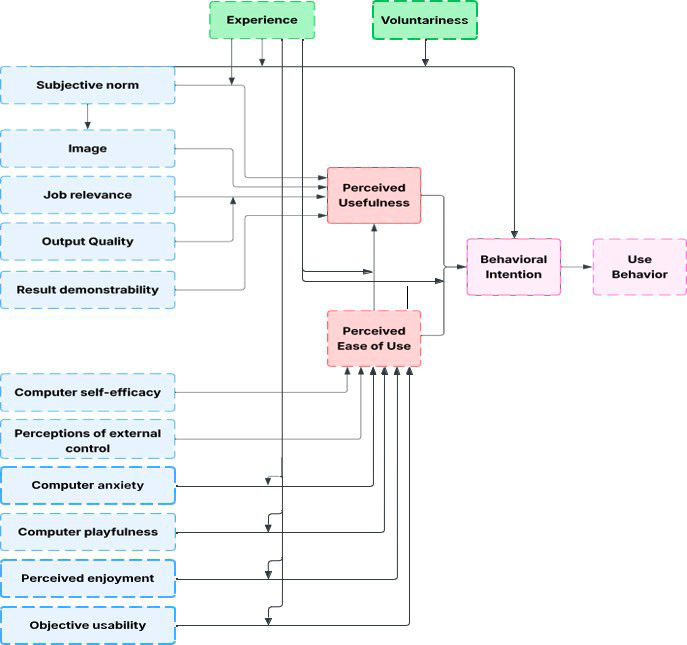
Davis (1989) has defined these two concepts where perceived usefulness is the extent to which an individual considers that using a particular technology improves their job performance. Perceived ease of use is the extent to which an individual considers that using a particular technology will be effortless and free of difficulty (Davis, 1989). Furthermore, several modifications and extensions have been made to the model since it included other external variables, predicting attitudes toward technology, behavioral intentions, or actual behavioral use (Marangunić & Granić, 2015). For example, an extension of the model called TAM2 was proposed by Venkatesh and Davis (2000) where they both developed new constructs that would explain perceived usefulness of adopted technologies in a manner that allows for more comprehensible understanding of the model. All these factors were developed to provide thorough explanation of the utility of adopted technologies. However, new constructs were added to the perceived ease of use to better explain this significant element in the model. These new variables included computer self- efficacy, computer anxiety, perceptions of external control, computer playfulness, perceived enjoyment, and objective usability (See Figure 2).
Figure 2 Expanded Technology Acceptance Model (TAM3) adopted from Venkatesh and Bala (2008).
Key Factors Affecting Attitudes and Use of AI Perceived Usefulness
As defined by Davis (1989) PU is the utility of using a particular technology on job performance. Since earlier research has proved that PU has a strong direct influence on technology acceptance and use, recent studies have also shown a continuing trend toward technology’s perceived usefulness as a direct major factor influencing its usage (Backfisch et al., 2021). For instance, literature has proven that perceived usefulness and perceived ease of use are key factors influencing pre-service teachers’ intention to use AI (Ali et al., 2024; Runge et al., 2025; Zhang et al., 2023). This suggests that teachers can be ultimately driven by AI’s practical benefits. This also indicates that when educators see tangible benefits of using AI, their intentions and willingness to adopt it increase significantly.
Perceived Ease of Use
PEOU is the other key factor that strongly impacts the users’ attitudes, behavioral intentions, and actual use of the technology. It is when the user of technology perceives it as an easy-to-use tool (Davis, 1989). Literature has shown that PEOS has a strong influence on pre-service teachers’ acceptance and use of AI as a strong predictor for integrating AI in education (Benali & Boukare, 2023; Ma & Lei, 2024). This suggests that when pre-service teachers see AI as easy to use, they are more likely to adopt it into teaching. Thus, PEOU as a key variable employed in the study, enables pre-service teachers to discuss their experiences, including its possible advantages and disadvantages on teaching in general and English language teaching in particular as well as whether it was easy or difficult to use.
AI Anxiety
Anxiety towards AI can be another key factor that affects how pre-service teachers accept and use AI. A strong relationship has been found between AI anxiety and negative attitudes toward AI (Eyüp & Kayhan, 2023). AI anxiety was also found to have a negative impact on pre-service teachers’ engagement in learning and using AI technology (Ayanwale et al., 2024). Additionally, teachers who are anxious about AI are less likely to find it easy to use or helpful (Wang et al., 2024). Consequently, high self-efficacy towards AI use can lower AI anxiety and encourage positive attitudes toward its perceived usefulness and ease of use. Furthermore, according to Bae et al. (2024), there’s a strong correlation between AI knowledge and anxiety. The study engaged pre-service teachers with no prior AI experience through four-week courses along with weekly discussions regarding their experiences with using AI technology. Findings revealed that as their awareness and knowledge of AI increased, their anxiety decreased.
AI Output Quality
Output Quality refers to the performance results of a technology such as AI when it is used to complete job-related tasks (Ma & Lei, 2024). Accordingly, pre-service teachers have expressed varying opinions regarding the output quality of AI technology. One perspective pre-service teachers shared is that AI outputs are criticized for being generic in nature and for being difficult to produce tailored and unique responses, despite their capacity to create content (Hur, 2024; Karata¸s & Yüce, 2024; Uwosomah & Dooly, 2025). Additionally, some have voiced concerns about how AI can show bias, unfairness, and misinformation (Bae et al., 2024). Furthermore, one of the opinions that was also raised among pre-service educators is that while AI outputs are inspiring and useful, they must be adapted and modified to guarantee responsible AI use and meet students’ needs and learning objectives (Karina & Kastuhandani, 2024). Hence, critical evaluation of AI’s outputs is a crucial process for ensuring accuracy and reliability (Alvarez et al., 2024). In contrast, some pre-service teachers showed an extremely trusting attitude toward AI’s ability to produce reliable and accurate data (Guan et al., 2025).
Facilitating Conditions
Facilitating conditions play a crucial role in supporting and encouraging the effective use of AI technologies in educational settings and teaching practices. Facilitating conditions are identified as the extent of one’s belief that there is an organizational and technical infrastructure to support the use of a technology (Venkatesh et al., 2003). Facilitating conditions mainly include the existence of the necessary equipment such as computers and the availability of technical support staff for assistance with any technological difficulties (Venkatesh et al., 2003). Therefore, facilitating conditions have a direct influence on the effectiveness of technology implementation in educational settings. Additionally, they can greatly aid in promoting a positive attitude toward AI integration into pedagogical practices (Galindo-Domínguez et al., 2024).
METHODOLOGY
Research Paradigm
A research paradigm is a set of assumptions and beliefs that guide the research process in terms of its ontological, epistemological components, and methodological choices (Guba and Lincoln, 1994). It includes key philosophical concepts about what is one’s beliefs and views about reality (ontology), how we can know what we want to know (epistemology), and what methods we should use to best understand this reality and knowledge (Rehman & Alharthi, 2016). Since this study follows a mixed-methods design, the pragmatic paradigm is adopted. As this philosophical position considers to be the paradigmatic partner for this research approach (Tashakkori & Teddlie, 2010). Pragmatism allows researchers to work with both quantitative and qualitative data to better comprehend the investigated phenomena (Creswell & Clark, 2018). This paradigm stipulates that each individual has a unique interpretation of reality and there is no one fixed truth about it (ontology), and it supports the combination of quantitative and qualitative research methods (methodology) (Kivunja & Kuyini, 2017). While its epistemological aspect asserts that what counts as real, accepted, and valid knowledge can be created and found by observable phenomena and also through subjective meanings such as individuals’ feelings, opinions, and experiences (Wahyuni, 2012). A Key feature of mixed methods research that pragmatism supports is what Johnson & Onwuegbuzie (2004) have called a ’methodological pluralism’ that enables researchers to select multiple tools to blend numerical data with personal experiences, providing richer, more profound, and accurate results.
Participants
The study’s participants were pre-service English teachers who are enrolled in TESOL programs in Saudi universities. These student teachers underwent micro-teaching, where they were required to conduct mini English lessons as part of their curriculum within their teacher education programs in order to assess their English teaching abilities. The attitudes and actual AI practices of these future teachers were investigated through their teaching experience.
Regarding the first method of data collection, which is the questionnaire. 100 (91 females and 9 males) master’s TESOL students from different Saudi universities, including King Abdulaziz University, King Saud University, and Taif University, answered the questionnaire. Their ages ranged from 22 to 49. Purposive sampling was used in order to deliberately choose the participants. As this sampling technique enables researchers to choose participants who had direct exposure to the specific event under investigation (Sibona & Walczak, 2012). Additionally, it allows them to find participants who can offer rich and varied data in order to broaden understanding and gain comprehensive knowledge about what is being investigated (Dörnyei, 2007). Those who participated in the questionnaire were contacted online via WhatsApp and Telegram from different TESOL groups and accounts. As a result, the questionnaire was administered to the participants based on their academic background (they had to be TESOL students), and according to the condition that they had previously completed micro-teaching.
Concerning the other data collection method, which is the interview, 5 MA TESOL students were chosen to gain deeper comprehension and knowledge about their pedagogical experience with AI through conducting interviews.
Accordingly, the purpose of this is not only to gather more comprehensive information but also to verify the consistency of the data that has been collected quantitatively, enhancing the robustness of findings (Patton, 2002). Semi- structured interviews were employed, which often includes predetermined questions while providing the interviewees the flexibility to express any relevant ideas that come up during the interview (Wahyuni,
2012). This technique offers greater freedom of time and questions to explore various topics while obtaining greater depth and knowledge (Aksu, 2009). Purposive sampling was also conducted to ensure that the participants fulfilled the selection criteria. Participants were directly contacted via WhatsApp, and they were given all the necessary instructions regarding the interview procedures.
Data Collection Instruments
The data was collected through two methods. The first method is a questionnaire that began with general instructions, included the study’s purpose, voluntary participation, and number of questions with estimated completion time. It consisted of 9 sections started with demographic information about the participants’ gender, age group, major, and university name. Followed with an important question to confirm who could be included in the study, which was whether or not they had conducted micro-teaching session in their teacher education programs and whether or not they had used AI tools in this teaching experience. According to the selection criteria, the former question was as significant as the question about their major. Therefore, responses from those who did not major in TESOL or have previous experience with micro-teaching were removed.
The second method for collecting data involved conducting semi-structured interviews. The interview questions were organized into categories that addressed all the key aspects of the research to better explain the quantitative data. The categories included questions about AI usage, AI benefits, challenges, and concerns, as well as attitudes toward AI, and the key TAM factors affecting attitudes and use of AI.
The Internal Reliability of the Questionnaire
To ensure the reliability of the questionnaire, the degree of stability of each category of the study tool was calculated separately, using the Cronbach’s alpha equation. The study tool was applied to a survey sample of (20) TESOL students outside the primary sample. The results are shown in the following table:
Table 1 Cronbach’s alpha reliability coefficient values for the study categories and the questionnaire as a whole.
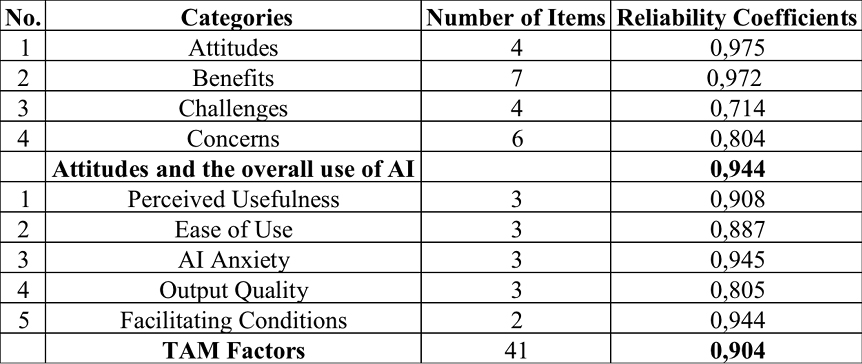
The results in Table 1 show that the values of the reliability coefficients for attitudes and the use of artificial intelligence are high, as the values of the Cronbach’s alpha coefficient for these categories ranged between (0.714 – 0.975). Overall, the attitudes and the use of artificial intelligence as a whole is (0.944). Additionally, the reliability coefficient values for the TAM factors are also high, ranging between (0.805 – 0.945), and (0.904) as a whole. These high values indicate that the questionnaire items are consistent and reliable (Dörnyei, 2007), which confirms the validity of the tool for application to the study sample.
Ethical Considerations
For the questionnaire, the respondents were informed that their participation in the questionnaire is entirely voluntary, and their information would remain confidential and only be used for academic research purposes. For the interviews, the participants were required to sign a consent form that had all the necessary details regarding their participation in the interview. They were also informed about the purpose of the study and their voluntary participation prior to and during the interview.
Data Analysis & Discussion
Quantitative Data Analysis: Demographic Information
Figure 3 shows that the majority of the study sample was female (91 %). This refers to the fact that there are significantly more female students than male students enrolled in TESOL programs in Saudi Arabia. Additionally, 51 % of the study samples were between the ages of 22 and 28. Moreover, 68 % of the participants were affiliated with KAU. As there was direct access to the sample population since the researcher is a member of the KAU institution.
Figure 3 Demographic Information of Participants.
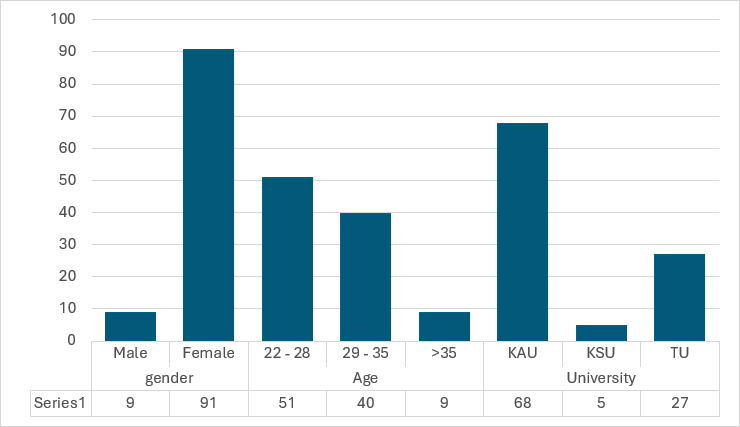
Figure 4 Use of AI Tools in Micro-teaching.

Participants were asked about their micro-teaching experience and use of AI tools. As responses from those who had not micro-teaching were excluded. Therefore, the results in Figure 4 show that all participants underwent micro- teaching experience, and that 69 % of them used AI tools during the micro- teaching sessions.
Results of Research Question 1: (What are the attitudes of pre-service English teachers toward the use of Artificial Intelligence in English language teaching?
The participants were asked about their attitudes toward the use of AI in English language teaching based on their micro-teaching experiences. The study also addressed perceived benefits and concerns associated with using AI for pedagogical purposes to clarify and explain pre-service teachers’ attitudes. Therefore, their positive attitudes were based on AI perceived benefits, and their negative attitudes were expressed through AI-related concerns.
Table 2 One-Sample t-test Results on Participants’ Attitudes toward Artificial Intelligence in Education.
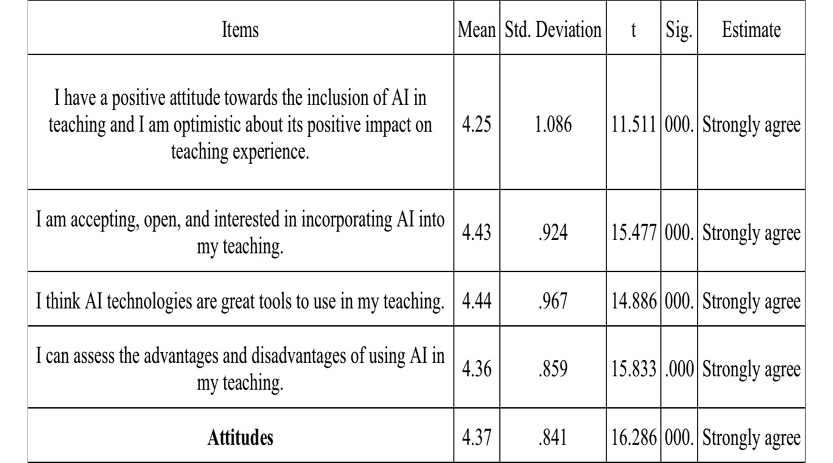
The results of Table (2) indicate that the sample’s average responses were high across all items related to their attitudes toward integrating artificial intelligence technologies into Education. The arithmetic means ranged between (4.25 - 4.44), with a standard deviation ranging between (0.924 – 1.086.) which are higher than the hypothetical mean (3). All t-values were statistically significant at the 0.05 level, with a significance level of 0.000, indicating statistically significant differences between the sample’s response means and the hypothetical mean, in favor of integrating artificial intelligence technologies into education.
Table 3 Results of the One-Sample t-test on the Perceived Benefits of Using Artificial Intelligence in Education.
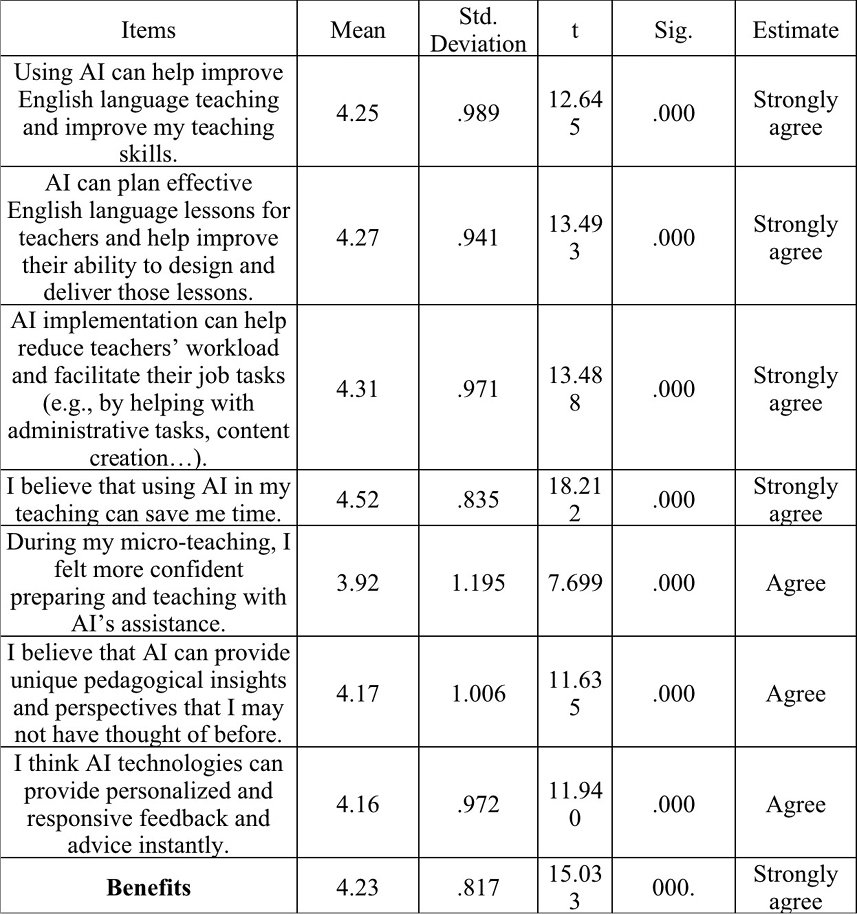
Participants answered questions about the benefits of AI, which helped explain their positive attitudes. The results of Table (3) indicate that the average responses of sample members were high across all items related to the perceived benefits of using artificial intelligence in Education, with arithmetic means ranging from (3.92 - 4.52), and with a standard deviation ranging between (0.835 – 1.195.) Values higher than the hypothetical mean (3), reflecting how participants perceive various benefits of using artificial intelligence in education with AI saving their time as the primary benefit. All t- values were statistically significant at the 0.05 level, with a significance level of 0.000, indicating the presence of statistically significant differences between the sample response averages and the hypothetical average, in favor of the importance of the perceived benefits of using artificial intelligence in education on participants’ attitudes.
In general, the overall mean for the perceived benefits of using artificial intelligence in education was 4.23, with a (strongly agree) rating, indicating that participants strongly perceive AI as beneficial in various aspects of teaching and reflect a positive attitude toward its use in teaching.
Table 4 Results of the One-Sample t-test Related to the Challenges that May Pose Obstacles to the Effective Application of Artificial Intelligence.
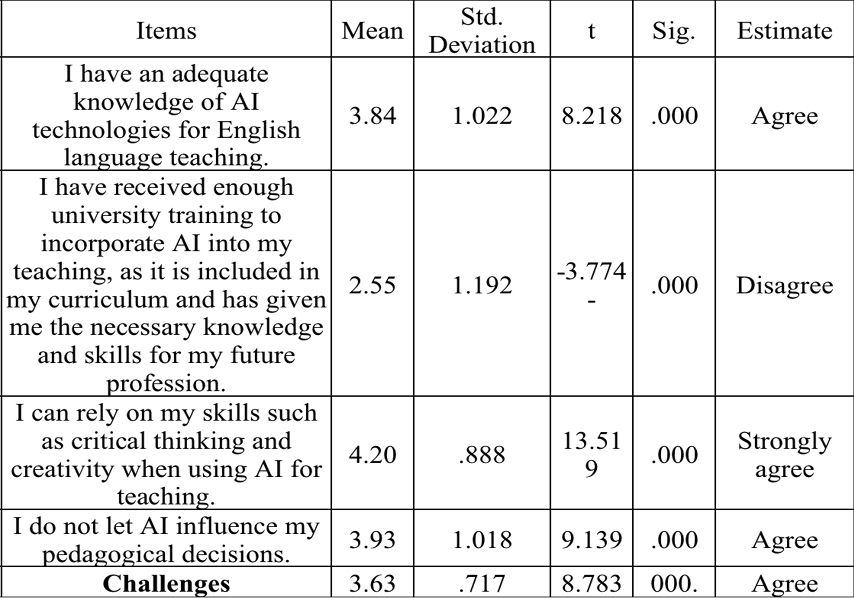
The results of Table (4) indicate that the challenges that may pose obstacles to the effective application of artificial intelligence had an arithmetic mean ranging between (2.55 – 4.20), with a standard deviation ranging between (0.888 – 1.192).
Statement (2), which says that (I have received enough university training to incorporate AI into my teaching, as it is included in my curriculum and has given me the necessary knowledge and skills for my future profession.), came in last place, with an arithmetic mean of (2.55), a standard deviation of (1.192), and a significance level of (0.000). It ranked first in terms of the most key challenges that may pose obstacles to the effective application of artificial intelligence in teaching. This indicates that participants have not received sufficient university training to integrate artificial intelligence into education.
Results of Research Question 2: (Is there a relationship between certain TAM factors and pre-service teachers’ attitudes toward the use of Artificial Intelligence in English language teaching?)
The quantitative results reflect the descriptive analysis that shows the correlation between certain TAM factors (as indicated in Table 4) and pre- service teachers’ attitudes toward AI integration into teaching.
Table 5 Results of the One-Sample t-test on Perceived AI Usefulness in Micro-teaching.
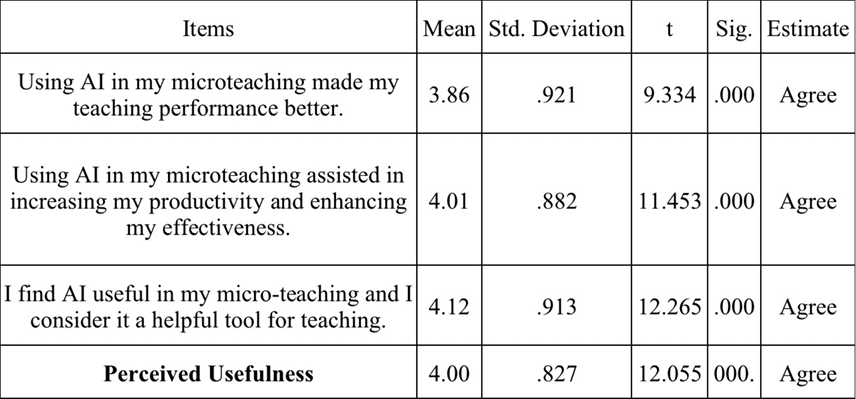
The results of Table (5) indicate that participants’ responses were high across all items related to perceived usefulness, with arithmetic means ranging between (3.86 - 4.12), with a standard deviation ranging between (0.882 - 0.921). All t-values were statistically significant at the 0.05 level, with a significance level of 0.000, reflecting the positive impact of AI usefulness on attitudes and the use of AI in teaching.
In general, the results show that the overall mean of perceived usefulness influencing attitudes and the use of AI in teaching was 4.00, with a standard deviation of 0.827, and a significance level of 0.000, with a “agree” rating, demonstrating a strong correlation between the usefulness of AI and positive attitudes about it, and suggesting that pre-service teachers’ positive attitudes can be explained by their realization of its value in their micro-teaching.
Table 6 Results of the One-Sample t-test on Participants’ Anxiety toward Using AI in Teaching.

The results indicate that the sample members’ responses were lower than the hypothetical mean in all items related to the impact of anxiety about artificial intelligence on attitudes and use of artificial intelligence. The arithmetic means ranged between 2.06 and 2.28, with a standard deviation of 1.111 and 1.155. Furthermore, all t-values were statistically significant at the 0.05 level, with a significance level of 0.000.
In general, the results showed that the overall mean for the effect of the anxiety factor on attitudes and use of AI was (2.19), with a standard deviation of (1.051), and a significance level of (0.000), with a (disagree) estimate. Overall, the disagreement on AI anxiety items indicates that participants generally do not feel anxious about using AI in their teaching, and negative emotions such as fear or nervousness do not play a major role in shaping their attitudes and use of AI for pedagogical practices.
Table 7 Results of the One-Sample t-test on AI Output Quality.

The results indicate that the participants’ responses regarding the effect of AI output quality on attitudes and use of AI had an arithmetic mean ranging from (2.76 - 4.05), with a standard deviation ranging from (0.978 - 1.150).
The results showed that participants are aware that AI may produce incorrect results and may exhibit bias and unfairness, with an arithmetic mean of (4.05), a standard deviation of (0.978), and a significance level of (0.000). The results also showed that participants were neutral and showed no disagreement regarding the quality of AI outputs being excellent, accurate, and reliable. With an arithmetic mean of 3.01, a standard deviation of 1.150, and a significance level of 0.931. Respondents were also neutral regarding the quality of AI outputs being problematic, with an arithmetic mean of 2.76, a standard deviation of 1.120, and a significance level of 0.035. Overall, the results showed that the overall mean for the impact of output quality on AI attitudes and use was 3.27, with a standard deviation of 0,754 and a significance level of 0.000, with a neutral estimate. This shows that participants held neutral views on AI output quality, suggesting some uncertainty and distrust about the accuracy and reliability of AI-generated content.
Table 8 Results of the One-Sample t-test on Facilitating Conditions when Using AI in Micro-teaching.

The results of Table (8) indicate that participants’ responses were high across all items related to the effect of facilitating conditions on attitudes and use of artificial intelligence. The mean ranged between 3.69 and 4.20, with a standard deviation of 0.816 and 1.051.
The results showed that participants had the necessary resources (computer, internet connection, etc.) to use artificial intelligence in micro-teaching, with an arithmetic mean of 4.20, a standard deviation of 0.816, and a significance level of 0.000. Conversely, participants perceived that they had the ability to obtain assistance if they encountered difficulties with artificial intelligence during the micro-teaching session, with an arithmetic mean of 3.69, a standard deviation of 1.051, and a significance level of 0.000.
Results Related to the Relationship between the Influence of the Key Factors on Attitudes and Use of Artificial Intelligence
Table 9 The Relationship between the Influence of TAM Factors on Atitudes and Use of Artificial Intelligence.
|
Attitudes |
Benefits |
Challenges |
Concerns |
||
|---|---|---|---|---|---|
|
Perceived Usefulnes s |
Pearson Correlatio n |
.492** |
.653** |
.462** |
.173 |
|
Sig. (2- tailed) |
.000 |
.000 |
.000 |
.086 |
|
|
N |
100 |
100 |
100 |
100 |
|
|
Ease of Use |
Pearson Correlatio n |
.422** |
.527** |
.517** |
.155 |
|
Sig. (2- tailed) |
.000 |
.000 |
.000 |
.123 |
|
|
N |
100 |
100 |
100 |
100 |
|
|
AI Self- Efficacy |
Pearson Correlatio n |
.618** |
.661** |
.479** |
–.023- |
|
Sig. (2- tailed) |
.000 |
.000 |
.000 |
.820 |
|
|
N |
100 |
100 |
100 |
100 |
|
|
AI Anxiety |
Pearson Correlatio n |
–.225-* |
–.215-* |
.030 |
.374** |
|
Sig. (2- tailed) |
.025 |
.031 |
.767 |
.000 |
|
|
N |
100 |
100 |
100 |
100 |
|
|
Output Quality |
Pearson Correlatio n |
.431** |
.450** |
.388** |
.118 |
|
Sig. (2- tailed) |
.000 |
.000 |
.000 |
.243 |
|
|
N |
100 |
100 |
100 |
100 |
|
|
Facilitating Conditions |
Pearson Correlatio n |
.402** |
.484** |
.409** |
.160 |
|
Sig. (2- tailed) |
.000 |
.000 |
.000 |
.113 |
|
|
N |
100 |
100 |
100 |
100 |
|
.**Correlation is significant at the 0.01 level (2-tailed). *. Correlation is significant at the 0.05 level (2-tailed).
The results in Table (9) show a strong, positive, and statistically significant relationship at the 0.01 level between (Perceived Usefulness, Ease of Use, AI Self-Efficacy, Output Quality, Facilitating Conditions) and (Attitudes, Benefits, Challenges).
The results also showed a statistically significant relationship between (AI Anxiety) and (Concerns), meaning that the greater the anxiety about AI, the greater the fear of the negative consequences of its use. There is also a statistically significant, inverse relationship between (AI Anxiety) and (Attitudes, Benefits), that is, the more anxiety about artificial intelligence increases, the weaker the positive attitudes and perceived benefits of using artificial intelligence in education. On the other hand, there is no statistically significant relationship between (AI Anxiety) and (Challenges).
Qualitative Data Analysis
The focus of the qualitative data analysis section is to answer the third research question and to identify themes emerged from the interviews. As these findings can assist in confirming, clarifying, triangulating data, and expanding on some of the conclusions drawn from the questionnaire-analyzed data.
Research Question 3: How do Saudi pre-service English teachers use AI- powered applications in their English language micro-teaching sessions? When pre-service English teachers described their AI usage when prepared their lessons for their micro-teaching classes, they discussed which AI tools were used and for what purposes. The results showed that the most widely used AI tool was ChatGPT. They also shared other tools that either include AI features or are fully powered by AI such as Notion, Kahoot, Canva, Quizlet, Quizziz, Gemini, Poe, Gamma, Quillbot, and Grammarly. Participants’ opinions varied regarding the purpose of using AI tools. Nevertheless, AI tools were mainly used for creating and organizing lesson plans, generating instructional materials like short exercises and worksheets and engaging students with AI- generated interactive games. They were also used to create dialogues and discussion prompts, improve teaching methods such as scaffolding complex grammar, paraphrase sentences, and check grammatical errors. Figure 5 summarizes the five main purposes for which AI tools were used by pre-service English teachers in their micro-teaching classes.
Figure 5 Summary of the Five Purposes of Using AI Tools in Micro-teaching.

Findings: Pre-service teachers hold positive attitudes toward the integration and use of AI in education
Regarding pre-service teachers’ attitudes, the qualitative data analysis shows that the interview participants hold positive attitudes toward the integration and use of AI in education. This finding confirms the quantitative data result since the attitudes of questionnaire respondents were positive overall. For example, one participant stated that AI tools are, “Very helpful and interesting because they provide me with great ideas and examples which make my lesson very active and engaging for students and attractive” (Participant 3). Themes derived from perceived benefits and concerns of AI are presented in tables 9 and 10, which are important aspects of pre-service teachers’ attitudes toward AI.
Table 10 Themes and Sub-themes of Perceived Benefits of AI in Micro-teaching.
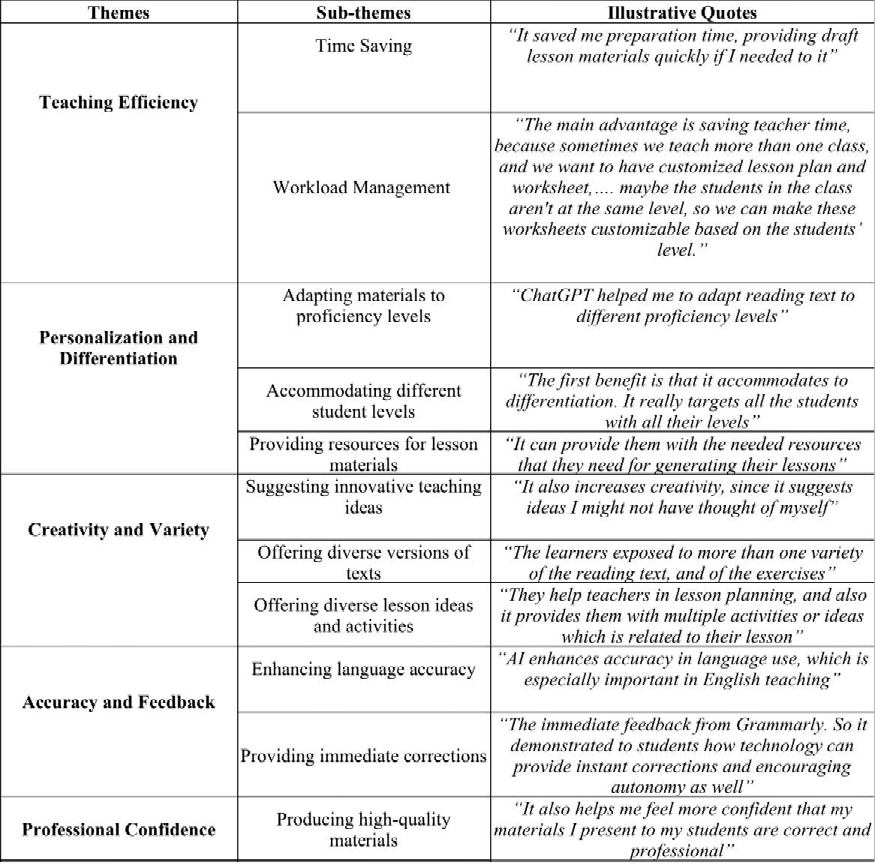
The analysis of participants’ responses elaborated on several key benefits of using AI tools in teaching that were provided in the questionnaire. A central theme was teaching efficiency, as all participants emphasized that AI aids in reducing lesson preparation time and in managing the workload for multiple classes. Additionally, student personalization and differentiation was also a major theme as participants were able to adapt instructional materials to students’ different language levels and accommodate them to varying proficiency needs. Another important benefit was the availability of resources since AI can instantly provide teachers with resources that include draft lesson materials to support their lesson planning process. Furthermore, participants also highlighted creativity and variety as AI provided them with innovative teaching ideas and diverse versions of texts and exercises to meet their students’ language needs.
CONCLUSION
The study aimed to fulfill the research objectives and provide answers to the research questions through a mixed-methods approach. Initially, the main purpose was to explore the attitudes of pre-service English teachers with
artificial intelligence during their micro-teaching sessions. Thus, the study found that pre-service English teachers have strong positive attitudes toward AI integration and use in English language instruction. Additionally, based on their micro-teaching experiences, pre-service teachers reported several perceived benefits, like reducing their workload, enhancing language accuracy, and offering diverse lesson ideas and activities. They also revealed some challenges and concerns regarding the use of AI tools in teaching, such as the lack of training, risk of over-reliance, and information inaccuracy. Subsequently, the study also aimed to identify the relationship between certain TAM factors and pre-service teachers’ attitudes toward AI. As a result, the findings showed that perceived usefulness and ease of use factors had a positive impact and a strong correlation with pre-service teachers shaping positive attitudes and using AI effectively in their micro-teaching. However, AI output quality and facilitating conditions had indirect impact on pre-service teachers’ attitudes toward AI in education. As they have used AI tools in their micro-teaching and formed positive attitudes despite their recognition of the limitations of AI output quality and the facilitating conditions of their teacher education programs. In other words, pre-service teachers’ attitudes and usage of AI were unaffected by the concerns regarding these two factors.
IMPLICATIONS OF THE STUDY
The findings of the study have several significant implications for pre-service teachers and their teacher education programs. Initially, pre-service English teachers should take a more active role in exploring and deepening their knowledge of the ethical and pedagogical AI integration into English language instruction. Additionally, developing positive attitudes toward AI can also assist pre-service teachers in creating better teaching experiences and learning outcomes. This can be achieved through multiple approaches, in which pre- service teachers have hands-on experience with using AI in teaching tasks, discuss primary AI-related ethical and practical issues, and receive sufficient guidance and institutional support. The findings also suggest that pre-service teachers need to critically evaluate the quality and reliability of AI generated outputs to ensure its suitability for their students’ needs and interests. In fact, pre-service teachers have emphasized on the lack of structured support and training needed for a successful implementation of AI tools into teaching practices. Therefore, teacher education programs should integrate hands-on workshops and training sessions specifically designed to effectively use AI tools for educational purposes to improve teaching and learning experiences. Furthermore, they also should integrate AI topics and courses within the curriculum of these programs to develop pre-service teachers’ efficacy in using AI tools for pedagogy.
LIMITATIONS
The study has a number of limitations. First, although there were 100 respondents from three different Saudi Arabian universities, more could have been reached. This would have enabled additional pre-service teachers’ attitudes and experiences to be included in the study. Second, there were significantly more female participants compared to the number of male participants. More of male participants should have been involved in the study. Third, TAM factors were not fully adopted in the study, since only certain factors
were highlighted, which were the most relevant and applicable factors. Fourth, the study might not be applicable to other contexts because it was conducted within a specific setting and participants. Therefore, this might affect the generalizability of the findings.
RECOMMENDATIONS FOR FUTURE RESEARCH
Future research should include the investigation of the differences between male and female pre-service teachers regarding their attitudes and pedagogical experiences with AI. Additionally, research on the influence of similar or other TAM factors on the attitudes toward AI among pre-service teachers should also be explored across national and international educational environments. The study can also be replicated in other contexts with different disciplines or educational levels. This can be conducted with similar, or different research methods to deeply understand the role of AI in education. Overall, the topic of AI is increasingly becoming more and more significant in education due to its role and effectiveness in this field. Thus, with the inevitable integration of AI into various educational areas, such as content generation and curriculum development, investigating AI from different angles and viewpoints can enhance English language instruction in particular and education in general.
DATA ACCESSIBILITY AND AVAILABILITY STATEMENT
All content presented in this study is original and forms an integral part of the article and its supplementary materials. The data supporting the findings of this research are available within the manuscript or accompanying supplementary files. Should further information or clarification be required, interested parties are invited to contact the corresponding authors.
REFERENCES
. (2009). Questionnaries and Interviews in Educational Researches. Journal of Graduate School of Social Sciences, 13(1).
., ., ., ., ., & . (2024). Pre-service Teachers’ Technology Acceptance of Artificial Intelligence (AI) Applications in Education. STEM Education, 4(4), 445–465. https://doi.org/10.3934/steme.2024024
., & . (2023). Exploring The Impact of AI on the EFL Context: A Case Study of Saudi Universities. Journal of Intercultural Communication, 23(2), 41–49. https://doi.org/10.36923/jicc.v23i2.125
. (2024). The Role of Artificial Intelligence in Advancing English as A Foreign Language Teaching at Saudi Universities. World Journal on Educational Technology: Current Issues, 16(3), 181–200. https://doi.org/10.18844/wjet.v16i3.9311
., ., & . (2024). Acceptance and Use of Artificial Intelligence and AI-based Applications in Education: A Meta-analysis and Future Direction. Information Development, 41(3 Special Issue: “Artificial Intelligence Initiatives”), 859–874. https://doi.org/10.1177/02666669241257206
., ., ., ., ., ., & . (2024). Future Teachers’ Beliefs about Generative AI. Assessing Technology Acceptance as Students or as Aspiring Professionals. Journal of Technology and Teacher Education, 32(3), 383-408. https://doi.org/10.70725/379206cljimb
., ., ., ., & . (2024). Examining Artificial Intelligence Literacy among Pre-service Teachers for Future Classrooms. Computers and Education Open, 6, 100179. https://doi.org/10.1016/j.caeo.2024.100179
.,., ., & . (2024). Exploring Factors That Support Pre-service Teachers’ Engagement in Learning Artificial Intelligence. Journal for STEM Education Research, 8(2), 199–229. https://doi.org/10.1007/s41979-024-00121-4
., ., ., & . (2021). Variability of Teachers’ Technology Integration in the Classroom: A Matter of Utility! Computers and Education, 166. https://doi.org/10.1016/j.compedu.2021.104159
.,., ., ., & . (2024). Pre-Service Teachers’ Dual Perspectives on Generative AI: Benefits, Challenges, and Integration into their Teaching and Learning. Online Learning Journal, 28(3), 131–156. https://doi.org/10.24059/olj.v28i3.4543
., & . (2023). Education in the Era of Generative Artificial Intelligence (AI): Understanding the Potential Benefits of ChatGPT in Promoting Teaching and Learning. Journal of AI, 7(1), 52-62. https://dx.doi.org/10.2139/ssrn.4337484
., ., ., ., ., ., & . (2024). Preservice Teachers’ Readiness Towards Integrating AI-Based Tools in Education: A TPACK Approach. Educational Process: International Journal, 13(3), 40–68. https://doi.org/10.22521/edupij.2024.133.3
., & . (2023). Preservice Moroccan Language Teachers’ Perspectives on Integrating Generative Artificial Intelligence into Their Teaching. Innovation, Technologies, Education & Communication, 7. https://doi.org/10.60590/PRSM.itec-iss7.105
., & . (2025). Attitudes, Perceptions and AI Self-efficacy in K-12 Education. Computers and Education: Artificial Intelligence, 8. https://doi.org/10.1016/j.caeai.2024.100358
., & . (2024). May the Force Be with You JedAI: Balancing the Light and Dark Sides of Generative AI in the Educational Landscape. Online Learning Journal, 28(2), 1–6. https://doi.org/10.24059/olj.v28i2.4563
., ., ., & . (2022). The Promises and Challenges of Artificial Intelligence for Teachers: A Systematic Review of Research. TechTrends, 66(4), 616–630. https://doi.org/10.1007/s11528-022-00715-y
., &. (2023). Students’ Voices on Generative AI: Perceptions, Benefits, and Challenges in Higher Education. International Journal of Educational Technology in Higher Education, 20(1), 43. https://doi.org/10.1186/s41239-023-00411-8
., ., ., & . (2022). Preparation of Pre- service Teachers: Assessment of Generation Z Students. In (Eds), Handbook of Research on Digital-Based Assessment and Innovative Practices in Education (pp. 116-130). IGI Global Scientific Publishing. https://doi.org/10.4018/978-1-6684-2468-1.ch006
., ., & . (2020). Artificial Intelligence in Education: A Review. IEEE Access, 8, 75264–75278. https://doi.org/10.1109/ACCESS.2020.2988510
., ., ., ., & . (2022). Two Decades of Artificial Intelligence in Education: Contributors, Collaborations, Research Topics, Challenges, and Future Directions. Journal of Educational Technology & Society, 25(1), 28–47. https://www.jstor.org/stable/48647028
., ., ., ., & . (2023). Systematic Literature Review on Opportunities, Challenges, and Future Research Recommendations of Artificial Intelligence in Education. Computers and Education: Artificial Intelligence, 4, 100118. https://doi.org/10.1016/j.caeai.2022.100118
., ., & . (2018). Research Methods in Education (8th ed.). Routledge. https://doi.org/10.4324/9781315456539
., & . (2022). Acceptability of Technology Involving Artificial Intelligence among Future Teachers. In , , & (Eds.), Proceedings of the 44th Annual Conference of the Cognitive Science Society. eScholarship. https://escholarship.org/uc/item/4vp429tp
. (2012). Educational Research: Planning, Conducting, and Evaluating Quantitative and Qualitative Research (4th ed.). London: Pearson Education, Inc.
., & . (2018). Research Design: Qualitative, Quantitative, and Mixed Methods Approaches (5th ed.). London: SAGE Publications, Inc.
., & . (2018). Designing and Conducting Mixed Methods Research (3rd ed.). SAGE Publications, Inc.
. (1989). Perceived Usefulness, Perceived Ease of Use, and User Acceptance of Information. MIS Quarterly 13(3), 319–340. https://doi.org/10.2307/249008
., ., & . (1989). User Acceptance of Computer Technology: A Comparison of Two Theoretical Models. Management Science 35(8), 982–1003. https://doi.org/10.1287/mnsc.35.8.982
. (1985). A Technology Acceptance Model for Empirically Testing New End-user Information Systems: Theory and Results [Doctoral dissertation, Massachusetts Institute of Technology]. http://hdl.handle.net/1721.1/15192
. (2007). Research Methods in Applied Linguistics: Quantitative, Qualitative, and Mixed Methodologies. Oxford University Press. https://doi.org/10.4000/asp.294
. (2003). Questionnaires in Second Language Research: Construction, Administration, and Processing. Lawrence Erlbaum Associates, Inc. https://doi.org/10.4324/9781410606525
., ., ., & . (2023). Artificial Intelligence and English Language Teaching: Preparing for the Future. British Council. https://doi.org/10.57884/78ea-3c69
., & . (2023). Pre-Service Turkish Language Teachers’ Anxiety and Attitudes Toward Artificial Intelligence. International Journal of Education and Literacy Studies, 11(4), 43–56. https://doi.org/10.7575/aiac.ijels.v.11n.4p.43
. (2024). Evaluating Artificial Intelligence Anxiety Among Pre- Service Teachers in University Teacher Education Programs. Journal of Mathematics Instruction, Social Research and Opinion, 4(1), 1–16. https://doi.org/10.58421/misro.v4i1.309
. (1989). On the Power and Functionality of Attitudes: The Role of Attitude Accessibility. In , , & (Eds.), Attitude Structure and Function (pp. 153–179). Lawrence Erlbaum Associates, Inc. https://doi.org/10.4324/9781315801780
., & . (1975). Belief, Attitude, Intention and Behavior: An Introduction to Theory and Research. Addison-Wesley Pub. Co., Reading, Mass. https://doi.org/10.2307/2065853
., & . (2020). The Affordances of AI-enabled Automatic Scoring Applications on Learners’ Continuous Learning Intention: An Empirical Study in China. British Journal of Educational Technology, 51(5), 1674–1692. https://doi.org/10.1111/bjet.12995
., ., ., & . (2024). An Analysis of the Use of Artificial Intelligence in Education in Spain: The In-service Teacher’s Perspective. Journal of Digital Learning in Teacher Education, 40(1), 41–56. https://doi.org/10.1080/21532974.2023.2284726
.,., ., & . (2022). The Relationship between Teacher Leadership and School Climate: Findings from a Teacher-Leadership Project. Education Sciences, 12(11), 749. https://doi.org/10.3390/educsci12110749
., ., & . (1989). Toward a Conceptual Framework for Mixed-Method Evaluation Designs. Educational Evaluation and Policy Analysis, 11(3), 255–274. https://doi.org/10.3102/01623737011003255
., ., & . (2025). Pre-service Teachers Preparedness for AI-integrated Education: An Investigation from Perceptions, Capabilities, and Teachers’ Identity Changes. Computers and Education: Artificial Intelligence, 8, 100341. https://doi.org/10.1016/j.caeai.2024.100341
., & . (1994). Competing Paradigms in Qualitative Research. In & (Eds.), Handbook of Qualitative Research (pp. 105–117). Sage Publications, Inc. https://doi.org/10.1111/j.1365-2648.2001.0472a.x
., & . (2024). Pre-Service Teachers’ Perceptions of AI and Its Implementation in the Foreign (English) Language Classroom. Strategies for Policy in Science and Education, 32(5s), 218–232. https://doi.org/10.53656/str2024-5s-22-pre
. (2023). Role of AI in Education. Interdiciplinary Journal and Hummanity, 2(3). https://doi.org/10.58631/injurity.v2i3.52
. (2024). A Year of Generative AI in English Language Teaching and Learning-A Case Study. Journal of Research on Technology in Education, 1-21. https://doi.org/10.1080/15391523.2024.2404132
. (2009) Conducting Intensive Interviews and Elite Interviews. In , & (Eds.), Workshop on Interdisciplinary Standards for Systematic Qualitative Research (pp. 124–133). National Science Foundation.
., & . (2022). State of the Art and Practice in AI in Education. European Journal of Education, 57(4), 542–570. https://doi.org/10.1111/ejed.12533
. (2024). Fostering AI Literacy: Overcoming Concerns and Nurturing Confidence among Preservice Teachers. Information and Learning Sciences, 126(1–2), 56–74. https://doi.org/10.1108/ILS-11-2023-0170
., & . (2004). Mixed Methods Research: A Research Paradigm Whose Time Has Come. Educational Researcher, 33(7), 14–26. https://doi.org/10.3102/0013189X033007014
., ., & . (2007). Toward a Definition of Mixed Methods Research. Journal of Mixed Methods Research, 1(2), 112–133. https://doi.org/10.1177/1558689806298224
., ., & . (2021). AI-enabled Adaptive Learning Systems: A Systematic Mapping of the Literature. Computers and Education: Artificial Intelligence, 2, 100017. https://doi.org/10.1016/j.caeai.2021.100017
., & . (2024). AI and the Future of Teaching: Preservice Teachers’ Reflections on the Use of Artificial Intelligence in Open and Distributed Learning. International Review of Research in Open and Distributed Learning, 25(3), 304–325. https://doi.org/10.19173/irrodl.v25i3.7785
., & . (2024). Pre-Service English Teachers’ Lived Experience in Using AI in Teaching Preparation. Edunesia: Jurnal Ilmiah Pendidikan, 5(1), 550–568. https://doi.org/10.51276/edu.v5i1.767
., ., ., ., ., & . (2022). The Roles of Personality Traits, AI Anxiety, and Demographic Factors in Attitudes toward Artificial Intelligence. International Journal of Human-Computer Interaction, 40(2), 497–514. https://doi.org/10.1080/10447318.2022.2151730
., & . (2017). Understanding and Applying Research Paradigms in Educational Contexts. International Journal of Higher Education, 6(5), 26–41. https://doi.org/10.5430/ijhe.v6n5p26
. (2023). Teaching English in the Age of AI: Embracing ChatGPT to Optimize EFL Materials and Assessment. Language Education & Technology, 3(1), 55-72. https://langedutech.com/letjournal/index.php/let/article/view/48
., ., ., & . (2024). Revealing the Potential of ChatGPT for English Language Teaching: EFL Preservice Teachers’ Teaching Practicum Experience. Studies in English Language and Education, 11(2), 650–670. https://doi.org/10.24815/siele.v11i2.34748
., & . (2022). Power to the Teachers: An Exploratory Review on Artificial Intelligence in Education. Information, 13(1), 14. https://doi.org/10.3390/info13010014
. (2024). Application of Generative Artificial Intelligence (GenAI) in Language Teaching and Learning: A Scoping Literature Review. Computers and Education Open, 6, 100174. https://doi.org/10.1016/j.caeo.2024.100174
.,., & . (2003). The Technology Acceptance Model: Past, Present, and Future. Communications of the Association for Information Systems, 12. https://doi.org/10.17705/1cais.01250
., &. (2025). Developing and Validating a Scale of Artificial Intelligence Anxiety among Chinese EFL Teachers. European Journal of Education, 60(1), 12902. https://doi.org/10.1111/ejed.12902
., &. (2024). The Factors Influencing Teacher Education Students’ Willingness to Adopt Artificial Intelligence Technology for Information- based Teaching. Asia Pacific Journal of Education, 44(1), 94–111. https://doi.org/10.1080/02188791.2024.2305155
., & . (2015). Technology Acceptance Model: A Literature Review from 1986 to 2013. Universal Access in the Information Society, 14(1), 81–95. https://doi.org/10.1007/s10209-014-0348-1
., ., . & . (2024). The Impact of Artificial Intelligence on Improving the Quality of Education and Reducing Future Anxiety among a Sample of Teachers in Saudi Arabia. Kurdish Studies, 12(2), 5741–5758. https://doi.org/10.58262/ks.v12i2.426
., & . (2015). Qualitative Research: A Guide to Design and Implementation. Jossey-Bass.
., ., & (2009). The Song Remains the Same: Looking Back to the Future of Educational Technology. TechTrends, 53(5), 48–53. https://doi.org/10.1007/s11528-009-0325-3
. (2024). Beginning and First-year Language Teachers’ Readiness for the Generative AI Age. Computers and Education: Artificial Intelligence, 6, 100201. https://doi.org/10.1016/j.caeai.2024.100201
. (2007). Paradigms Lost and Pragmatism Regained: Methodological Implications of Combining Qualitative and Quantitative Methods. Journal of Mixed Methods Research, 1(1), 48–76. https://doi.org/10.1177/2345678906292462
., ., ., ., ., ., & . (2025). Artificial Intelligence-related Plagiarism in Education: A Systematic Review. European Journal of Education Studies, 12(4), 321–336. https://doi.org/10.46827/ejes.v12i4.6029
., .,., ., ., ., & . (2024). Generative AI as a Learning Buddy and Teaching Assistant: Pre-service Teachers’ Uses and Attitudes. arXiv:2407.11983. https://doi.org/10.48550/arXiv.2407.11983
., & . (2005). On Becoming a Pragmatic Researcher: The Importance of Combining Quantitative and Qualitative Research Methodologies. International Journal of Social Research Methodology, 8(5), 375–387. https://doi.org/10.1080/13645570500402447
. (2014). Micro-Teaching: A Technique for Effective Teaching. African Research Review, 8(4), 183–197. https://doi.org/10.4314/afrrev.v8i4.15
., & . (2025). Exploring Pre-service English Language Teachers’ Readiness for AI-integrated Language Instruction. Pedagogies: An International Journal, 20(4), 584–600. https://doi.org/10.1080/1554480X.2025.2451299
.,., & . (2024). A Systematic Review of EFL Teachers’ Perspectives on Artificial Intelligence Technologies. Ihlara Journal of Educational Research, 9(2), 150–168. https://doi.org/10.47479/ihead.1535035
. (2009). An Analysis of the Technology Acceptance Model in Understanding University Students’ Behavioral Intention to Use e- Learning. Educational Technology and Society, 12(3), 150–162. http://www.jstor.org/stable/jeductechsoci.12.3.150
. (2002). Qualitative Research and Evaluation Methods (3rd ed.). Sage Publications, Inc.
., ., ., & . (2023). On ChatGPT and Beyond: How Generative Artificial Intelligence May Affect Research, Teaching, and Practice. International Journal of Research in Marketing, 40(2), 269–275. https://doi.org/10.1016/j.ijresmar.2023.03.001
. (2023). Pre-service Teachers’ Attitudes towards Artificial Intelligence and Its Integration into EFL Teaching and Learning. Journal of Language and Cultural Education, 11(3), 100–114. https://doi.org/10.2478/jolace-2023-0031
. (2022). Engineering Education in the Era of ChatGPT: Promise and Pitfalls of Generative AI for Education. TechRxiv. https://doi.org/10.36227/techrxiv.21789434.v1
., ., ., & . (2020). Engineering Education, Moving into 2020s: Essential Competencies for Effective 21st Century Electrical Computer Engineers. 2020 IEEE Frontiers in Education Conference (FIE). https://doi.org/10.1109/FIE44824.2020.9274067
., & . (2016). An Introduction to Research Paradigms. International Journal of Educational Investigations, 3(8), 51–59. https://api.semanticscholar.org/CorpusID:228253774
., ., & . (2025). Acceptance of Pre-service Teachers Towards Artificial Intelligence (AI): The Role of AI-related Teacher Training Courses and AI-TPACK Within the Technology Acceptance Model. Education Sciences, 15(2), 167. https://doi.org/10.3390/educsci15020167
., ., ., ., ., ., & . (2022). Current Perspectives on the Strategic Future of the Poultry Industry After the COVID-19 Outbreak. Brilliance: Research of Artificial Intelligence, 2(3). https://doi.org/10.47709/brilliance.v2i3.1597
& . (2023). Generative AI in Education. Sdaia.
., & . (2020). Initial Validation of the General Attitudes towards Artificial Intelligence Scale. Computers in Human Behavior Reports, 1. https://doi.org/10.1016/j.chbr.2020.100014
., & . (2012). Purposive Sampling on Twitter: A Case Study. Proceedings of the Annual Hawaii International Conference on System Sciences. https://doi.org/10.1109/HICSS.2012.493
., ., ., ., ., & . (2023). Cloud Based Electric Vehicle’s Temperature Monitoring System Using IOT. Cybernetics and Systems, 56(6), 768– 783. https://doi.org/10.1080/01969722.2023.2176649
. (2023). AI Tools for Pre-service EFL Teachers: Exploring Applications and Implications. In , , & (Eds.), Proceedings of ICSES 2023—International Conference on Studies in Education and Social Sciences (pp. 638–654), Antalya, Turkiye. ISTES Organization.
., ., & . (2022). Artificial Intelligence in EFL Classrooms: Friend or Foe? LEARN Journal: Language Education and Acquisition Research Network, 15(1), 232-256. https://so04.tci-thaijo.org/index.php/LEARN/article/view/256723
. (1996). Empirical Evaluation of the Revised Technology Acceptance Model. Management Science, 42(1), 85–92. https://doi.org/10.1287/mnsc.42.1.85
., & . (2024). Opportunities and Challenges in AI-assisted Language Teaching: Perceptions of Pre-service EFL Teachers. Research and Experience Journal, 9(2), 74–83. https://doi.org/10.47214/adeder.1575897
. . (Eds.). (2010). SAGE Handbook of Mixed Methods in Social & Behavioral Research. Thousand Oaks, CA, Sage Publications, Inc. https://doi.org/10.4135/9781506335193
., & . (2024). Exploring Perspectives of Teacher Students Toward Generative AI Technologies. International Education Studies, 17(5), 22–28. https://doi.org/10.5539/ies.v17n5p22
., ., ., ., ., & . (2012). Preparing Pre-service Teachers to Integrate Technology in Education: A Synthesis of Qualitative Evidence. Computers and Education, 59(1), 134–144. https://doi.org/10.1016/j.compedu.2011.10.009
., & . (2025). It Is Not the Huge Enemy: Preservice Teachers’ Evolving Perspectives on AI. Education Sciences, 15(2), 152. https://doi.org/10.3390/educsci15020152
., & . (2023). ChatGPT and Generative AI: Possibilities for Its Contribution to Lesson Planning, Critical Thinking and Openness in Teacher Education. Education Sciences, 13(10), 998. https://doi.org/10.3390/educsci13100998
., & . (2008). Technology Acceptance Model 3 and a Research Agenda on Interventions. Decision Sciences, 39(2), 273–315. https://doi.org/10.1111/j.1540-5915.2008.00192.x
., & . (2000). A Theoretical Extension of the Technology Acceptance Model: Four Longitudinal Field Studies. Management Science, 46(2),186–204. https://doi.org/10.1287/mnsc.46.2.186.11926
., ., ., & . (2003). User Acceptance of Information Technology: Toward a Unified View. MIS Quarterly: Management Information Systems, 27(3), 425–478. https://doi.org/10.2307/30036540
., & . (2023). Artificial Intelligence and the Future of Language.Brill. https://doi.org/10.1163/9789004678545_008
Teacher Education. A Critical Review of the Use of AI Tools in the Foreign Language Classroom. In & (Eds.), Innovating the Future of Teacher Education (pp. 179–199). https://doi.org/10.1163/9789004678545_008
. (2012). The Research Design Maze: Understanding Paradigms, Cases, Methods and Methodologies. Journal of Applied Management and Accounting Research, 10(1), 69–80. https://ssrn.com/abstract=2103082
., ., ., ., & . (2024). Pre-service Teachers’ GenAI Anxiety, Technology Self-Efficacy, and TPACK: Their Structural Relations with Behavioral Intention to Design GenAI-assisted Teaching. Behavioral Sciences, 14(5), 373. https://doi.org/10.3390/bs14050373
., & . (2022). Development and Validation of an Artificial Intelligence Anxiety Scale: An Initial Application in Predicting Motivated Learning Behavior. Interactive Learning Environments, 30(4), 619–634. https://doi.org/10.1080/10494820.2019.1674887
. (2022). Perceptions of Preservice Teachers on AI Chatbots in English Education. International Journal of Internet, Broadcasting and Communication, 14(1), 44–52. https://doi.org/10.7236/IJIBC.2022.14.1.44
. (2021). Guest Editorial: Precision Education - A New Challenge for AI in Education. Educational Technology & Society, 24(1), 105–108. https://www.jstor.org/stable/26977860
. (2024). The Future Prospects of Deep Learning and Neural Networks: Artificial Intelligence’s Impact on Education. Applied and Computational Engineering, 33(1), 94–101. https://doi.org/10.54254/2755-2721/33/20230239
. (2023). ChatGPT for Next Generation Science Learning. SSRN Electronic Journal. https://doi.org/10.2139/ssrn.4331313
., ., ., ., ., ., ., ., & . (2021). A Review of Artificial Intelligence (AI) in Education from 2010 to 2020. Hindawi Complexity, 8812542,1–18. https://doi.org/10.1155/2021/8812542
., ., ., ., & . (2023). Acceptance of Artificial Intelligence among Pre-service Teachers: A Multigroup Analysis. International Journal of Educational Technology in Higher Education, 20(1), 49. https://doi.org/10.1186/s41239-023-00420-7
., & . (2021). AI Technologies for Education: Recent Research & Future Directions. Computers and Education: Artificial Intelligence, 2, 100025. https://doi.org/10.1016/j.caeai.2021.100025
.,., & . (2023). Design and Application of Intelligent Classroom for English Language and Literature Based on Artificial Intelligence Technology. Applied Artificial Intelligence, 37(1), 2216051. https://doi.org/10.1080/08839514.2023.2216051
., ., ., ., & . (2024). Exploring Factors Influencing Continuance Intention of Pre-service Teachers in Using Generative Artificial Intelligence. International Journal of Human- Computer Interaction, 41(16), 10325–10338. https://doi.org/10.1080/10447318.2024.2433300