El impacto de los libros de texto digitales mejorados con Inteligencia Artificial en el rendimiento académico de los Estudiantes Universitarios en China
The Impact of AI-Enhanced Digital Textbooks on University Students’ Academic Performance in China
Yong Li
Chongqing Technology and Business Institute, China
RESUMEN
Esta investigación analiza los mecanismos mediadores y los factores contingentes que subyacen a la efectividad de los libros de texto digitales mejorados con inteligencia artificial (AI-EDT) en estudiantes universitarios chinos. Empleando modelado de ecuaciones estructurales por mínimos cuadrados parciales (PLS-SEM) con datos de 554 estudiantes, este artículo propone un marco conceptual en el que las características de los libros de texto con IA (AITF) inciden en el rendimiento académico (AP) mediante dos vías diferenciadas: el impacto percibido en el aprendizaje (PLI) y el aprendizaje autodirigido (SDL). Los resultados revelan que las AITF ejercen un efecto positivo sobre el PLI (β = 0.427) y el SDL (β = 0.356), los cuales median parcialmente la relación AITF-AP. La infraestructura y el soporte para el aprendizaje (LIS) moderan el vínculo AITF-PLI (β = 0.189), en tanto que la efectividad comparativa (CE) fortalece la conexión PLI-AP (β = 0.234). Estos hallazgos demuestran que el éxito de los AI-EDT no radica únicamente en su dimensión tecnológica, sino que depende de ecosistemas institucionales y de percepciones comparativas favorables por parte de los estudiantes. El estudio ofrece un marco fundamentado en evidencia para la integración de herramientas basadas en IA, al tiempo que subraya la sinergia entre innovación pedagógica, adaptación conductual y soporte contextual.
PALABRAS CLAVE
Libros de texto digitales mejorados con Inteligencia Artificial; aprendizaje electrónico; aprendizaje personalizado; China digital; educación vocacional; educación STEM.
ABSTRACT
This research explores the mediating mechanisms and contingent factors that underlie the effectiveness of AI-enhanced digital textbooks (AI-EDT) for Chinese university students. Using partial least squares structural equation modeling (PLS-SEM) on data from 554 students, this paper proposes a conceptual framework where AI textbook features (AITF) affect academic performance (AP) via two distinct pathways: perceived learning impact (PLI) and self-directed learning (SDL). The results indicate that AITF exerts a positive effect on PLI (β = 0.427) and SDL (β = 0.356), which partially mediate the AITF-AP relationship. Learning infrastructure and support (LIS) moderates the AITF-PLI link (β = 0.189), while comparative effectiveness (CE) reinforces the PLI-AP connection (β= 0.234). This shows that AI-EDT’s success is not merely technological but contingent upon robust institutional ecosystems and learners’ favorable comparative perceptions. It provides an evidence-based framework for integrating AI-driven tools and highlights the synergy of pedagogical innovation, behavioral adaptation, and contextual support.
KEYWORDS
AI;enhanced digital textbooks; e;learning; personalized learning; digital China; vocational education; STEM education.
1. INTRODUCTION
The digitalization of education has profoundly transformed teaching and learning methodologies in Chinese higher education. This shift from conventional printed materials to digital resources has fostered greater accessibility, interactivity, and student engagement. Concurrently, advancements in information technology have accelerated the integration of educational technologies into pedagogical practice (Liu, Geertshuis, & Grainger, 2020; Ma et al., 2025). Among these tools, AI-enhanced digital textbooks (AI-EDT) have attracted significant attention from scholars and practitioners (Wan Sulaiman & Mustafa, 2020; Yoo & Roh, 2019). Existing research has extensively examined the impact of these textbooks, identifying various benefits for students. For instance, References (Rockinson-Szapkiw, Courduff, Carter, & Bennett, 2013; Weng, Otanga, Weng, & Cox, 2018) found that, compared to conventional textbooks, digital textbooks can significantly enhance students’ affective and psychomotor learning. Within this digital transformation, a central research focus has been the integration of technology into pedagogical environments to optimize positive learning outcomes. Given the textbook’s fundamental role as a primary medium for instruction and learning, the development of AI-EDT has emerged as a critical area of interest in the movement to digitize education (Im, 2024; Lee, Lee, & Jeong, 2023). The AI-EDT represents a dynamic and rapidly evolving concept. Its development marks a significant evolution from the initial digitization of textbooks, which involved a straightforward conversion from print to digital formats such as basic e-books or PDFs. In response to evolving pedagogical demands, these resources have since advanced into interactive digital textbooks, enriched with multimedia and interactive components (Jang, Yi & Shin, 2016; Kim & Kim, 2022). Key advantages of these advanced textbooks include their flexibility and location-independent accessibility, their capacity for rapid updates to meet changing user needs (ElAdl & Musawi, 2020), and their contribution to educational sustainability through reduced economic and environmental costs (Al Mulhim & Zaky, 2023; Im, 2024). The impact of AI-EDT on students’ cognitive development and academic achievement has been a subject of significant research since their inception. Given that the cultivation of cognitive skills is a fundamental objective of formal education, the efficacy of these tools has been rigorously investigated from this perspective. Several studies across various academic disciplines have reported positive effects on students’ cognitive abilities when using these textbooks (Im, 2024; Lim et al., 2022; Wijaya, Cao, Weinhandl, & Tamur, 2022). Encouraged by such empirical findings, national governments (Lee & Bang, 2025), including that of China (Zhang, 2023), have implemented policies to promote the widespread adoption of AI-EDT (Dou & Wang,2024).
In recent years, educational objectives have broadened to encompass not only cognitive development but also social, affective, and civic competencies Im (2024). This holistic approach aligns with the principles of Education for Sustainable Development (Im, 2024; UNESCO, 2017). The rapid shift to online learning during the COVID-19 pandemic, in particular, heightened concerns regarding the development of students’ social and collaborative skills in digital environments (Johler, 2022). Concurrently, the remote learning context has intensified the focus on affective domains such as intrinsic motivation and self-efficacy, which are critical for maintaining student engagement (Al-Qatawneh, Alsalhi, Al Rawashdeh, Ismail, & Aljarrah, 2019). However, despite this expanded understanding of educational goals and the growing prevalence of digital tools, the impact of AI-EDT on these non-cognitive domains, specifically on social and affective outcomes, has received comparatively limited scholarly attention. Despite their recognized benefits, AI-EDT are not without drawbacks. The efficacy of these tools as complete substitutes for conventional printed textbooks remains a subject of debate (Al-Qatawneh et al., 2019), with some studies indicating a persistent student preference for print materials (Johnston, Berg, Pillon, & Williams, 2015). In addition, from a policy perspective, a significant barrier to widespread adoption is the substantial initial investment required for their implementation (Snilstveit et al., 2017).
As a result, a careful, evidence-based assessment of the cost-effectiveness of AI-EDT is essential before large-scale national implementation. Such policy decisions should be grounded in robust empirical evidence, particularly concerning their impact on university students’ academic performance, and should consider a phased adoption strategy. Currently, a comprehensive synthesis of empirical findings on AI-EDT’s effect on learning outcomes is lacking. To address this gap, this study investigates the impact of AI-EDT on the academic performance of university students in China, using survey data from 554 students across diverse disciplines. The following research hypotheses were formulated to guide the inquiry:
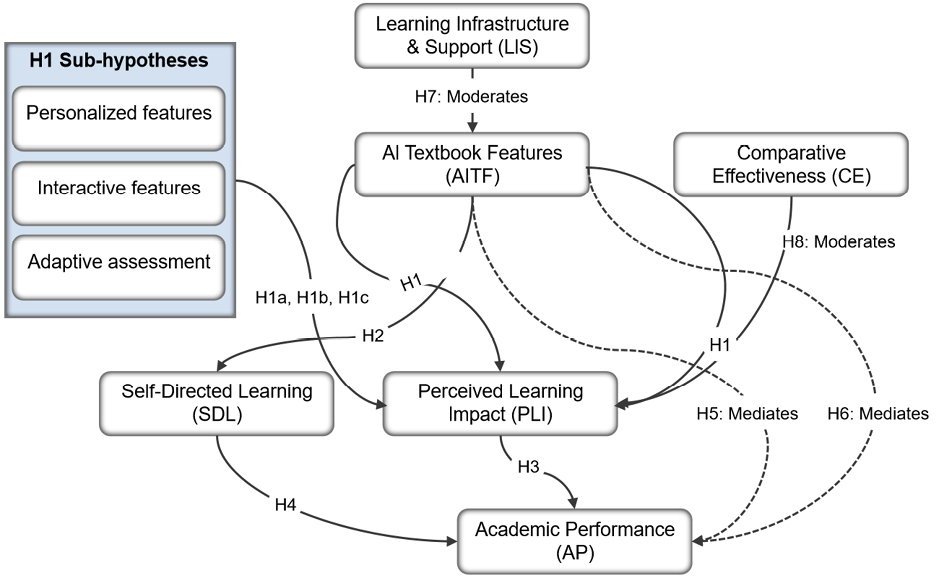
•H1: AI Textbook Features (AITF) have a positive effect on Perceived Learning Impact (PLI).
•H1a: Personalized learning features have a positive effect on PLI.
•H1b: Interactive features have a positive effect on PLI.
•H1c: Adaptive assessment features have a positive effect on PLI.
•H2: AITF have a positive effect on Self-Directed Learning (SDL).
•H3: PLI has a positive effect on Academic Performance (AP).
•H4: SDL has a positive effect on AP.
•H5: PLI mediates the relationship between AITF and AP.
•H6: SDL mediates the relationship between AITF and AP.
•H7: Learning Infrastructure & Support (LIS) moderates the relationship between AITF and PLI, such that the relationship is stronger when LIS is high.
•H8: Comparative Effectiveness (CE) moderates the relationship between PLI and AP, such that the relationship is stronger for students who perceive AI textbooks as more effective than conventional materials.
This study provides an empirical analysis of the impact of AI-EDT on the academic performance of university students in China. The findings offer a valuable evidence base to inform policymaking regarding the integration of this technology, thereby supporting efforts to enhance learning outcomes within the Chinese higher education system.
2. BACKGROUND AND HYPOTHESIS DEVELOPMENT
2.1. AI-enhanced digital textbooks and their effective usage
AI-enhanced digital textbooks (AI-EDT), also known as AI-powered e-textbooks, an advanced form of digital textbook, have emerged as a significant educational technology with the potential to reshape learning in higher education. Moving beyond static content, these tools function as intelligent partners that facilitate an active, conversational, and personalized learning experience. This evolution aligns with the broader definition of digital textbooks as multimedia learning materials designed to enhance educational effectiveness (Rockinson-Szapkiw et al., 2013) & convenience through integrated learning support features (Joo, Park, & Shin, 2017). AI-EDT represents a specific, sophisticated iteration of this category, leveraging AI to dynamically adapt to individual student needs (Wang, Zhao, Xu, Zhang, & Lei, 2025; Zawacki-Richter, Marín, Bond, & Gouverneur, 2019). Building on this foundation, AI-EDT is distinguished from conventional digitalized texts by their integration of dynamic, interactive features. These features are designed to foster active engagement and promote self-regulated learning (Yoo & Roh, 2019), aligning with core principles of modern educational pedagogy (Zawacki-Richter et al., 2019). The key characteristics of these intelligent systems offer significant advantages, particularly in a university context (Wang et al., 2025). A primary characteristic is the provision of adaptive learning pathways (Peng, Ma, & Spector, 2019; Zhang & Cai, 2025), where machine learning (ML) algorithms analyze a student’s performance to dynamically adjust the difficulty and sequence of content, thereby targeting individual knowledge gaps (Hong, Hwang, Park, & Lee, 2024). In addition, embedded intelligent tutoring systems, often through conversational AI (Chen, Chen, & Lin, 2020), provide immediate and personalized guidance, clarifying complex concepts outside formal classroom hours. Beyond static content, these textbooks utilize generative capabilities to create endless practice problems and personalized summaries, offering the crucial hands-on practice required for deep conceptual understanding (Sosnovsky, Brusilovsky, & Lan, 2025). A further critical advantage lies in automated assessment, which delivers detailed, formative feedback on open-ended responses, enabling students to learn from their mistakes independently. Collectively, these functionalities transform the textbook from a passive information repository into an active learning partner. For university students in China, this directly supports the mastery of complex subjects by providing a personalized (Wu, 2015), responsive, and practice-oriented educational resource that is available beyond the constraints of the traditional classroom, with clear potential implications for their academic performance (Tan, 2024).
Despite the growing presence of AI-EDT in higher education, research reveals mixed findings regarding student acceptance. Some studies indicate that adoption rates are unsatisfactory (Liu et al., 2020; Ma et al., 2025), often citing challenges such as difficulty maintaining concentration (Rockinson-Szapkiw et al., 2013). Conversely, other research underscores the critical role of student self-determination in shaping a positive attitude towards these tools (Dennis, Abaci, Morrone, Plaskoff, & McNamara, 2016), which in turn enhances learning performance through increased engagement. These findings collectively suggest that the technological benefits of AI-EDT do not, in themselves, guarantee effective adoption. Consequently, the role of educators becomes paramount (Chen & Tsai, 2025; Ma et al., 2025). When instructors themselves accept and proficiently utilize AI-EDT, they model effective usage and signal the tool’s pedagogical value. This instructor buy-in is critical within the Chinese higher education context, as educator perceptions and advocacy are particularly influential in shaping student attitudes and engagement, ultimately affecting academic performance.
Figure 1. Theoretical framework of AI-EDT impact on academic performance.
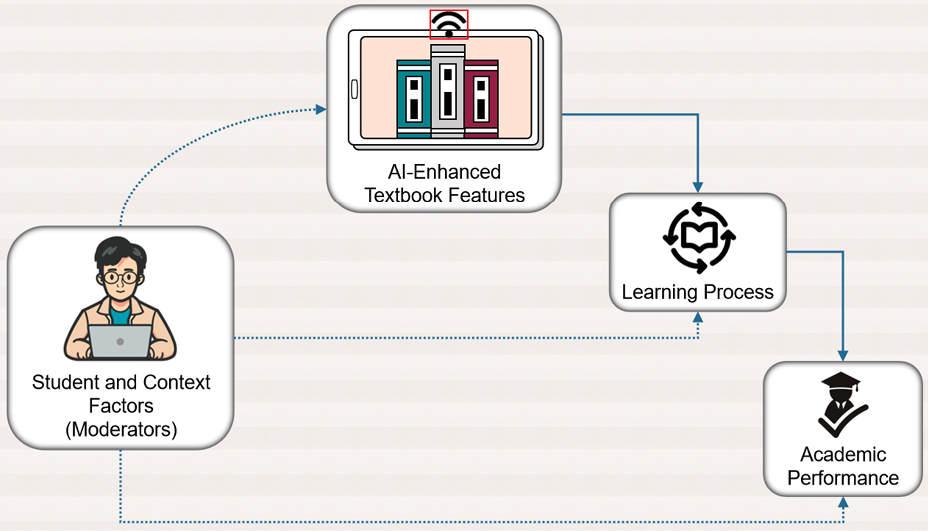
Empirical evidence underscores the instructor’s pivotal role in mediating technology’s impact. For instance, a study on the “Effects of e-textbook instructor annotations on learner performance” demonstrated that active instructor use of digital tools directly correlates with improved student outcomes, suggesting that an educator’s proficiency and enthusiasm implicitly model the technology’s perceived value (Dennis et al., 2016). In the context of AI-EDT, instructors thus act as critical gatekeepers; their pedagogical integration legitimizes the technology and can significantly amplify its perceived utility for students. This dynamic aligns with Self-Determination Theory (SDT) (Deci & Ryan, 1985), which emphasizes that engagement stems from supporting students’ needs for autonomy, competence, and relatedness. A gap exists, however, in explicitly linking specific AI-EDT affordances (e.g., adaptive pathways, intelligent tutoring) to these core psychological drivers of engagement and performance. Based on the reviewed literature, we propose the following theoretical framework (Figure 1) that illustrates the relationships between AI-enhanced textbook features, learning processes, and academic performance, with contextual factors as moderators.
Figure 2. Conceptual framework of AI-enhanced digital textbooks’ impact on academic performance.
2.2. Conceptual framework development
The effectiveness of AI-EDT in higher education is contingent not only on their technological capabilities but also on how students perceive and interact with these tools. While prior research has established the cognitive benefits of AI-driven features such as personalized learning paths (Chen & Tsai, 2025), interactive simulations (Da Costa et al., 2025), and adaptive assessments (Khine, 2024; Kim & Kim, 2024), less is known about the underlying mechanisms through which these features influence academic performance (Hussain, 2024). To address this gap, this study proposes a conceptual framework that integrates the technological affordances of AI textbooks with key pedagogical and psychological constructs, including perceived learning impact (PLI) (Sun, Norman, & Abdourazakou, 2018), self-directed learning (SDL) (Lee & Chang, 2025), and contextual moderators such as learning infrastructure (Marín et al., 2020) and comparative effectiveness (CE) (Zheng, Niu, Zhong, & Gyasi, 2023).
The proposed framework builds upon and extends established technology acceptance theories, particularly the Technology Acceptance Model (Davis, 1989) and the Unified Theory of Acceptance and Use of Technology (Chakraborty & Al Rashdi, 2018; Ahmad, 2015). TAM posits that perceived usefulness and perceived ease of use are fundamental determinants of technology adoption and usage behavior. In the proposed framework, PLI operationalizes a context-specific form of perceived usefulness tailored to educational outcomes, capturing students’ subjective evaluations of improved understanding, efficiency, and confidence. Similarly, the emphasis on AITF encompassing interactive and adaptive functionalities directly addresses the ease-of-use dimension, as well-designed features reduce cognitive load and facilitate seamless engagement. UTAUT extends this logic by incorporating facilitating conditions and social influence as key moderators. The inclusion of LIS as a moderator of the AITF-PLI relationship directly parallels UTAUT’s facilitating conditions construct, recognizing that institutional readiness and technical support shape technology’s perceived benefits. In addition, the CE moderator aligns with UTAUT’s performance expectancy dimension, capturing students’ relative judgments of AI textbooks against conventional alternatives. However, the proposed framework advances beyond these foundational models in three respects: (a) it distinguishes between two distinct mediating pathways (perceptual and behavioral) through which technology features influence outcomes, (b) it incorporates SDL as a competency-based mediator that reflects the developmental nature of learner autonomy, and (c) it situates the technology acceptance process within the specific pedagogical context of higher education, where learning outcomes rather than mere usage constitute the ultimate dependent variable. This theoretical integration ensures that our model is both grounded in established acceptance literature and tailored to the unique demands of AI-mediated learning environments.
Furthermore, the proposed framework posits that AI Textbook Features (AITF), comprising personalized, interactive, and adaptive functionalities (Lee & Bang, 2025), serve as the primary exogenous variable. These features are hypothesized to directly enhance PLI, a construct capturing students’ subjective evaluations of improved understanding, efficiency, engagement, and confidence. Simultaneously, AITF is expected to foster SDL (Navas Bonilla, Viñán Carrasco, Gaibor Pupiales, & Murillo Noriega, 2025; Wu, Zhang, Ma, Yue, & Dong, 2024), reflecting the development of autonomous learning habits. Both PLI and SDL are positioned as mediating variables that translate the benefits of AITF into improved Academic Performance (AP) (Ellikkal & Rajamohan, 2025), measured through self-reported grade improvement. To account for contextual influences, the model incorporates two moderating variables. Learning infrastructure & support (LIS), encompassing technological reliability and institutional training, is expected to strengthen the relationship between AITF and PLI. Similarly, comparative effectiveness (CE) students’ perception of AI textbooks relative to conventional materials is hypothesized to amplify the effect of PLI on AP. This moderated-mediation structure allows the framework to address not only whether AI textbooks improve performance, but also how and under what conditions these effects are optimized. This path diagram, as shown in Figure 2, illustrates the hypothesized relationships between AITF and AP among Chinese university students. Solid arrows represent direct effects (H1-H4), dotted arrows indicate mediation effects (H5-H6), and moderation effects (H7-H8) are shown through interaction symbols. The model posits that AITF directly influence PLI and SDL, which in turn affect AP. LIS moderates the AITF-PLI relationship, while CE moderates the PLI-AP relationship. Grounded in the context of Chinese higher education’s digital transformation, this framework offers a nuanced understanding of the mechanisms through which AI tools impact learning, while providing actionable insights for implementation.
3. METHODOLOGY
3.1. AI-enhanced digital textbook in China
The adoption of AI-enhanced digital textbooks (AI-EDT) in China unfolds within an educational landscape still anchored in conventional pedagogies and printed materials. This creates a unique duality, as the centralized, standardized curriculum system interacts with the inherently personalized nature of adaptive learning platforms. This context makes China an ideal setting to study how top-down technology integration meets student-driven engagement. AI-EDT represents a significant shift from static content to intelligent platforms offering adaptive pathways and personalized feedback. However, for their potential to be realized, implementation must carefully navigate technical challenges and ensure these tools support, rather than hinder intrinsic motivation and critical thinking.
3.2. Data collection and participants
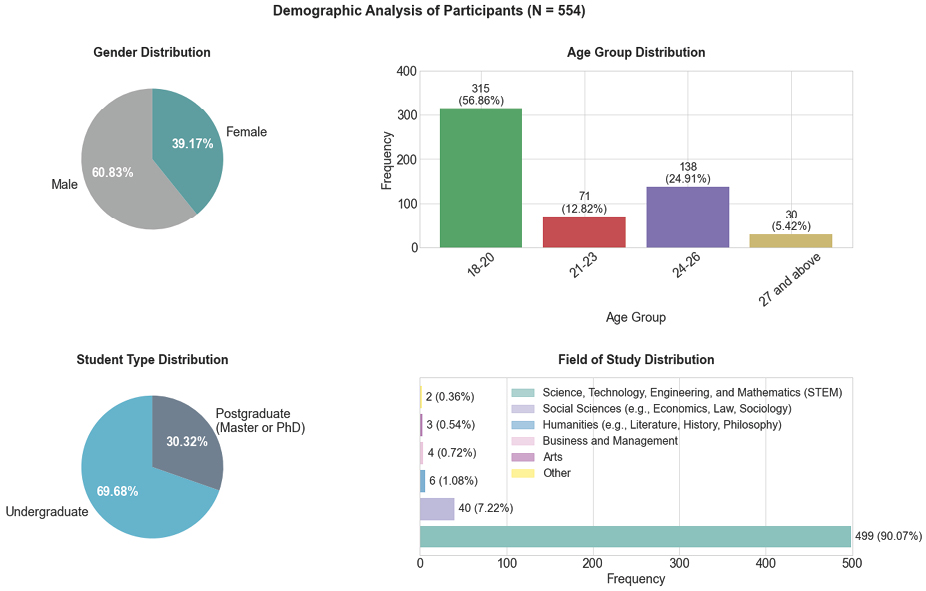
This study is based on a survey of 554 Chinese university students, conducted to understand the impact of AI-powered educational tools on their academic performance. Data was gathered anonymously via an online questionnaire between September and November 2025, a period of active academic engagement. The survey was distributed through student networks, including social media platforms like WeChat and QQ, as well as classrooms, and all participants provided informed consent. The participant profile is representative of the target population. The majority of respondents were male (60.83 %), which aligns with enrollment patterns at STEM-focused universities in China. Most students were traditional undergraduates aged 18-20 (56.86 %), with a significant proportion of postgraduate and mature students also represented (30.32 %). Reflecting the institutional context, an overwhelming 90.07 % of participants were enrolled in STEM fields, making this group highly relevant for assessing the use of advanced educational technologies like AI-driven textbooks.
Figure 3. Demographic information of participants (N = 554).
3.3. Measurements
The study employed a structured online questionnaire to assess Chinese university students’ experiences with AI-EDT. The instrument was developed in English and Chinese, with a rigorous back-translation process to ensure accuracy. Demographic information was collected in the first section, capturing data on gender, age, student type, and field of study to contextualize the participant profile. The core constructs of the survey were measured across five subsequent sections, with items adapted from established literature on educational technology, user experience, and self-regulated learning to ensure theoretical grounding. Student perceptions and experiences were measured through the following sections:
1.Experience with AI-Enhanced Digital Textbooks (AI-EDT): This section captured usage frequency, types of AI features utilized (e.g., personalized learning paths, intelligent Q&A), and overall user satisfaction via single-choice and multiple-choice questions.
2.Perceived Impact on Learning and Performance: The core constructs of perceived effectiveness were measured using five-point Likert-scale agreement items (from 1, “Strongly Disagree” to 5, “Strongly Agree”). These items gauged the impact on understanding complex concepts, engagement, study efficiency, self-confidence, self-directed learning habits, and perceived academic performance.
3.Support, Environment, and Challenges: This section employed single-choice and multiple-choice questions to evaluate the reliability of digital infrastructure, the adequacy of university training and support, and the specific challenges faced by users, such as technical glitches.
4.Comparison and Future Outlook: This part assessed the perceived comparative effectiveness of AI textbooks against conventional materials and users’ willingness to recommend them. It also identified future improvement priorities through multiple-choice questions.
5.Closing Remarks: Two open-ended textbox questions were included to capture qualitative insights into the biggest perceived advantages and the most significant concerns or suggestions for future development, providing rich, user-generated data.
Before full deployment, the questionnaire was validated through expert review and a pilot test with a representative student group to ensure clarity and reliability.
4. RESULTS
This research paper makes use of partial least squares structural equation modeling (PLS-SEM) to assess the factor relationships and the structural model. Following the guidelines for applying and reporting PLS-SEM (Hair, Risher, Sarstedt, & Ringle, 2019; Ma et al., 2025), the sample size (N = 554) is deemed appropriate for this method. Data analysis and computation were performed using the Python programming language (Python version: 3.9.18).
4.1. Evaluation of measurement properties: Reliability and validity tests
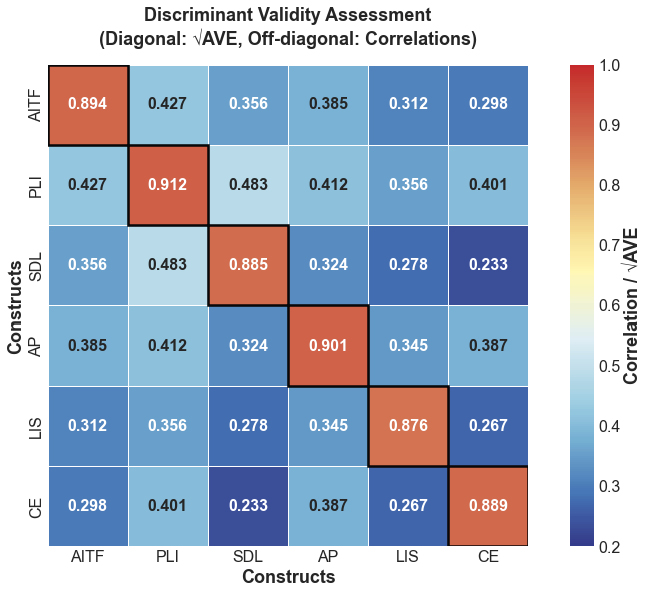
The measurement model was rigorously evaluated for reliability and validity. All indicator loadings were examined, and items with loadings exceeding 0.7 were retained, confirming a satisfactory level of indicator reliability (Hair et al, 2019; Ma et al., 2025). The internal consistency of the constructs was assessed using Cronbach’s alpha (α) and composite reliability (CR). The results for all constructs surpassed the recommended threshold of 0.7, demonstrating high internal reliability. In addition, convergent validity was evaluated using the average variance extracted (AVE). All AVE values were above the benchmark of 0.5, indicating that the constructs adequately capture the variance in their respective indicators and possess solid convergent validity for measuring students’ perceptions of AI-EDT. Regarding discriminant validity, the results are presented in Figure 4. As per the Fornell-Larcker criterion (Fornell & Larcker, 1981), discriminant validity is established when the square root of a construct’s AVE is greater than its correlations with other constructs. As shown in Figure 4, all constructs meet this condition, confirming that they are distinct from one another. Additionally, following the guidelines of (Henseler, Ringle, & Sarstedt, 2015), the Heterotrait-Monotrait (HTMT) ratio of correlations was computed. All HTMT values were found to be below the more conservative threshold of 0.90, further substantiating the distinctiveness of the constructs.
Figure 4. Distinctiveness of constructs: assessment of discriminant validity.
4.2. Structural equation model (SEM) test results
To examine the hypothesized relationships among constructs, PLS-SEM was employed. The model fit and quality indicators are presented in Table 1. The Standardized Root Mean Square Residual (SRMR) value of 0.062 was below the recommended threshold of 0.08 (Hu & Bentler, 1998), indicating an acceptable model fit. The Normed Fit Index (NFI) value of 0.923 surpassed the benchmark of 0.90 Bentler & Bonett (1980), further confirming a good fit to the data. In addition, all three endogenous constructs demonstrated substantial explanatory power, with R2 values of 0.482 for PLI, 0.327 for SDL, and 0.413 for AP, all exceeding the recommended threshold of 0.25. As presented in Figure 5, the structural model includes two mediators (PLI and SDL) and two moderators (LIS and CE). Standardized path coefficients (β) with significance levels are displayed on each path (***p < 0.001, **p < 0.01, *p < 0.05).
Figure 5. Structural model with path coefficients from PLS-SEM analysis. Solid lines represent direct effects, dashed lines indicate moderation effects. Path coefficients are standardized beta values with significance levels: ***p < 0.001, **p < 0.01, *p < 0.05.
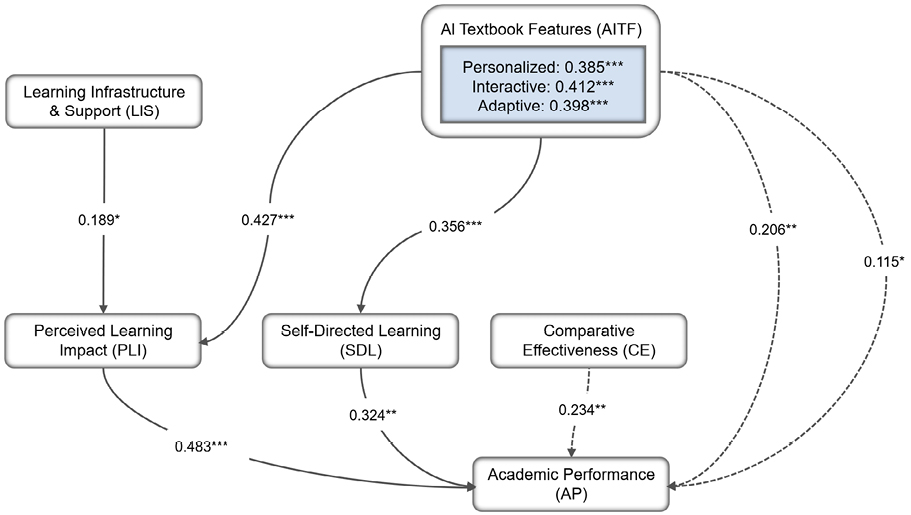
Table 1. Model Fit and quality indicators.
|
Indicator |
Value |
Threshold |
Assessment |
|---|---|---|---|
|
R2 (PLI) |
0.482 |
> 0.25 |
Substantial |
|
R2 (SDL) |
0.327 |
> 0.25 |
Substantial |
|
R2 (AP) |
0.413 |
> 0.25 |
Substantial |
|
SRMR |
0.062 |
> 0.08 |
Good fit |
|
NFI |
0.923 |
> 0.90 |
Good fit |
All eight hypothesized relationships (H1-H8) were statistically significant and aligned with the predicted directions (see Table 2). Specifically, AITF exhibited a strong positive effect on PLI (β = 0.427, p < 0.001), supporting H1. The sub-dimensions of AITF, personalized learning features (β = 0.385, p < 0.001), interactive features (β = 0.412, p < 0.001), and adaptive assessment features (β = 0.398, p < 0.001), also significantly improved PLI, confirming H1a, H1b, and H1c. Additionally, AITF positively influenced SDL (β = 0.356, p < 0.001), supporting H2. In terms of outcome variables, PLI demonstrated a substantial positive effect on AP (β = 0.483, p < 0.001), confirming H3. Similarly, SDL showed a significant, though comparatively weaker, positive effect on AP (β = 0.324, p < 0.01), supporting H4. The mediation analyses revealed that PLI partially mediated the relationship between AITF and AP (β = 0.206, p < 0.01), supporting H5. Likewise, SDL served as a significant mediator between AITF and AP (ca = 0.115, p < 0.05), confirming H6. These findings suggest that AI-EDT contributes to academic performance both directly and indirectly through enhanced learning perceptions and self-directed learning behaviors.
Table 2. Summary of hypothesis testing results.
|
Hypothesis |
Path |
β |
p-value |
Supported |
|
H1 |
AITF → PLI |
0.427*** |
0.000 |
Yes |
|
H1a |
Personalized → PLI |
0.385*** |
0.000 |
Yes |
|
H1b |
Interactive → PLI |
0.412*** |
0.000 |
Yes |
|
H1c |
Adaptive → PLI |
0.398*** |
0.000 |
Yes |
|
H2 |
AITF → SDL |
0.356*** |
0.000 |
Yes |
|
H3 |
PLI → AP |
0.483*** |
0.000 |
Yes |
|
H4 |
SDL → AP |
0.324** |
0.002 |
Yes |
|
H5 |
AITF → PLI → AP |
0.206** |
0.001 |
Yes |
|
H6 |
AITF → SDL → AP |
0.115* |
0.018 |
Yes |
|
H7 |
LIS × (AITF → PLI) |
0.189* |
0.008 |
Yes |
|
H8 |
CE × (PLI → AP) |
0.234** |
0.003 |
Yes |
In addition, regarding moderation effects, LIS significantly strengthened the relationship between AITF and PLI (β = 0.189, p < 0.01), supporting H7. This indicates that robust institutional and technological support amplifies the perceived learning benefits of AITF. Also, CE positively moderated the relationship between PLI and AP (β = 0.234, p < 0.01), confirming H8. That is, students who perceived AI textbooks as more effective than conventional materials exhibited a stronger relationship between PLI and actual AP. To this end, the SEM results validate the proposed conceptual framework, showing that AI-EDT features significantly improve academic performance through both perceptual and behavioral pathways, with contextual factors such as institutional support and perceived relative effectiveness playing crucial moderating roles.
This research paper investigates how AI-EDT impacts the academic performance of Chinese university students. The validated framework confirms significant relationships and clarifies the underlying pathways. The findings are discussed below in relation to the four research questions.
5.1. RQ1: To what extent do the features of AITF directly influence students’ PLI and SDL?
The findings confirm a strong, direct effect of AITF on both PLI (β = 0.427, p < 0.001) and SDL (ca
= 0.356, p < 0.001). Features like personalized paths and adaptive assessments actively reshape student engagement (Chen et al., 2020; Zawacki-Richter et al, 2019). The high agreement rates on understanding (85.74 %) and efficiency (84.12 %) support this. Crucially, AITF fosters metacognitive awareness and learner autonomy, aligning with theories that emphasize personalization and agency in technology-enhanced learning.
5.2. RQ2: Does PLI mediate the relationship between AITF and AP?
RQ2 is conclusively addressed through the significant partial mediation effect of PLI (β = 0.206, p < 0.01). This shows that AI features must first enhance students’ perceived understanding, confidence, and efficiency before translating into academic gains (Li, 2023). This psychological mechanism challenges purely instrumental views of educational technology, highlighting that tools need to be perceptually salient and reassuring to the learner, consistent with technology acceptance and self-efficacy theories.
5.3. RQ3: How does LIS moderate the relationship between AITF and PLI?
The analysis confirms that RQ3 is central to understanding the contextual boundaries of AI textbook effectiveness. The positive moderation by LIS (β = 0.189, p < 0.01) reveals that the strength of the AITF-PLI link depends on the institutional environment. In settings with reliable technology and support, AI’s positive impact is amplified. Conversely, technical instability (reported by 54.87 % of respondents) can cause frustration and diminish perceived gains. This underscores that advanced AI features alone are insufficient; their success requires a supportive ecosystem of infrastructure and user support.
5.4. RQ4: What is the role of SDL in the pathway from AITF to academic AP?
RQ4 is answered through the significant mediating role of SDL (β = 0.115, p < 0.05), which delineates a second, behavioral pathway linking AI features to academic outcomes. AI features promote self-regulated learning habits like goal-setting and self-monitoring, which then improve performance. This is significant in Chinese higher education, where instruction is often instructor-led. The smaller effect size compared to PLI suggests that while AI can scaffold self-direction, turning these behaviors into performance gains may require additional instructional strategies or longer-term development. This aligns with research emphasizing that SDL is a complex competency that develops over time and through supportive feedback loops (Doo & Zhu, 2024).
Beyond the student-focused mechanisms examined in the framework, the role of teaching staff emerges as a critical pedagogical mediator of AI-EDT effectiveness. Although not directly modeled in the quantitative analysis, the findings indirectly underscore the instructor’s importance through the significant moderation effect of LIS, which encompasses not only technological reliability but also institutional training and faculty guidance. This aligns with prior research (Dennis et al., 2016; Ma et al., 2025) demonstrating that instructor annotations, active modeling of tool usage, and pedagogical scaffolding significantly amplify the learning benefits of digital textbooks. In the Chinese higher education context, where teacher authority and instructional guidance carry particular cultural weight, educators serve as crucial gatekeepers who legitimize AI tools and frame their pedagogical value. When instructors demonstrate proficiency with AI-EDT and explicitly integrate these tools into their teaching strategies, they implicitly signal the technology’s academic relevance, thereby strengthening students’ PLI and encouraging SDL behaviors. This instructor-mediated effect operates through multiple channels: (a) explicit instruction on how to utilize adaptive features effectively, (b) alignment of AI-generated content with course objectives, (c) modeling of metacognitive strategies for interpreting AI feedback, and (d) provision of emotional reassurance that mitigates technostress. Future research should explicitly model instructor engagement as a moderating or mediating variable to quantify its distinct contribution to the AI-EDT effectiveness pathway.
5.5. Socio-emotional dimensions of AI-enhanced learning
While the quantitative model focuses on cognitive and behavioral pathways (PLI and SDL), the findings carry important implications for the socio-emotional dimensions of university learning that warrant explicit discussion. Although not directly measured in the survey, the qualitative responses and the pattern of results suggest that AI-EDT engagement intersects with students’ affective and social experiences in meaningful ways. First, the strong effect of AITF on PLI (β = 0.427) may be partially explained by socio-emotional mechanisms: personalized learning pathways and adaptive feedback can reduce anxiety associated with difficult subjects by providing non-judgmental, patient remediation outside the social pressures of the classroom. This aligns with research by (Al-Qatawneh et al., 2019; Im, 2024) on the affective benefits of digital learning tools. Second, the significant mediation through SDL (β = 0.115) suggests that AI tools may foster not only cognitive autonomy but also emotional self-regulation, the capacity to manage frustration, maintain motivation, and sustain engagement without external scaffolding. Third, the moderation by CE indicates that students’ affective judgments about AI relative to traditional materials shape the translation of perceived learning into actual performance, highlighting the role of positive emotional framing in technology adoption. However, the socio-emotional landscape is not uniformly positive. The 54.87 of respondents reporting technical instability points to potential frustration and disengagement, while the absence of face-to-face interaction in AI-mediated learning may diminish opportunities for collaborative emotion regulation and peer-supported learning (Johler, 2022). Future research should explicitly model socio-emotional variables, such as academic emotions (enjoyment, anxiety, boredom), social presence, and collaborative engagement, to fully capture the holistic impact of AI-EDT on university students’ development. This would extend the cognitive-behavioral framework into the affective domain, addressing UNESCO’s (2017) emphasis on socio-emotional competencies as integral to education for sustainable development.
5.6. Synthesis and theoretical implications
Collectively, the findings reveal a coherent process where AI features impact academic performance through key psychological (PLI) and behavioral (SDL) mediators, moderated by contextual support (LIS). This moves beyond simple cause-effect analysis, offering a granular model of how AI-EDT contributes to student success. It positions AI textbooks as integrated components of an educational system, whose effectiveness depends on aligning tool design, learner cognition, and institutional support.
5.7. Practical and policy implications
For instructors, the results stress the need to actively frame AI tool use to enhance students’ perceived value and self-directed skills. For administrators, the critical role of LIS means that deploying AI tools must be paired with investment in reliable infrastructure, technical support, and faculty training. A supported, phased rollout is preferable to a large-scale unsupported deployment. Additionally, the study’s skew toward STEM disciplines highlights the need for deliberate, discipline-specific adaptations to ensure inclusive innovation across all academic fields.
This study advances understanding of how AI-enhanced digital textbooks shape academic performance among Chinese university students. The findings demonstrate that AI-EDT significantly improve learning outcomes through two distinct yet complementary pathways: a psychological mechanism centered on PLI and a behavioral mechanism mediated by SDL. These effects, however, are not unconditional. Institutional support and students’ preference for AI over traditional materials emerge as critical boundary conditions that moderate these relationships. The contributions of this research are threefold. Theoretically, the study moves beyond simplistic technology-effects models by proposing and validating a dual-pathway moderated-mediation framework that explicates the distinct processes through which AI features translate into academic performance. This granular approach reveals that AI tools simultaneously shape how students perceive their learning and how they regulate their own educational behaviors. Empirically, the large-sample investigation of Chinese university students extends the predominantly western evidence base on adaptive learning technologies, offering insights into their operation within a distinctive educational context characterized by rapid digital transformation. Practically, the identification of learning infrastructure and comparative effectiveness as critical moderators provides actionable guidance: AI textbook success depends less on technological sophistication alone than on the ecosystem within which implementation occurs and on students’ affective orientation toward these tools.
The findings carry particular resonance for post-pandemic higher education, where hybrid and technology-mediated learning have become enduring features of the instructional landscape. As AI increasingly permeates educational settings, understanding not merely whether these tools work, but how and under what conditions, becomes essential for evidence-based implementation. This study suggests that realizing the potential of AI-EDT requires simultaneous attention to learner psychology, institutional context, and the affective judgments that shape technology adoption, a holistic perspective that future research might further elaborate through explicit modeling of socio-emotional variables.
Building on this study’s contributions and limitations, future research should advance along four interconnected pathways. Methodologically, longitudinal and experimental designs are needed to establish causality and trace developmental trajectories in AI textbook engagement, complemented by objective performance data and qualitative methods that capture the lived experience of human-AI interaction in learning. Theoretically, the validated dual-mediation model should be extended to incorporate socio-emotional variables, particularly academic emotions and technostress, as well as individual differences in digital literacy and personality. Cross-cultural and multi-level analyses would test the framework’s boundary conditions while formally modeling how pedagogical contexts and instructor roles moderate these relationships. Contextually, systematic sampling across disciplines and institution types is essential, given the STEM concentration in the current sample. Comparative studies across national systems with varying technological infrastructure and cultural orientations would illuminate how contextual factors shape AI textbook effectiveness.
Finally, design-focused research should examine how specific feature configurations and implementation models influence outcomes, with particular attention to emerging generative AI capabilities. Design-based approaches that iteratively refine AI textbooks in authentic settings can bridge explanatory research and practical innovation, generating actionable knowledge for shaping the future of digital learning. By pursuing this expanded research agenda, the scholarly community can progressively refine understanding of how AI-enhanced educational technologies interact with human learning processes, institutional contexts, and pedagogical practices to shape the future of higher education.
DATA ACCESSIBILITY STATEMENT
The datasets used and/or analysed during the current study are available from the corresponding author upon reasonable request.
SUPPORTING AGENCIES
This work was supported by the Chongqing Municipal Education Commission Teaching Reform Project (Grant No. Z2253130).
REFERENCES
. (2015). Unified theory of acceptance and use of technology (UTAUT). LinkedIn Pulse, 1, 179-211.
., & . (2023). Sustainability in e-learning: E-books and academic procrastination among secondary students. Sustainability, 15(20), 14668. https://doi.org/10.3390/su152014668
., ., ., ., & . (2019). To E-textbook or not to E-textbook? A quantitative analysis of the extent of the use of E-textbooks at Ajman University from students’ perspectives. Education and Information Technologies, 24(5), 2997-3019. https://doi.org/10.1007/s10639-019-09912-4
., & . (1980). Significance tests and goodness of fit in the analysis of covariance structures. Psychological Bulletin, 88(3), 588-606. https://doi.org/10.1037/0033-2909.88.3.588
., & . (2018). Venkatesh et al.’s unified theory of acceptance and use of technology (UTAUT)(2003). In Technology adoption and social issues: Concepts, methodologies, tools, and applications (pp. 1657-1674). IGI Global Scientific Publishing. https://doi.org/10.4018/978-1-5225-5201-7.ch077
., & . (2025). Effect of interactive e-book use on learning engagement, satisfaction and perceived learning. Education and Information Technologies, 1-33. https://doi.org/10.1007/s10639-025-13415-w
., ., & . (2020). Artificial intelligence in education: A review. IEEE Access, 8, 75264-75278.
., ., ., ., ., ., & . (2025). An evolutionary taxonomy for digital textbooks: Towards intelligent and immersive learning environment. In EDULEARN25 Proceedings (pp. 4117-4126). IATED. https://doi.org/10.21125/edulearn.2025.1068
. (1989). Technology acceptance model: TAM. , (Eds). Information seeking behavior and technology adoption (pp. 205-219).University of Michigan.
., & . (1985). The general causality orientations scale: Self-determination in personality. Journal of Research in Personality, 19(2), 109-134. https://doi.org/10.1016/0092-6566(85)90023-6
., ., ., ., & . (2016). Effects of e-textbook instructor annotations on learner performance. Journal of Computing in Higher Education, 28(2), 221-235.
., & . (2024). A meta-analysis of effects of self-directed learning in online learning environments. Journal of Computer Assisted Learning, 40(1), 1-20. https://doi.org/10.1111/jcal.12865
., & . (2024). Development of digital textbooks based on the MOODLE Platform. In 2024 5th International Conference on Big Data and Informatization Education (ICBDIE 2024) (pp. 110-120). Atlantis Press. https://doi.org/10.2991/978-94-6463-417-4_11
., & . (2020). Effects of Students Attitudes towards Using E-Books on Their Self-Efficacy and Academic Motivation. European Journal of Educational Research, 9(3), 1167-1176. https://doi.org/10.12973/eu-jer.9.3.1167
., & . (2025). AI-enabled personalized learning: Empowering management students for improving engagement and academic performance. Vilakshan-XIMB Journal of Management, 22(1), 28-44. https://doi.org/10.1108/XJM-02-2024-0023
., & . (1981). Evaluating structural equation models with unobservable variables and measurement error. Journal of Marketing Research, 18(1), 39-50. https://doi.org/10.1177/002224378101800104
., ., ., & . (2019). When to use and how to report the results of PLS-SEM. European Business Review, 31(1), 2-24. https://doi.org/10.1108/EBR-11-2018-0203
., ., & . (2015). A new criterion for assessing discriminant validity in variance-based structural equation modeling. Journal of the Academy of Marketing Science, 43(1), 115-135. https://doi.org/10.1007/s11747-014-0403-8
., ., ., & . (2024). Expectations and concerns about adopting AI digital textbooks: Based on investigation of teachers’ use of AI and digital tools. The Journal of Studies in Language, 40(1), 7-20.
., & . (1998). Fit indices in covariance structure modeling: Sensitivity to underparameterized model misspecification. Psychological Methods, 3(4), 424-453. https://doi.org/10.1037/1082-989X.3.4.424
. (2024). An Experimental Study on the Impact of Digital Textbooks on the Academic Achievement of Elementary School Students. International Research Journal of Education and Innovation, 5(1), 16-27.
(2024). Affective and social competencies of elementary school students in the use of digital textbooks: a longitudinal study. Behavioral Sciences, 14(3), 179. https://doi.org/10.3390/bs14030179
., ., \& . (2016). Examining the effectiveness of digital textbook use on students’ learning outcomes in South Korea: A meta-analysis. The Asia-Pacific Education Researcher, 25(1), 57-68. https://doi.org/10.1007/s40299-015-0232-7
. (2022). Collaboration and communication in blended learning environments. In Frontiers in Education, 7, 980445. https://doi.org/10.3389/feduc.2022.980445
., ., ., & . (2015). Ease of use and usefulness as measures of student experience in a multi-platform e-textbook pilot. Library Hi Tech, 33(1), 65-82. https://doi.org/10.1108/LHT-11-2014-0107
., ., & . (2017). Students’ expectation, satisfaction, and continuance intention to use digital textbooks. Computers in Human Behavior, 69, 83-90. https://doi.org/10.1016/j.chb.2016.12.025
. (2024). Using AI for adaptive learning and adaptive assessment. In Artificial Intelligence in Education: A Machine-Generated Literature Overview (pp. 341-466). Springer. https://doi.org/10.1007/978-981-97-9350-1_3
., & . (2022). Study on blended learning lesson in English digital textbook on elementary school students. Journal of Learning-Centered Curriculum and Instruction, 22, 1-15. https://doi.org/10.22251/jlcci.2022.22.1.1
., & . (2024). Secondary school mathematics teachers’ perceptions of AI digital textbooks: Implications and challenges for adaptive learning. Journal of the Korean School Mathematics Society, 27(3), 417-452. https://doi.org/10.30807/ksms.2024.27.3.007
., & . (2025). AI policies in school education: a comparative study on China, Singapore, Finland, and the US. Journal of Science and Technology Policy Management. https://doi.org/10.1108/JSTPM-06-2024-0218
., & . (2025). Transforming language education through AI: Artificial intelligence digital textbook (AIDT). In Innovation in Language Learning and Teaching: The Case of Korea (pp. 49-72). Springer. https://doi.org/10.1007/978-3-031-83561-2_3
., \& . (2025). Evaluating self-directed learning competencies in digital learning environments: A meta-analysis. Education and Information Technologies, 30(6), 6847-6868. https://doi.org/10.1007/s10639-024-13083-2
., ., & . (2023). The effects of digital textbooks on students’ academic performance, academic interest, and learning skills. Journal of Marketing Research, 60(4), 792-811. https://doi.org/10.1177/00222437221130712
. (2023). Determinants of college students’ actual use of AI-based systems: An extension of the technology acceptance model. Sustainability, 15(6), 5221. https://doi.org/10.3390/su15065221
., ., ., ., ., & . (2022). Sustainable effect of the usefulness of and preference for digital textbooks on perceived achievements in elementary education environments. Sustainability, 14(11), 6636. https://doi.org/10.3390/su14116636
., ., & . (2020). Understanding academics’ adoption of learning technologies: A systematic review. Computers & Education, 151, 103857. https://doi.org/10.1016/j.compedu.2020.103857
., ., ., ., ., & . (2025). Effective Use of Digital Textbooks: A Hybrid Framework of Acceptance and Self-Determination in Higher Education Programming Courses. IEEE Transactions on Education, 68(3), 312-321. https://doi.org/10.1109/TE.2025.3569558
., ., ., ., ., ., ., ., ., ., & others. (2020). A comparative study of national infrastructures for digital (open) educational resources in higher education. Open Praxis, 12(2), 241-256. https://doi.org/10.5944/openpraxis.12.2.1071
., ., ., & . (2025). The future of education: A systematic literature review of self-directed learning with AI. Future Internet, 17(8), 366. https://doi.org/10.3390/fi17080366
., ., & . (2019). Personalized adaptive learning: an emerging pedagogical approach enabled by a smart learning environment. Smart Learning Environments, 6(1), 1-14. https://doi.org/10.1186/s40561-019-0089-y
., ., ., & . (2013). Electronic versus traditional print textbooks: A comparison study on the influence of university students’ learning. Computers & Education, 63, 259-266. https://doi.org/10.1016/j.compedu.2012.11.022
., ., & . (2024). How the teacher’s choice of e-textbook affects the primary school students’ performance? Education and Information Technologies, 29(4), 3793-3806. https://doi.org/10.1007/s10639-023-11937-9
., ., ., ., ., ., ., ., & . (2017). PROTOCOL: Interventions for improving learning outcomes and access to education in low- and middle-income countries: a systematic review. Campbell Systematic Reviews, 13(1), 1-82. https://doi.org/10.1002/CL2.176
., ., & . (2025). Intelligent textbooks. International Journal of Artificial Intelligence in Education, 1-20. https://doi.org/10.1007/s40593-024-00451-9
., ., & . (2018). Perceived value of interactive digital textbook and adaptive learning: Implications on student learning effectiveness. Journal of Education for Business, 93(7), 323-331. https://doi.org/10.1080/08832323.2018.1493422
. (2024). Pathways for Innovation Development of Digital Textbooks in Higher Education in China. Frontiers of Digital Education, 1(3), 267-271. https://doi.org/10.1007/s44366-024-0016-9
. (2017). Unpacking sustainable development goal 4: Education 2030. UNESCO Paris.
, & . (2020). Theory on exploring acceptance and adoption of digital textbooks: A guide for the book publishing industry. Publishing Research Quarterly, 36(3), 381-398. https://doi.org/10.1007/s12109-020-09742-0
., ., ., ., & . (2025). AI adoption in Chinese universities: Insights, challenges, and opportunities from academic leaders. Acta Psychologica, 258, 105160. https://doi.org/10.1016/j.actpsy.2025.105160
., ., ., & . (2018). Effects of interactivity in E-textbooks on 7th graders science learning and cognitive load. Computers & Education, 120, 172-184. https://doi.org/10.1016/j.compedu.2018.02.008
., ., ., & . (2022). A meta-analysis of the effects of E-books on students’ mathematics achievement. Heliyon, 8(6), e09411. https://doi.org/10.1016/j.heliyon.2022.e09432
., ., ., ., \& . (2024). Unlocking potential: Key factors shaping undergraduate self-directed learning in AI-enhanced educational environments. Systems, 12(9), 332. https://doi.org/10.3390/systems12090332
. (2015). Personalized education in globalization era. Nanjing Journal of Social Sciences, (7), 104-110.
., & . (2019). Adoption of e-books: A digital textbook perspective. Journal of Computer Information Systems, 59(2), 136-145. https://doi.org/10.1080/08874417.2017.1318688
., ., ., & . (2019). Systematic review of research on artificial intelligence applications in higher education-where are the educators? International Journal of Educational Technology in Higher Education, 16(1), 1-27. https://doi.org/10.1186/s41239-019-0171-0
., & . (2025). A Novel Adaptive Learning Systems for Development Digital College Chinese Textbooks Based on Bi-directional Gated Neural Networks. In 2025 International Conference on Intelligent Computing and Knowledge Extraction (ICICKE) (pp. 1-8). IEEE. https://doi.org/10.1109/ICICKE65317.2025.11136640
. (2023). Research on the development and construction of digital textbooks for vocational education from the perspective of digital China. In Proceedings of the 4th International Conference on Education Studies: Experience and Innovation (ICESEI 2023) (Vol. 15). https://doi.org/10.4108/eai.8-9-2023.2340192
., ., ., & . (2023). The effectiveness of artificial intelligence on learning achievement and learning perception: A meta-analysis. Interactive Learning Environments, 31(9), 5650-5664. https://doi.org/10.1080/10494820.2021.2015693