La inteligencia artificial como mediadora de la reflexión lingüística en clases de FLE (*)
Artificial intelligence as mediator of linguistic reflection in FFL classes (*)
Raquel Sanz Moreno
Universidad de Valencia
(*) El presente artículo es derivado de un estudio inicial presentado en el VIII Congreso Internacional sobre Innovación Pedagógica y Praxis Educativa (Innovagogía 2026). https://www.innovagogia.es/
RESUMEN
El presente estudio examina el potencial pedagógico de la inteligencia artificial (IA) para promover la reflexión metalingüística en la enseñanza del francés como lengua extranjera (FLE) en el contexto de la formación inicial del profesorado. La investigación se centra en el análisis de la interacción entre reflexión metalingüística, competencia plurilingüe e integración didáctica de herramientas de IA en el aprendizaje de expresiones idiomáticas, un componente esencial del lenguaje cotidiano que, pese a su relevancia comunicativa, suele ocupar un lugar marginal en los currículos de enseñanza de lenguas debido a su complejidad semántica, cultural y pragmática.
Esta investigación describe una experiencia didáctica implementada durante el curso académico 2025-2026 en la asignatura Lengua extranjera para maestros – Francés del Grado en Educación Primaria de la Universitat de València. La intervención se estructuró mediante una secuencia didáctica orientada al aprendizaje de expresiones idiomáticas a partir de un enfoque de reflexión metalingüística basado en la comparación interlingüística entre las lenguas presentes en el repertorio lingüístico del alumnado. Paralelamente, se integraron diferentes herramientas de inteligencia artificial con el propósito de apoyar el análisis lingüístico, facilitar la exploración semántica de las unidades fraseológicas y promover el desarrollo de una alfabetización digital crítica en el alumnado.
Los resultados obtenidos evidencian que la combinación de estrategias de contraste interlingüístico y el uso pedagógicamente orientado de herramientas de IA favorece el desarrollo de la conciencia metalingüística del alumnado, incrementa su motivación hacia el aprendizaje de lenguas y contribuye a un uso más reflexivo y crítico de las tecnologías digitales. Asimismo, los hallazgos sugieren que la integración didáctica de la inteligencia artificial puede constituir un recurso relevante para enriquecer la enseñanza de las expresiones idiomáticas y contribuir al desarrollo simultáneo de competencias lingüísticas, plurilingües y digitales en la formación de futuros docentes.
PALABRAS CLAVE
Expresiones idiomáticas; FLE; inteligencia artificial; reflexión metalingüística.
ABSTRACT
This study examines the pedagogical potential of artificial intelligence (AI) to promote metalinguistic reflection in the teaching of French as a foreign language (FFL) within the context of initial teacher training. The research focuses on analysing the interaction between metalinguistic reflection, plurilingual competence and the didactic integration of AI tools in the learning of idiomatic expressions, an essential component of everyday language which, despite its communicative relevance, often occupies a marginal place in language teaching curricula due to its semantic, cultural and pragmatic complexity.
This research describes a teaching experience implemented during the 2025–2026 academic year in the course ‘Foreign Language for Teachers – French’ within the Bachelor’s Degree in Primary Education at the University of Valencia. The intervention was structured around a teaching sequence focused on the learning of idiomatic expressions, based on a metalinguistic reflection approach centred on interlinguistic comparison between the languages present in the students’ linguistic repertoire. In parallel, various artificial intelligence tools were integrated with the aim of supporting linguistic analysis, facilitating the semantic exploration of phraseological units and promoting the development of critical digital literacy among the students.
The results obtained show that the combination of interlinguistic contrast strategies and the pedagogically guided use of AI tools promotes the development of students’ metalinguistic awareness, increases their motivation to learn languages, and contributes to a more reflective and critical use of digital technologies. Furthermore, the findings suggest that the integration of artificial intelligence into teaching can be a valuable resource for enriching the teaching of idiomatic expressions and contributing to the simultaneous development of linguistic, plurilingual and digital competences in the training of future teachers.
KEYWORDS
Idiomatic expressions; FFL; artificial intelligence; metalinguistic reflection.
1. INTRODUCTION
The Common European Framework of Reference for Languages (CEFRL) establishes that the objective of language teaching is for students to be able to “act in real-life situations” (Council of Europe, 2021, p. 29). In that sense, it would be essential to address the teaching of idiomatic expressions (IE) in language classes and for students to become familiar with them, since it is very likely that they will encounter them in authentic communication situations (García-Moreno, 2011, p. 21; González-Rey, 2016, p. 178-179). However, experience tells us that, in language classes, the teaching of IE is ignored or, at most, relegated to advanced levels of learning, due to the difficulty of teaching them, despite the fact that Detry (2014, p. 144) emphasizes the importance of not waiting for the last phases of learning to familiarize students with the phraseology; and González-Rey (2005, p. 1429) establishes that it would be necessary to give them more importance in programs and manuals.
In these pages, we present a teaching experience that was implemented in the 2025-2026 academic year, in the subject Foreign language for teachers - French, at the University of Valencia. Through an Egramint (SDGE) teaching sequence on IE designed for the French class, the use of different artificial intelligence (AI) tools was introduced aiming to motivate students to reflect on the language through comparison between the languages they already knew and to contribute to AI literacy to promote its conscious and critical use. In the following pages, we present the theoretical framework and the methodology followed in this experience (data collection instruments and phases); Subsequently, we will describe the results obtained and, finally, we will outline the conclusions.
2. THEORETICAL FRAMEWORK
Although traditionally the teaching of a language is associated with the acquisition of grammatical knowledge, it is also necessary to assimilate its idiomatic aspect to guarantee good command of it (González-Rey, 2010). There is consensus in stating that IE should be taught, since it allows to enrich the vocabulary and reach a language level closer to that of native speakers. In addition, “they also allow us to develop the mental image, know its meaning and be able to use it appropriately in both oral and written language” (Tatah, 2021, p. 1).
However, there are many difficulties that students will face in understanding and using these expressions, since they usually have a non-literal figurative meaning, and often depend on culture, which is why they require knowledge of the context; Furthermore, they are characterized by semantic unpredictability (the overall meaning differs from the sum of the words) and are difficult for language learners to memorize and use, since literal translation, in many cases, does not work. The question is not so much whether they should be taught, but rather how they should be taught, that is, what pedagogical techniques and strategies can be used to guarantee their learning. According to Beacco, images can be a useful resource to work on the understanding and assimilation of IE, both in the mother tongue and in the foreign language being learned: “Teachers can help students to better remember the idiomatic expression illustrated with an image. It is an independent teaching technique that is not part of a methodology but can be used occasionally as a complement to other activities” (2007, p. 17). Tatah (2021, p. 2) proposes the use of visual memory to learn and memorize figurative expressions. The image is also used by Detry (2006, p. 662), who determines that “it contributes to activating a mental process of discovering meanings (...), since it creates the need to interpret them.” The author promotes the use of images with a double didactic function: literal sense and figurative sense. Thus, a mixed technique is recommended, presenting a single drawing with two different scenarios, one for each sense (2006, p. 663). Tatah also proposes memorization to assimilate expressions and “expand the student’s vocabulary” (Tatah, 2021, p. 3).
On the other hand, in a plurilingual educational context, language teachers must guide students in the process of acquiring different skills and in the development of communication strategies that allow them to assert themselves as social agents (Council of Europe, 2021) in a modern, diverse, plural and multilingual society. Among them, plurilingual competence, understood as “the use of the linguistic repertoire and reflection on its use” (Royal Decree 217/2022 establishing the organization and minimum contents of compulsory secondary education), occupies a primary place in the new curricula. Teachers must take into account the languages that their students already know and use them to promote the learning of other languages, in order to develop their plurilingual linguistic repertoire and their cultural awareness (Decree 107/2022 of the Regional Ministry of Education, Culture and Sports establishing the organization and program of compulsory secondary education). According to Guasch (2008), stimulating reflection and using all the languages (both the first and foreign languages) that the students know will produce more reflective and meaningful learning.
That is why we consider that translation will also serve as a tool for reflection and learning of these expressions. Thus, as De Serres (2011:143) states, “from a pedagogical point of view, identifying the potential equivalences of IE in the students’ L1 with respect to the FL can contribute to highlighting the linguistic differences between one language and another and, where appropriate, the existence of intercultural variation”, and therefore can encourage interlinguistic and metalinguistic reflection, since “it is above all when studying a foreign language that one becomes aware of the existence of combinations fixed words that are impossible to translate word by word without committing a semantic incongruity” (González- Rey, 2002, p. 50). Similarly, Tatah points out that “when translating, the student also learns to understand the meaning of the IEs that reflect the thoughts of the natives of the language and their ways of life” (2021, p. 3). The contrast between IE in different languages is not reduced to a confrontation between linguistic forms but rather becomes a true discovery of the similarities and differences between languages with regard to the conception of reality (Detry, 2006, p. 669).
The teaching experience we describe in this article uses images and interlinguistic translations to understand and learn IE, but we have also used AI to obtain images and linguistic equivalents, as we will see below.
3. METHODOLOGY
This didactic experience aimed to explore a different way of approaching IE in FFL class (level A2), as well as the role that AI could play in promoting metalinguistic reflection. We start, therefore, from the following research question:
Can the use of AI promote metalinguistic reflection on languages in FFL class?
To try to answer this question, we set the following objectives:
•Determine students’ knowledge and uses of AI in the classroom.
•Explain the design of a didactic sequence based on EI.
•Study the results of the implementation of said sequence.
•Promote student literacy in AI.
To achieve them, two data collection instruments were designed: an online questionnaire that was previously completed and a French Egramint didactic sequence (SDGE) which included the use of AI to encourage metalinguistic reflection.
3.1. Phases of the project
The implementation of the SDGE was carried out at the end of the first semester of the 2025-2026 academic year, when the participating students already had a certain level of French that allowed them to express themselves in this language. The project was developed following the following phases:
1.Presentation of the project and objectives.
In this first phase, the final task of the SDGE was explained, which consisted of making videos about IE, and precise instructions were given for this. At the end of the sessions, the students had to choose four idioms different from those presented throughout the SDGE, two in French and the others in one or more languages of their choice. In the videos, they had to represent the literal meaning and the figurative meaning of said IE.
2.Organization in groups of 3 or 4 people.
In order to promote cooperative work, the students organized themselves into small groups and designated different experts in various languages within each group (an expert in French, an expert in Catalan, etc.).
3.Implementation of the SDGE.
The SDGE was implemented in the classroom of the first year of the Primary Teacher degree over three sessions of 120 minutes each.
4.Preparation of the video.
In this phase, the students carried out the choice of the IE, the choice of the languages Swith which to work and introduce the interlinguistic contrast, the writing of the script, the recording of the sound and the image, the editing and the publication of the video.
3.2. Data collection instruments
3.2.1. The Egramint didactic sequence
The didactic sequence that we have developed to carry out this experience is based on the Egramint prototype, derived from the research project “Development of an interlinguistic school grammar: towards reflective language teaching in multilingual contexts” (PID2019-105298RB-I00. Egramint Project, funded by the Ministry of Science and Innovation and the National Research Agency). This project contemplated, in one of its phases, the development by the members of the research team of didactic grammar sequences whose main interest was focused on the study of various grammatical forms based on metalinguistic reflection on their uses in real communicative contexts, in line with the sequences proposed by Camps and Zayas (2006).
The didactic sequences are developed in three phases (Rodríguez-Gonzalo, 2022a, 2022b, 2024):
•Observation: It is the first phase, in which the grammatical form to be studied is presented, in different contexts of use. Students are taken to observe the different linguistic forms and interlinguistic contrast is also introduced in this phase. In addition, the final task to be performed is revealed and the common thread of the sequence is exposed.
•Manipulation: This second phase proposes manipulation and analysis activities to understand the characteristics of the selected grammatical element and encourage metalinguistic and interlinguistic reflection between the languages that the students know and that are present in the classroom. The students use the forms, transform them and reflect on them.
•Production and reflection: In this last phase, the student creates the final product, which can be an oral, written or multimedia text, and reflects on the linguistic forms studied.
The didactic sequence that was designed to carry out this experience is titled En cours de français, ça passe crème! and consists of eight activities that cover all the cognitive operations identified in Bloom’s taxonomy, revised by Anderson and Krathwohl (2001), from the simplest (understand, apply) to the most complex (analyze, create) (García-Pastor & Sanz-Moreno, 2023). The novelty of this sequence compared to the previous ones designed following the Egramint prototype lies in the introduction of AI tools and automatic translators (Image Describer, Chat GPT, DeepL, etc.) to promote metalinguistic and interlinguistic reflection on the IEs studied. The final task consists of recording a video interpreting four IE: two in French and two in other languages chosen by the participants (Spanish, Valencian, English, Turkish and Galician). This sequence was designed to be carried out in small groups of three or four people, in order to encourage dialogue and interaction between them.
In the first observation phase, the first activity starts from IE used in real communicative contexts. Students must determine the literal meaning (what the words say) and the real meaning (what the expression actually means) without any help (dictionaries or online translators) of different press headlines where current IE are used in French (avoir le vent en poupe, c’est la cerise sur le gâteau). A similar process is expected in Spanish press headlines that contain IE widely used in Spain (dar luz verde, hacer caja). In the Activity 3 of this phase, students must translate the expressions with the help of an automatic translator and analyze the proposed translations. Finally, they are invited to give a definition of IE, which will serve as a starting point for the development of the sequence.
The manipulation phase is the longest and most complex one. The students must manipulate the proposed IE in several languages. In addition, the comparison between different languages is explored through interlinguistic translation (human and automatic) (Sanz-Moreno, 2025); Reflection is encouraged through the evaluation of translations and obtaining AI images of these expressions (intersemiotic translation), to determine the ability of the AI to recognize their true meaning.
In the last phase, the students created a series of videos explaining four IE of their choice.
3.2.2. Online questionnaire
The online questionnaire consists of 38 questions: multiple choice, closed questions and some open questions. Its main objective was to determine the sociocultural profile of the students, as well as their opinions on the use of ICT and AI in their classes.
The development of the questionnaire is based on two previous studies: we start from the questionnaire created by Sanz-Moreno (Sanz-Moreno, Marin-Ciocan and Pérez Giménez, 2025), which in turn was based on previous works by Allué and Cassany (2023), Cassany and Shafirova (2021) and Rodríguez-Padín et al., (2023). This previous questionnaire was validated by three expert teachers in pedagogical innovation in order to complement the initial design of the questionnaire; Once validated, a pilot test was carried out with six teachers (primary, secondary and language school teachers). In addition, we adapted some questions from Gallent Torres’ previous work (2025) about a teaching experience in FLE classes using AI, and the questionnaire that the author used in that context.
The didactic experience that we describe was carried out in a first-year Primary Education Teacher class at the University of Valencia. The questionnaire was completed by 46 students before beginning the intervention in the course. With the exception of two Erasmus students from Turkey, the rest are Spanish: a large majority, specifically 42 students, consider that their L1 is Spanish, and 15 of them also consider that their L1 is Catalan, which is why they define themselves as bilingual. In addition, 21 students have a C1 level in Catalan, since it is a language that all students study in school from the age of 4 in the Valencian Community. Regarding knowledge of foreign languages, English is the first language studied in all cases; However, the levels of linguistic competence achieved in this language are diverse: more than half have a B1 level (26 students); As for the rest, 7 students have an A2 level, 7 students declare they have a level C1 and 6 a level C2.
It is striking that 67.4 % of the sample (n=31) had not learned any other language during their schooling. The remaining 12.6 % (n=15) studied French, since it is a language, whose learning can be chosen from the age of 12 (1st ESO) in the Valencian Community. Thus, 3 students learned French for personal reasons, and 15 students had their first introduction to this language in high school, but the time they dedicated to it varies (between one and four years), and only 6 students studied French for five years or more. Despite this, only 10 students consider having reached an A2 level in this language. Likewise, we point out that two students speak Turkish and one student speaks Galician, as these are their native languages. Only two students expressed their curiosity about studying other languages, such as Chinese (1) and Japanese (1).
4. RESULTS
4.1 Knowledge, beliefs and uses of AI in language classes
The participants in this study are familiar with the use of AI in the classroom, but they are all self-taught. Thus, 82.6 % (n=38) use or have used AI tools to perform class assignments, although 63 % (n=29) do so occasionally (once or twice a month) and 28.3 % (n=13) once or twice a week. When asked if they consider that the use of AI can help them learn a language, 52.2 % (n=24) responded affirmatively, 23.9 % (n=11) had doubts and 13 % (n=6) did not agree with this statement.
Regarding the AI tools they regularly use (Graphic 1), machine translators stand out (80.4 %, n=37), followed by conversational assistants, such as Chat GPT or Perplexity (65.2 %, n=30) and AI-based language learning applications, such as Duolingo, for example (50 %, n=23).
Graphic 1. Most used AI tools.

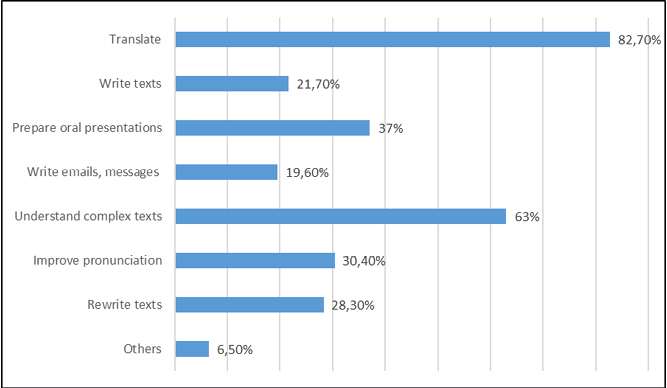
The objectives of this use are diverse. Mainly, students use AI tools to translate texts (82.6 %, n=38), understand complex texts (63 %, n=29) and prepare oral presentations (37 %, n=17). (Graphic 2).
Graphic 2. AI use in language classes.
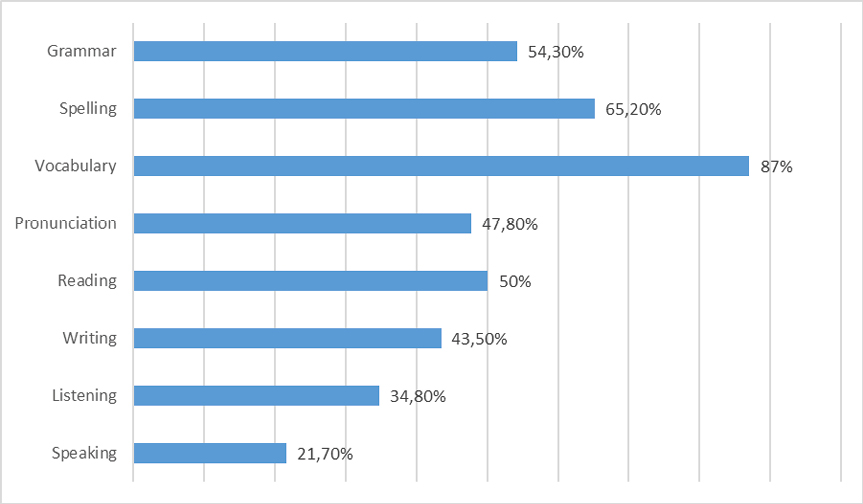
Among the aspects that students consider they can improve with AI tools, a large majority estimates that they can improve vocabulary (87 %, n=40), followed by spelling (65.20 %, n=30) and grammar (54.30 %, n=25). Regarding communicative skills, related to reception and production, the percentages are not as high, but they still reach 34.8 % for oral comprehension and 21.7 % for oral expression. (Graphic 3).
Graphic 3. Areas of language that can be improved with the help of AI.
58.7 % (n=27) of the participants claim that AI makes them dependent on language practice, while 15.2 % (n=7) categorically reject this statement. What we find interesting in the responses about the use of AI is that 52.2 % (n=24) of the sample consider that AI influences their way of writing and 32.6 % (n=15) have doubts about it. However, in the case of oral expression it is different, since 39.1 % (n = 18) do not agree with the statement that AI influences the way of expressing oneself orally, and only 32.6 % (n = 15) consider that this influence is also exerted in orality.
Therefore, we can observe a coherence between the results, since students, in general, perceive the advantages of using AI to work on written production and reception, but not for everything related to orality. This could also be explained by the widespread practice in foreign language classes, which focuses mainly on written activities and in which there is very little space for oral expression.
For the majority of students (73.9 %, n=34), the aspect most influenced by the use of AI, both in oral and written expression, is vocabulary (word choice, synonyms, etc.), followed by sentence structure (52.2 %, n=24), verb tenses and conjugation (37 %, n=17). Neither clarity of expression (6.5 %, n= 3) nor pronunciation (17.4 %, n=8) were aspects indicated as most influenced by the use of AI. On the other hand, only 8.7 % of the sample (n=4) fully trust the translations proposed by machine translators, and just over half (56.5 %, n=26) partially trust them.
Finally, students stated that they look for reliable sources of information and compare the results obtained with AI (39.1 %, n=18), while 23.9 % (n= 9) systematically verify AI information and 15.2 % (n=7) do so occasionally. Only four students stated that they do not usually verify the information generated by AI. However, it is worth noting that no students have received training in AI and that the use of AI is generally perceived as “cheating” or doing something that is not allowed in language classes.
4.2 AI to promote metalinguistic reflection in the language classroom
In this study, eleven dossiers prepared by small groups of 3 and 4 people have been analyzed. The dossiers have been anonymized and numbered consecutively from 1 to 11, so we will refer to them as SDGE1, SDGE2 and so on until SDGE11.
4.2.1 Using machine translation tools and idiomatic expressions
Translation was very present throughout the entire SDGE, in order to promote comparison between the different languages that students know and serve as a basis for explicit reflection on languages understood as complex systems that are used to communicate. The first activity proposed on translation was Activity 3, which encouraged students to find the translation of certain IE from French to Spanish, Catalan and English with the tools Deepl.com, Google Translate or Salt.gva.es. The results in the proposed cases were quite correct, although some small changes were observed.
In general, students observed that the translations between the four languages were adequate, with subtle changes in some cases (“cerise” for “guinda” in Spanish; “dans la tourmente” translates as “through the wind” in English). This exercise allowed them to reflect on the fact that the meaning of an idiomatic expression does not correspond to the sum of the meanings of the words that compose it. Furthermore, this was an interesting starting point since they ventured to give a definition of what they understood by an idiomatic expression:
SDGE2: “An idiomatic expression is a phrase that has a meaning other than the literal one, that is, the phrase has a figurative meaning.”
SDGE11: “A figurative expression is a phrase that does not say things directly. It uses an image to express an idea.”
SDGE12: “A figurative expression is a phrase that has a literal meaning and a real meaning.”
In activity 4, students had to explain the literal meaning of the proposed idiomatic expression, its figurative meaning, and then look for an equivalent in the three languages worked on in class. To do this, you could use automatic translators. For this activity, we proposed very culturally marked IE, such as “en faire un fromage” (make a drama), “avoir la frite” (be in a good mood), “radio can-can”, Senegalese IE (gossip) or “aller à Guindaille”, Belgian IE (partying), in order to address, on the one hand, the concept of francophonie and, on the other, the link between language and culture. The more culturally marked a given IE is, the greater the difficulty in translation and understanding.
On this occasion, the students realized the difficulty they had in explaining the expression given by “intuition”, without using dictionaries or external help. But they also observed that machine translators were not suitable for translating these expressions and often provided a literal translation. They tried to give an explanation and found it in a direct relationship between figurative expressions and culture. Cultural references that are specific to a specific culture and that are not shared by others, because they do not exist in the target culture, do not have a linguistic equivalent:
SDGE1: “IE are based on very specific cultural images. Their meaning is metaphorical, not literal. Humor, irony or worldview are not the same in all languages. Some realities mentioned (such as cagalló, tortilla, bajoqueta) do not have direct equivalents in other cultures. Therefore, translating an expression is not translating words: it is translating an idea, a way of thinking.”
SDGE11: “Machine translations do not always work well for many Spanish or Catalan expressions. The AI often translates word by word and does not always capture the true meaning of the expression. The result may seem strange or incomprehensible [because] these expressions are very cultural and the AI does not always have the necessary context to understand them.”
SDGE7: “Because figurative expressions depend greatly on culture, context and social usage, and a translator cannot always interpret these elements.”
The students came to the conclusion that machine translation tools are not capable of interpreting the meaning of expressions, but only of words, hence, apparently, the AI understands the words, but not their meaning. Therefore, “human” intervention is essential to find a real equivalent for these expressions, especially when they have a marked cultural character. Therefore, they expressed their distrust of AI tools and their correctness to carry out certain linguistic tasks.
4.2.2 Using Image Describer to understand idiomatic expressions
The conclusions obtained when using automatic translators were further reaffirmed when the students used AI to obtain images from specific figurative expressions. The results were surprising in most cases, very creative but inaccurate.
Figure 1. Images obtained with the prompt “Create an image representing the expression in faire un fromage”.


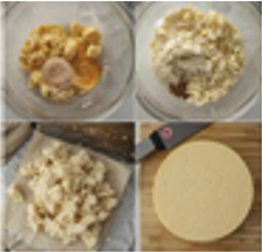
Figure 2. Images obtained with the prompt “Create an image representing the expression mouiller la barbe”.



The students tried again to explain why the AI returned those images or photos to them based on the proposed expressions:
SDGE8: “AI fails to give us correct images because it creates literal images, and figurative expressions have a figurative meaning.”
SDGE2: “No, because the AI usually takes words literally. It doesn’t always understand figurative expressions, so it creates a somewhat utopian or unreal situation.”
SDGE3: “No, because the AI creates literal images, it does not understand idiomatic expressions, it creates the images verbatim.”
The conclusions drawn by the students coincide with the conclusions of a previous study by D’Armenio et al. (2025) on two generative image AI tools: Midjourney and DALL·E. Although they manage to produce aesthetically pleasing images, they fail to follow basic instructions. In their study, AI had difficulty understanding negation or spatial relationships, for example, as they reproduced visual stereotypes from their databases, often constructed from Western images, and revealed the limitations of translation between verbal and visual language. In our cases, the AI could not understand the expressions and therefore interpreted them literally (as in the case of “mouiller la barbe” or “avoir deux bouches”, for example), which resulted in drawings or photos that did not make any sense, although sometimes the images generated were very interesting and beautiful from an aesthetic point of view.
The use of AI tools to translate IE into images is effective in encouraging reflection on the suitability of these instruments with regard to the understanding and intersemiotic translation of such expressions. The students reflect on the limits of the performance of these tools and become aware of the need to review and post-edit the results obtained. Furthermore, they come to understand how AI works and relativize the advantages of this type of tools.
5. CONCLUSION
In this article, we wanted to explore a new way of teaching-learning IE using AI tools to obtain images and translations in several languages.
From the questionnaire analyzed, the students recognized that they had not received any training on the appropriate use of AI in language classes, although they all used it self-taught and mainly to work on written expression (and not oral expression). The participants very often used online translators, but they did not perceive all the advantages of using AI in the production of foreign language texts, although they were aware of AI tools and used them in their daily lives.
Regarding the sequence, the results obtained highlight several relevant contributions. Firstly, it has been shown that the guided use of AI can act as a powerful catalyst for metalinguistic and interlinguistic reflection, since the limitations of these tools for interpreting the figurative meaning of IE favor awareness of the semantic, cultural and pragmatic complexity of language. Secondly, our analysis confirms that comparison between languages and translation – both interlinguistic and intersemiotic – constitute especially effective strategies for developing plurilingual competence and reflection on the functioning of languages as systems.
From a theoretical point of view, the results reinforce the approaches that defend a reflective, contextualized and interlinguistic teaching of languages (Rodríguez Gonzalo, 2024), showing that AI can be coherently integrated into this paradigm not as a substitute for learning, but as a mediator that makes visible the cognitive processes involved in linguistic interpretation. Likewise, evidence is provided about the potential of AI as a tool to promote critical digital literacy, by allowing students to understand its operating mechanisms, its biases, its limits and the importance of critically reviewing and analyzing the results obtained with AI.
This experience highlights the need to explicitly integrate training in the critical use of AI in the initial training of future teachers, given that students use these tools on a regular basis, but without pedagogical guidance or systematic reflection. Furthermore, the didactic value of designing activities that intentionally exploit the errors and limitations of AI as opportunities for linguistic and metacognitive learning has been highlighted. However, we are aware that this study has limitations, including the small sample size and its contextualized nature, which invites us to interpret the results with caution. In future research, it would be pertinent to expand the number of participants, diversify the educational contexts and analyze the long-term impact of this type of interventions on language learning and the development of digital and critical skills.
FUNDS
This study has been partially financed by the teaching innovation project “Audiovisual productions and Artificial Intelligence in the language classroom. Teaching experiences around the creation of videos (PIEC- 3900047) of the University of Valencia.
REFERENCES
. & . (2023). Grabando vídeos: educación literaria multimodal. Texto Livre, 16, 1-19. https://doi.org/10.1590/1983-3652.2023.41797
. 2007. L’approche par compétences dans l’enseignement des langues Didier. https://doi.org/10.14375/NP.9782278069972
(2021). Cadre européen commun de référence pour les langues: apprendre, enseigner, évaluer. Unité des Politiques linguistiques. Strasbourg
. & . (2006). Seqüències didàctiques per aprendre gramàtica. Graó.
. & . (2021). “¡Ya está! Me pongo a filmar”: Aprender grabando vídeos en clase. Revista Signos. Estudios de Lingüística, 54 (107), 893-918. https://doi.org/10.4067/S0718-09342021000300893
., ., ., . (2025). For a Semiotic Approach to Generative Image AI: On Compositional Criteria. Semiotic Review, 9. https://doi.org/10.71743/ee5nrx33
. (2011). Tendances en enseignement des expressions idiomatiques en langue seconde: de la théorie à la pédagogie, Revue canadienne de linguistique appliquée, numéro hors-série: 14,2,129-155.
. (2014). Image, image, quelle motivation renfermes-tu ? Iconicité et apprentissage cognitif des expressions idiomatiques en FLE, Çédille: Revista de Estudios Franceses, 10, 143-160. https://doi.org/10.21071/ced.v10i.5556
. (2006). El papel de la imagen en el aprendizaje de las expresiones idiomáticas: Pistas metodológicas para la clase de LE. Linguistique plurielle: Valencia. 25, 26 et 27 Octobre 2006 / coord. por J, , , , , ; (dir. congr.), (dir. congr.), Vol. 2, 2006 (Comunications), p. 661-672.
. (2025). Autoria algorítmica i llenguatge en transformació: influeix la IA en la producció escrita de l’alumnat? Jornadas Alfabetización mediática, inteligencia artificial y enseñanza de lenguas, Valencia.
. (2011). The role of etymology in the teaching of idioms related to colours in an L2, Porta Linguarum, 16, 19-32. https://doi.org/10.30827/Digibug.32003
. & . (2023). Enseñanza gramatical reflexiva e interlingüística en lenguas extranjeras: análisis curricular para el diseño de dos secuencias didácticas de gramática en torno a la expresión de la obligación. Huarte De San Juan. Filología Y Didáctica De La Lengua, 23, 65–92. https://doi.org/10.48035/rhsj-fd.23.4
. (2016). Une approche analogique à la compétence phraséologique: une double compétence, intégrale et intégrée. Language Design Special Issue, 165-188.
. (2010). La phraséodidactique en action: les expressions figées comme objet d’enseignement. La Clé des Langues. http://cle.enslyon.fr/espagnol/la-phraseodidactique-en-action-les-expressions-figees-comme-objet-denseignement-92012.kjsp
. (2005). De l’opacité des séquences figées comme exception sémantique. Faits des langues (25), 239-244. https://doi.org/10.1163/19589514-025-01-900000033
. (2002). La Phraséologie du Français. Presses Universitaires du Mirail.
. (2008). Reflexión interlingüística y enseñanza integrada de las lenguas. Textos de didáctica de la lengua y la literatura, 47, 20-32.
. (2022a). La enseñanza reflexiva de las lenguas en contextos multilingües (EGRAMINT). Tavira. Revista Electrónica de Formación de Profesorado en Comunicación Lingüística y Literaria, 27, 1-14. https://doi.org/10.25267/Tavira.2022.i27.1104
. (2022b). Situaciones de aprendizaje para la reflexión interlingüística. Textos de Didáctica de la Lengua y la Literatura, 97, 41-46.
. (ed.) (2024). Enseñar y aprender gramática en contextos multilingües. Graó.
., ., . & . (2023). Uso de vídeos cortos entre el alumnado adolescente y universitario como herramienta de aprendizaje. EDUCA International Journal, 1 (3), 42-59. https://doi.org/10.55040/educa.v3i1.52
. (2025). La traducción interlingüística en el diseño de secuencias didácticas de futuros docentes de FLE. Estudio de caso. Parallèles, 37 (2), 128-143.
., , & . (2025). Diseño y validación de un cuestionario sobre uso del vídeo y de la Inteligencia Artificial Generativa por docentes de lenguas en activo, Jornadas Internacionales de Innovación Docente, Universidad de Oviedo.
. (2021). L’enseignement des expressions idiomatiques en première année licence de FLE. Multilinguales. https://doi.org/10.4000/multilinguales.7370