

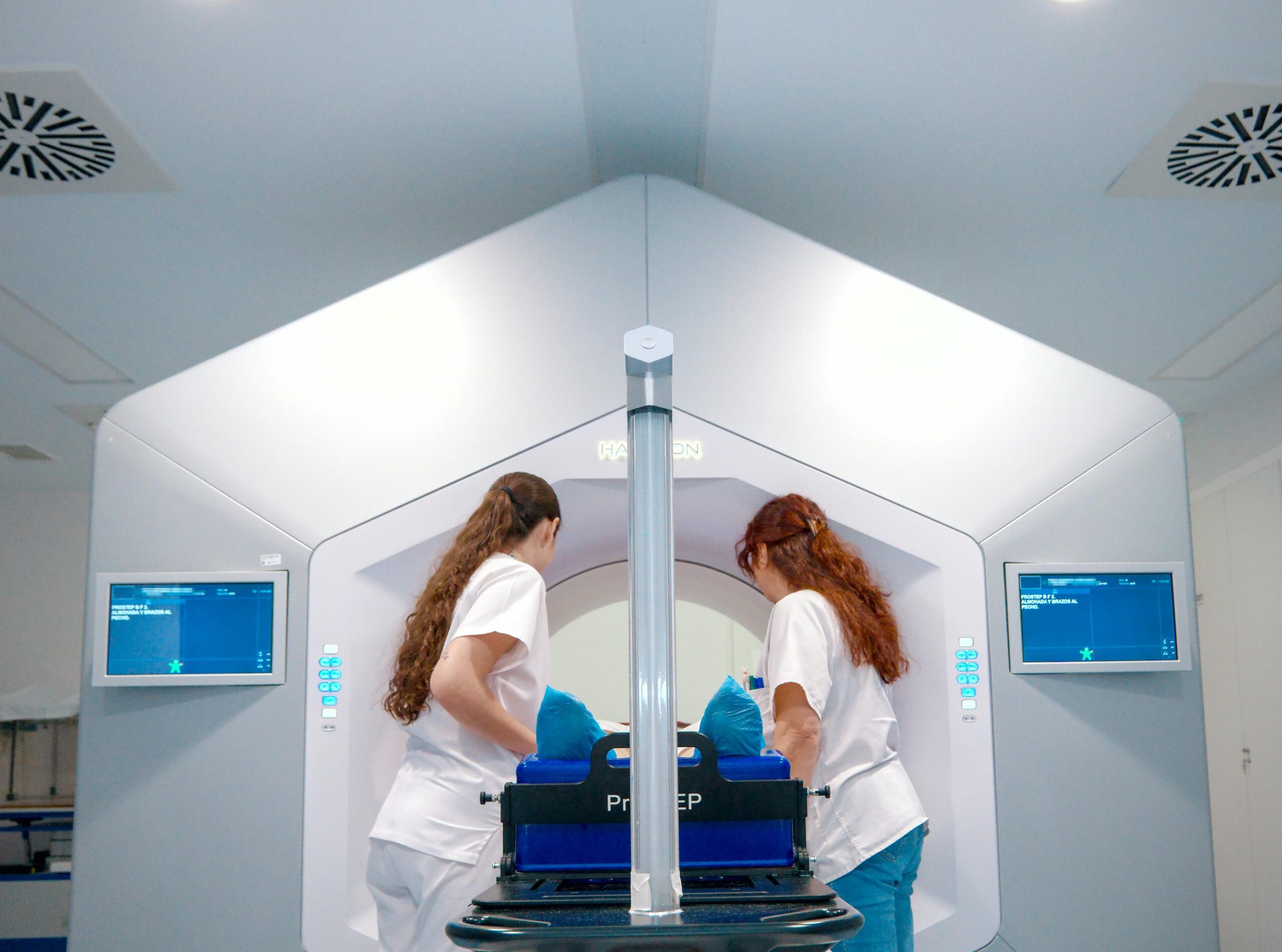
🔍The aim is to identify promising biomarkers in complex cancers such as sarcomas that will enable more effective and personalized treatments to be applied.
Researchers at Pablo de Olavide University (UPO), the University of Seville (US), and the Virgen del Rocío University Hospital are beginning to use high-performance computing and artificial intelligence models to identify promising biomarkers in complex cancers such as sarcomas.
Cancer remains one of the leading causes of death worldwide. Early detection and a better understanding of how each type of tumor evolves are key to applying more effective and personalized treatments.
In this context, a team of university and healthcare researchers are applying these technologies to accelerate the discovery of biomarkers related to different types of sarcomas, a group of rare and particularly complex cancers. Thanks to the combination of high-performance computing and artificial intelligence, it is possible to analyze millions of pieces of biomedical data—such as gene activity or images from patient samples—in much less time than with traditional computational techniques.
This advance is particularly useful in cancers where large amounts of data are available and analysis is highly complex. Thanks to these methodologies, biological patterns have been identified that could be used to detect the disease before symptoms appear or to predict which treatments would be most effective based on each patient’s molecular profile.
The process developed includes several phases: from the treatment and selection of reliable data to the construction of networks of relationships between genes and the use of artificial intelligence models to prioritize the most relevant potential biomarkers. All of this is carried out in high-performance computing environments capable of processing millions of data points in parallel, which drastically reduces analysis times.
The team has identified potentially relevant molecular signals, known as biomarkers, in sarcomas such as leiomyosarcoma, Ewing’s sarcoma, malignant tumors of the peripheral nerve sheath, and osteosarcoma. Among the results obtained, which are still under study, candidate genes such as CSF1R and SOX9 in leiomyosarcoma; IKZF3, RXRA, E2F3, and TBX19 in malignant tumors of the peripheral nerve sheath; COL11A1, VCAN, BUB1B, CDC20, UBE2C, and AURKA in Ewing sarcoma; and NKX2-1, TAL1, GFI1, and IKZF1 in osteosarcoma.
Many of these genes had not previously been associated with these specific subtypes of cancer, which opens the door to new lines of research and possible personalized treatments. These results are currently undergoing cross-validation with external databases and independent clinical resources.
José Luis López Guerra and Inmaculada Rincón Pérez, from the Department of Radiation Oncology at the Virgen del Rocío University Hospital, participated in the study. “This study highlights the importance of multidisciplinary work between oncologists and engineers, a key collaboration in the search for biomarkers that allow a more personalized and effective approach to the treatment of cancer patients,” says Dr. Rincón.
In fact, according to Professor Juan Antonio Ortega Ramírez, a researcher in the Department of Computer Languages and Systems at the University of Seville, “the use of high-performance computing and intelligent models allows us to discover hidden patterns in data and move towards faster, more robust, and personalized precision medicine.”
On behalf of the Pablo de Olavide University, specifically the SIALAB team, Dr. Francisco Antonio Gómez Vela, explains that “thanks to these techniques and the joint work of multidisciplinary teams, we hope to make significant progress towards personalized treatments that improve the quality of life of patients suffering from these types of cancer.” Also working on this project at the SIALAB team are Dr. Aurelio López Fernández, Dr. Dulcenombre M. Saz-Navarro, Marc Ríos Cadenas, and Iván Segura Carmona.
Although there is still a long way to go, the results obtained so far open the door to new opportunities. In the medium term, it is hoped that these tools will enable more precise personalization of treatments, save time in diagnosis and, above all, offer real hope to people fighting types of cancer that have been particularly difficult to treat until now.
📄 Access the news item here: https://www.upo.es/diario/ciencia/2025/07/virgen-rocio-upo-us-se-alian-en-proyecto-de-inteligencia-artificial-y-computacion-frente-al-cancer/