
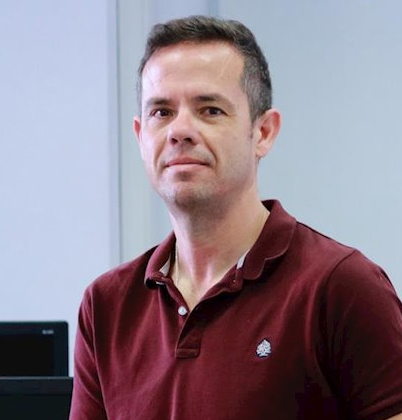
He has been working on knowledge extraction since his Ph.D. thesis at Pablo de Olavide University. Nowadays, his research lines are related with the new databases technologies, big data programming techniques and sensors data processing for knowledge extraction.
Teaching
Computer Science (Information Systems), Pablo de Olavide University.
- Databases Design.
- Database Management.
- Final Degree Project.
Computer Science, Pablo de Olavide University.
- Cloud Computing.
- Final Master Project.
History and Digital Humanities, Pablo de Olavide University.
- Introduction to the theory and methodology of historical analysis and digital humanities.
- Final Master Project.
- External internships.
Related links
Publications
2020 |
D. Rodríguez-Baena; F. Gómez-Vela; M. García-Torres; F. Divina; C. D. Barranco; N. Díaz-Díaz; M. Jiménez; G. Montalvo Identifying livestock behavior patterns based on accelerometer dataset Journal Article In: Journal of Computational Science, vol. 41, pp. 101076, 2020, ISSN: 1877-7503. @article{Rodríguez-Baena2020,In large livestock farming it would be beneficial to be able to automatically detect behaviors in animals. In fact, this would allow to estimate the health status of individuals, providing valuable insight to stock raisers. Traditionally this process has been carried out manually, relying only on the experience of the breeders. Such an approach is effective for a small number of individuals. However, in large breeding farms this may not represent the best approach, since, in this way, not all the animals can be effectively monitored all the time. Moreover, the traditional approach heavily rely on human experience, which cannot be always taken for granted. To this aim, in this paper, we propose a new method for automatically detecting activity and inactivity time periods of animals, as a behavior indicator of livestock. In order to do this, we collected data with sensors located in the body of the animals to be analyzed. In particular, the reliability of the method was tested with data collected on Iberian pigs and calves. Results confirm that the proposed method can help breeders in detecting activity and inactivity periods for large livestock farming. |
2018 |
A. Lopez-Fernandez; D. Rodríguez-Baena; F. Gómez-Vela; N. Díaz-Díaz BIGO: A web application to analyse gene enrichment analysis results Journal Article In: Computational biology and chemistry, vol. 76, pp. 169-178, 2018, ISSN: 1476-9271. @article{Lopez-Fernandez2018,Background and objective Gene enrichment tools enable the analysis of the relationships between genes with biological annotations stored in biological databases. The results obtained by these tools are usually difficult to analyse. Therefore, researchers require new tools with friendly user interfaces available on all types of devices and new methods to make the analysis of the results easier. Methods In this work, we present the BIGO Web tool. BIGO is a friendly Web tool to perform enrichment analyses of a collection of gene sets. On the basis of the obtained enrichment analysis results, BIGO combines the biological terms to organize them and graphically represents the relationships between gene sets to make the interpretations of the results easier. Results BIGO offers useful services that provide the opportunity to focus on a concrete subset of results by discarding too general biological terms or to obtain useful knowledge by means of the visual analysis of the functional connections between the sets of genes being analysed. Conclusions BIGO is a web tool with a novel and modern design that provides the possibility to improve the analysis tasks applied to gene enrichment results. |
2017 |
F. Gómez-Vela; A. Lopez-Fernandez; J. A. Lagares; D. Rodríguez-Baena; C. D. Barranco; M. García-Torres; F. Divina Bioinformatics from a Big Data Perspective: Meeting the Challenge Conference IWBBIO 2017: Bioinformatics and Biomedical Engineering, pp. 349-359, Springer International Publishing, Cham, 2017, ISBN: 978-3-319-56154-7. @conference{Gómez-Vela2017,Recently, the rising of the Big Data paradigm has had a great impact in several fields. Bioformatics is one such field. In fact, Bioinfomatics had to evolve in order to adapt to this phenomenon. The exponential increase of the biological information available, forced the researchers to find new solutions to handle these new challenges. |
2011 |
F. Gómez-Vela; F. Martínez-Álvarez; C. D. Barranco; N. Díaz-Díaz; D. Rodríguez-Baena; J. Aguilar-Ruiz Pattern Recognition in Biological Time Series Journal Article In: Advances in Artificial Intelligence, pp. 164-172, 2011, ISBN: 978-3-642-25274-7. @article{Gómez-Vela2011b,Knowledge extraction from gene expression data has been one of the main challenges in the bioinformatics field during the last few years. In this context, a particular kind of data, data retrieved in a temporal basis (also known as time series), provide information about the way a gene can be expressed during time. This work presents an exhaustive analysis of last proposals in this area, particularly focusing on those proposals using non--supervised machine learning techniques (i.e. clustering, biclustering and regulatory networks) to find relevant patterns in gene expression. |
J. Aguilar-Ruiz; D. Rodríguez-Baena; N. Díaz-Díaz; I. A. Nepomuceno-Chamorro CarGene: Characterisation of sets of genes based on metabolic pathways analysis Journal Article In: International Journal of Data Mining and Bioinformatics, vol. 5, no. 5, pp. 558-573, 2011. @article{Aguilar-Ruiz2011,The great amount of biological information provides scientists with an incomparable framework for testing the results of new algorithms. Several tools have been developed for analysing gene-enrichment and most of them are Gene Ontology-based tools. We developed a Kyoto Encyclopedia of Genes and Genomes (Kegg)-based tool that provides a friendly graphical environment for analysing gene-enrichment. The tool integrates two statistical corrections and simultaneously analysing the information about many groups of genes in both visual and textual manner. We tested the usefulness of our approach on a previous analysis (Huttenshower et al.). Furthermore, our tool is freely available (http://www.upo.es/eps/bigs/cargene.html). |
N. Díaz-Díaz; F. Gómez-Vela; D. Rodríguez-Baena; J. Aguilar-Ruiz Gene Regulatory Networks Validation Framework Based in KEGG Conference Hybrid Artificial Intelligent Systems, 2011, ISBN: 978-3-642-21222-2. @conference{Díaz-Díaz2011,In the last few years, DNA microarray technology has attained a very important role in biological and biomedical research. It enables analyzing the relations among thousands of genes simultaneously, generating huge amounts of data. The gene regulatory networks represent, in a graph data structure, genes or gene products and the functional relationships between them. These models have been fully used in Bioinformatics because they provide an easy way to understand gene expression regulation. |
2007 |
I. A. Nepomuceno-Chamorro; J. Aguilar-Ruiz; N. Díaz-Díaz; D. Rodríguez-Baena; J. García A Deterministic Model to Infer Gene Networks from Microarray Data Conference Intelligent Data Engineering and Automated Learning - IDEAL 2007, 2007, ISBN: 978-3-540-77226-2. @conference{Nepomuceno-Chamorro2007,Microarray experiments help researches to construct the structure of gene regulatory networks, i.e., networks representing relationships among different genes. Filter and knowledge extraction processes are necessary in order to handle the huge amount of data produced by microarray technologies. We propose regression trees techniques as a method to identify gene networks. Regression trees are a very useful technique to estimate the numerical values for the target outputs. They are very often more precise than linear regression models because they can adjust different linear regressions to separate areas of the search space. In our approach, we generate a single regression tree for each genes from a set of genes, taking as input the remaining genes, to finally build a graph from all the relationships among output and input genes. In this paper, we will simplify the approach by setting an only seed, the gene ARN1, and building the graph around it. The final model might gives some clues to understand the dynamics, the regulation or the topology of the gene network from one (or several) seeds, since it gathers relevant genes with accurate connections. The performance of our approach is experimentally tested on the yeast Saccharomyces cerevisiae dataset (Rosetta compendium). |
D. Rodríguez-Baena; N. Díaz-Díaz; J. Aguilar-Ruiz; I. A. Nepomuceno-Chamorro Discovering alpha–Patterns from Gene Expression Data Conference Intelligent Data Engineering and Automated Learning - IDEAL 2007, 2007, ISBN: 978-3-540-77226-2. @conference{Rodríguez-Baena2007,The biclustering techniques have the purpose of finding subsets of genes that show similar activity patterns under a subset of conditions. In this paper we characterize a specific type of pattern, that we have called ?–pattern, and present an approach that consists in a new biclustering algorithm specifically designed to find ?–patterns, in which the gene expression values evolve across the experimental conditions showing a similar behavior inside a band that ranges from 0 up to a pre–defined threshold called ?. The ? value guarantees the co–expression among genes. We have tested our method on the Yeast dataset and compared the results to the biclustering algorithms of Cheng & Church (2000) and Aguilar & Divina (2005). Results show that the algorithm finds interesting biclusters, grouping genes with similar behaviors and maintaining a very low mean squared residue. |
2006 |
N. Díaz-Díaz; D. Rodríguez-Baena; I. A. Nepomuceno-Chamorro; J. Aguilar-Ruiz Neighborhood-Based Clustering of Gene-Gene Interactions Conference Intelligent Data Engineering and Automated Learning -- IDEAL 2006, 2006, ISBN: 978-3-540-45487-8. @conference{Díaz-Díaz2006,In this work, we propose a new greedy clustering algorithm to identify groups of related genes. Clustering algorithms analyze genes in order to group those with similar behavior. Instead, our approach groups pairs of genes that present similar positive and/or negative interactions. Our approach presents some interesting properties. For instance, the user can specify how the range of each gene is going to be segmented (labels). Some of these will mean expressed or inhibited (depending on the gradation). From all the label combinations a function transforms each pair of labels into another one, that identifies the type of interaction. From these pairs of genes and their interactions we build clusters in a greedy, iterative fashion, as two pairs of genes will be similar if they have the same amount of relevant interactions. Initial two–genes clusters grow iteratively based on their neighborhood until the set of clusters does not change. The algorithm allows the researcher to modify all the criteria: discretization mapping function, gene–gene mapping function and filtering function, and provides much flexibility to obtain clusters based on the level of precision needed. The performance of our approach is experimentally tested on the yeast dataset. The final number of clusters is low and genes within show a significant level of cohesion, as it is shown graphically in the experiments. |