
Sun simulator
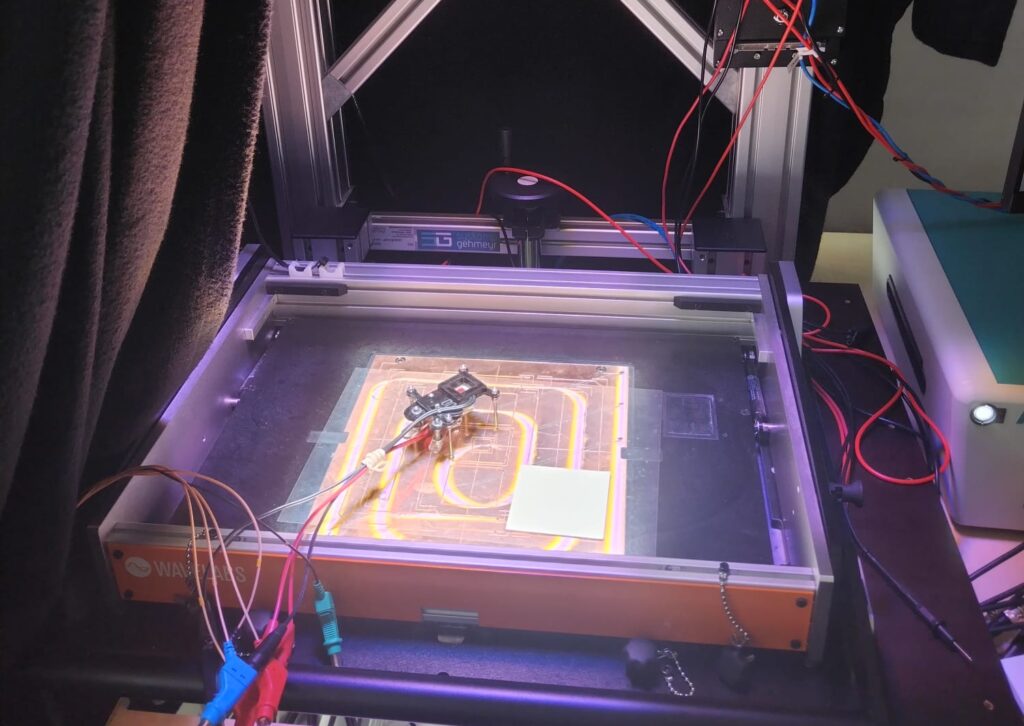
The LED solar simulator is used for evaluating photovoltaic devices by simulating natural and artificial light spectra. Unlike conventional solar simulators based on xenon or halogen lamps, LED-based simulators offer precise control over light intensity and spectrum, allowing for the replication of varying illumination conditions, such as sunlight at different times of the day (morning, noon, afternoon) or indoor lighting. This capability is essential for opto-electrical characterization of photovoltaic sub-modules, efficiency studies, and special applications such as photocatalysis or artificial light-driven biological growth.
The LEDMOF laboratory employs this simulator to conduct efficiency measurements, performance diagnostics, and stability studies on silicon, perovskite, and emerging solar cell technologies. It also enables advanced spectral and intensity modulation analysis to optimize device performance under different environmental conditions.
Wavelabs Sinus-300
This high-precision solar simulator provides a 22 cm × 22 cm illuminated area, allowing for accurate evaluation of emerging photovoltaic technologies. Its LED-based design offers flexibility for simulating various light spectra, enabling detailed studies of quantum efficiency, transient effects, and performance under non-standard conditions.
Key features include:
- Spectral match of 0.95 to 1.05 (A++ classification).
- Adjustable illumination intensity from 0.1 to 1 sun, with independent spectral band control.
- Automated IV curve measurement and extraction of solar cell parameters (Voc, Isc, FF, efficiency, Rs, Rsh).
- Temporal light modulation, allowing continuous or pulsed illumination.
- Advanced software control with data export interface
- Industrial PC with control and data analysis software.
- IV electronics and active load amplifier with a high-precision analog-to-digital converter.
- Recirculating cooling system for thermal stability of the LED system.
- Optional: Characterization module for thermography and electroluminescence defect analysis in photovoltaic devices.