

SIALAB researchers design a tissue-aware co-expression network analysis protocol that slashes tissue-of-origin confounding from 88.9% to 12.9%, paving the way for highly interpretable and biologically rigorous pan-cancer pharmacogenomics.
The SynergIA Laboratory (SIALAB) research group at Universidad Pablo de Olavide has published a groundbreaking methodological study that establishes a new computational standard in network medicine and personalized oncology drug response prediction.
The paper, titled “A tissue-aware computational framework for confounding-controlled co-expression network analysis: Context-dependent utility in drug sensitivity modelling”, has been recently published in the prestigious peer-reviewed journal Computational Biology and Chemistry. In this work, the authors propose a rigorous solution to a fundamental methodological challenge that has long hindered the translational utility of co-expression networks in pan-cancer studies.
📄 Access the full-text article here: https://doi.org/10.1016/j.compbiolchem.2026.109235
💻 Open-source Python repository: GitHub – SynergIA-Lab
Unlocking Bias-Free Pan-Cancer Pharmacogenomics
In precision oncology, gene co-expression networks are widely used to predict whether a tumor will respond to a specific therapeutic agent. However, standard pan-cancer machine learning models suffer from a crucial flaw: the topological network features often end up capturing and encoding the “identity” or tissue of origin of a cell line (e.g., lung, colon, breast) rather than the actual pharmacological sensitivity signal. This inflates the apparent predictive performance of models while obscuring the true underlying biological mechanisms.
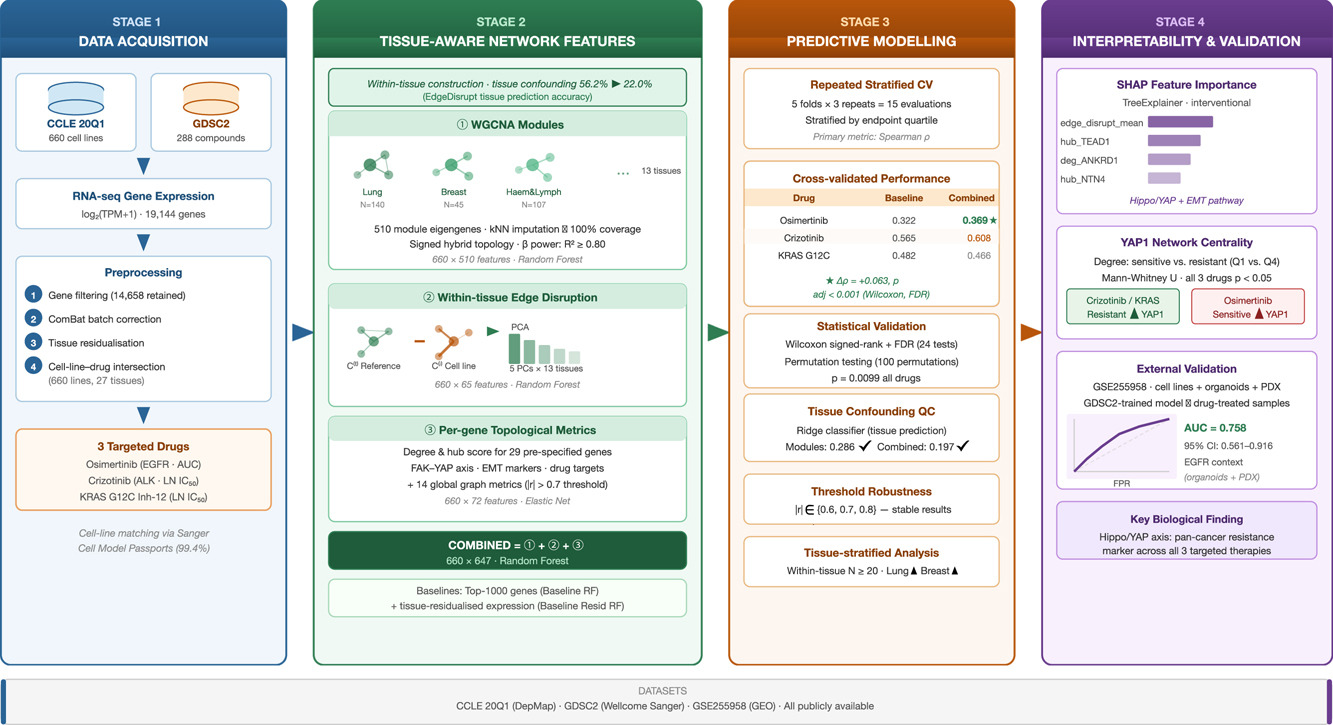
To overcome this confounding effect, the framework designed by the SynergIA team introduces a coordinated multi-phase protocol:
-
🧬 Within-Tissue Network Reconstruction (Within-Tissue WGCNA): Instead of building a single, biased pan-cancer reference network, the framework infers co-expression structures independently for each tissue type, employing smart kNN-based imputation to handle data-scarce tissues.
-
🔍 Deconfounding Pipeline (Intra-Tissue Z-Score): Through precise normalization of edge disruption profiles and topological metrics per gene, the framework drastically reduces tissue identity encoding in network features from an overwhelming 88.9% down to just 12.9%.
-
🚀 Quantitative Quality Control Standard: The authors define an auditable, reproducible quality control threshold (tissue prediction accuracy < 0.15) to formally certify that variables are sufficiently decoupled from tissue-of-origin noise before being fed into predictive models.
-
💊 Validation in Targeted Therapies: The framework was benchmarked across a pan-cancer cohort of 660 cell lines against three clinically highly relevant targeted agents: osimertinib, crizotinib, and a KRAS G12C inhibitor. The results show that the predictive advantage of network topology is drug-context dependent, proving exceptionally robust for osimertinib.
-
🎯 Uncovering True Biological Signal (Hippo/YAP Pathway): By filtering out tissue confounding, the models successfully identified the central roles of YAP1 and TEAD1 as genuine, tissue-independent predictors of therapeutic resistance, showcasing the utility of this framework in discovering reliable drug targets.
Broader Impact on the Scientific Community
This research provides the biomedical and bioinformatics communities with a transparent, highly auditable, and directly applicable computational pipeline for large-scale pharmacogenomic studies, such as CCLE or GDSC. By releasing the fully reproducible codebase as open-source, the SynergIA research group reinforces its ongoing commitment to open science and the development of robust, reliable AI tools to fight cancer.
Authors of the paper:
-
Marc Ríos-Cadenas (Universidad Pablo de Olavide).
-
Iván Segura-Carmona (Universidad Pablo de Olavide).
-
Aurelio López-Fernández (Universidad Pablo de Olavide).
-
Francisco A. Gómez-Vela (Universidad Pablo de Olavide).